
What Bugs Bunny Can Teach Us About Following Jesus

“Do not judge, or you too will be judged. For in the same way you judge others, you will be judged, and with the measure you use, it will be measured to you.”

Matthew 7:1-2 NIV

A quick glance at Facebook has shown me that we need this reminder desperately.

Over the past few days I’ve read folks from all political backgrounds judging political leaders, judging neighbors, and judging complete strangers. Disagreement is not judgement. Judgement comes when intent is assigned by someone other than the key figure in question. Let me see if I can clarify using a non-political example.

Bugs Bunny stated this week that he will not be eating green beans for lunch today.

Now you may very much be in favor of everyone eating green beans at every meal. That’s fine. And you are free to express that opinion. Let me give you an example of a completely Christ-like way to do so.

“I disagree with Mr. Bunny’s choice to not eat green beans. I also realize that he has the ability to make choices for himself. Because I follow Jesus, I choose to love my neighbor, and I certainly consider Mr. Bunny my neighbor. I will be praying for him, his family and friends, and I will continuing to eat green beans at every meal. I encourage you to do the same.”

See how easy that was? We expressed our disagreement, but showed kindness toward Mr. Bunny, as well as shining the light of Christ.

Here’s an example of what not to do.

“Stupid Bunny won’t do what we all know he should do. He does this because he hates green bean farmers, hates Looney Toon Land, and doesn’t give a rip about you or me. And anyone who would support him is just as evil as he is.”

Notice how this example assigns intent to Mr. Bunny when Mr. Bunny himself never said why he isn’t eating green beans. Perhaps Mr. Bunny was simply out of green beans. Or perhaps he’s allergic. The idea that he would only do something because of the reason you have chosen to supply is judging him. Jesus says we should not do that.

Now this whole exercise might seem very childish, but it’s clear that this concept hasn’t been grasped by many, and therefore I don’t want to write anything that’s confusing. We are called to not judge.

Our job as followers of Christ is to love. Love those you agree with, and love those you disagree with. Love those you know personally, and love those whom you have never met. This is how people will know you are actually a follower of Jesus.

One last thought.

“So in everything, do to others what you would have them do to you, for this sums up the Law and the Prophets.”

Matthew 7:12 NIV

Take a recent example from your own life. Maybe a recent conversation you had with someone. Perhaps a Facebook or Twitter post you wrote about someone. Would you want someone to talk about you the way you did in your conversation/post?

Let’s take it a step further. You will one day be judged eternally by Jesus himself (Mt. 25:31-46) And since he’s already told us that we will be judged in the same way we judge others (Mt. 7:1-2), then do you really want Jesus judging you the way you just judged someone?

As followers of Christ we are commanded to love one another (basically all of 1 John), and to not judge others.

May our thoughts, our words, our social media posts, and our conversations with others reflect the mercy we have been shown in Christ Jesus.


Daily Psalms – Psalm 2

Before you read this psalm in your Bible, first read 2 Samuel 7, and then turn over to Psalm 2.

Psalm 2 has no designation at the beginning of authorship as many of the psalms do, but Acts 4:25 tells us that David is the author.

Psalm 2 is a call for those who do not follow Yahweh to submit to Him, serving Him only. David also speaks of God’s “anointed” (lit. messiah) who is also His “son” who will rule over all the nations and punish those who stand against Him.

By reading this messianic psalm you can easily see why many felt like the Messiah would simply be an earthly ruler. Considering David’s life, there was a very practical earthly application to this psalm. David’s son (Solomon) would be anointed (as would every earthly king descended from David) and would face opposition as he came to the throne. David’s reign as king was full of opposition from earthly kings. Again, a very clear earthly reason for its writing.

But the eternal promise from God to David carries the application of this Psalm forward to future kings.

Your house and your kingdom will endure forever before me; your throne will be established forever.

2 Samuel 7:16 NIV

This psalm is a reflection on the promise of God in 2 Samuel 7 to establish the eternal throne of David, and therefore extends to the kingly descendants of David, including Jesus.

Peter and the early persecuted disciples saw this psalm as applying to Jesus’ suffering at the hands of Pilate and the leaders of Israel (Acts 4:23-31).

Paul saw this psalm as being central to the message of the Gospel.

“We tell you the good news: What God promised our ancestors he has fulfilled for us, their children, by raising up Jesus. As it is written in the second Psalm:

“‘You are my son;
    today I have become your father.’”

Acts 13:32-33 NIV

The writer of Hebrews also uses this psalm to show that Jesus is greater than the angels (1:5) and that it is God who appointed Jesus as our ultimate high priest (5:5).

Our encouragement from Psalm 2 today is that our God is over all the nations, and the entire earth is his. He will rule through his Son, the promised Messiah, to bring about justice on the earth. But we must submit and worship His Son. Refusing to do so leads to our destruction. As David reminds us:

Blessed are all who take refuge in him.

Psalm 2:12b NIV

My encouragement to you is to spend some time in the Psalms. They are the story of God’s relationship with his people, and point forward to the coming of the Messiah. The New Testament writers saw the Psalms as essential to understanding the life, ministry, and reign of Jesus. Shouldn’t we as well?

Faith or Fear?

When I am afraid, I put my trust in you.

Psalm 56:3 NIV

During these strange days of the Coronavirus pandemic, it’s easy to lose our discernment. We’re bombarded with information coming at us from all directions. 24 hour continuous TV coverage of sick people, or possible sick people, or the stock market falling, or the sky falling. It seems to never stop. And it’s enough to drive a person crazy!

So how do we know what information is helpful, and what information we should ignore? Simple. Ask this one question.

Does this build my faith, or my fear?

Pretty simple right? Much harder to apply though. We get sucked into the vortex of the news cycle. There’s always another case, there’s always another news report, there’s always another distraction. We want to be informed (and we should be informed), but be careful where you are getting your news from. Not everything on the news is beneficial. After all, CNN, FOX, NBC, CBS, and any other member of the alphabet soup news media is ultimately trying to accomplish one thing: make money.

“If it bleeds, it leads” as the old expression goes. And if the most engaging news story is the Coronavirus, they will report on it non stop, even if there is nothing new to report. And this type of news builds our fear, not our faith.

So how do we build our faith instead of fear?

Consequently, faith comes from hearing the message, and the message is heard through the word about Christ.

Romans 10:17 NIV

If you want to build your faith instead of fear, turn off the news and open your Bible.

Every day we are trying to offer Christ-centered, Spiritually fulfilling content to build your faith, not your fear. Sunday morning livestream Bible studies, Monday blog posts, Tuesday videos, Wednesday morning Bible studies, Wednesday evening prayer time, Thursday afternoon Bible questions are answered, Friday blog posts, and Saturday we rest.

And we’re not the only ones pushing out Biblical content. It’s my opinion that the Gospel is being preached more in this time when we cannot meet than it has ever been preached. Virtually every congregation is trying to get the message of Christ broadcast wherever they can, which sadly is a brand new concept for some of them.

This is a wonderful time to grow in faith, but you have to say no to fear.

So this week before you click on the news story, or before you watch the news, or before you have that conversation with your friend who swears the sky is falling…ask yourself:

Does this build my faith, or my fear?

I look forward to opening God’s word with you on Sunday morning at 10:00am CST on Facebook, our church website, and on YouTube. Until then, build faith.

Daily Psalms – Psalm 3

Even though this Psalm of David was written thousands of years ago, we can hear echos of Christ, as well as a lesson on how to pray during the Coronavirus pandemic.

LORD, how many are my foes! How many rise up against me! Many are saying of me, “God will not deliver him.”

Psalm 3:1-2 NIV

David was anointed as the next king of Israel while Saul was still on the throne. God had rejected Saul as king, and now David finds himself surrounded by Saul’s army. The taunt “God will not deliver him” was intended to break David’s spirit into believing that God had somehow abandoned him. It’s as if his enemies were saying “There is no hope for you David! Even God has left you!” We can hear similar taunts as Jesus was crucified (Mt. 27:43).

But you, LORD, are a shield around me, my glory, the One who lifts my head high. I call out to the LORD, and he answers me from his holy mountain.

Psalm 3:3-4 NIV

The Hebrew here is difficult to translate, and the tense can work either in present tense (as the NIV chooses), but could also be translated in the past tense (as the ESV chooses). It seems to work better in past tense as David has already committed to God his requests in prayer and it is as if God has already answered him. Because David has faith that God will deliver, he treats his situation as if God has already completed the work.

Verse 5-6 remind us that God protects, even when we are the most vulnerable. No matter the size of the foe, or how helpless we seem, our God never sleeps and is never weak. We have nothing to fear because of the power and strength of our God. Also hear the echoes of resurrection. Though physical death brings us sleep, that is not our eternal fate. It is God who sustains.

David pleads for God’s deliverance to defeat his enemies decisively. And verse 8 brings us a powerful reminder.

From the LORD comes deliverance. May your blessing be on your people.

Psalm 3:8 NIV

Deliverance comes from God alone. It will not be by our efforts that we overcome, but by God’s blessing alone.

This week as we are reminded once again that we are not in control, and we are surrounded by fear and foe, let us place our hope firmly in our God. Let us pray for deliverance, hope in resurrection, and rest in the assurance that he has heard our prayer and has already conquered on behalf of his people.

Shalom.

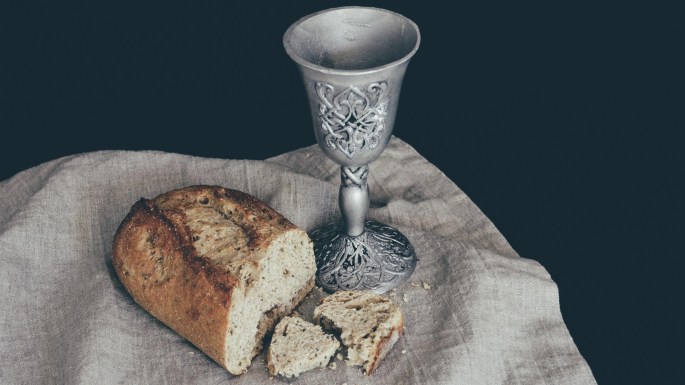
Communion at Home?

We trace our roots to the American Restoration Movement. Thomas & Alexander Campbell and Barton Stone were dedicated to seeing their churches return to simple Biblical Christianity. So many divisions had occurred in the Church over matters of opinion, and because over disagreements over things that are never enumerated in Scripture.

The Restoration Movement sought to restore simple Christianity in order to bring unity to all Christians everywhere. And one of the major ways they did this was through the Lord’s Supper.

If you grew up in the Church of Christ like me, you might be surprised to learn that the practice of the Lord’s Supper was once a battleground for division. We assume it’s always been done this way and there’s really nothing to consider that is new. But in the not-so-distant past the Lord’s Supper was a point of division, not unity. The Campbells ultimately broke their denominational ties over the issue of who could partake of the Lord’s Supper. The denomination they were a part of required people to pass a test and receive a coin as proof that they were worthy of partaking, and only ordained elders were allowed to distribute the elements. The Campbells saw no such exclusion in Scripture and welcomed all who professed faith in Christ to participate.

The desire to welcome all at the Lord’s Table led the Campbells, and similarly Barton Stone, to seek a way of practicing Christianity that was consistent with the Scriptures, and nothing more. They sought to unite in Christ, and in Christ alone. Nothing other than faith in Christ would be required for fellowship.

Some Christian traditions are struggling right now with how to share the Lord’s Supper. Sincere belief that only some can distribute the elements and only some can partake is causing real struggles for some congregations. But we view Scripture differently.

Here are some reasons why you can (and should) take communion at home, and why I believe you can do so on more than just Sunday.

  • If you are a believer in Jesus Christ, you are ordained by God as one of his priests. (1 Peter 2:5-9)
  • All the early believers were committed to “breaking bread” in their homes (Acts 2:42, 46)
  • It seems that the early church gathered to break bread on the first day of the week, at least in Troas (Acts 20:7). Historical writings from the 1st and 2nd century tell us that the practice varied from place to place.
  • Notice, however, that the church was ok with eating the Lord’s Supper after midnight, meaning this meal took place on Monday morning (Acts 20:7-11 shows they “broke bread and ate” after midnight).
  • Luke informs us that the early church had the practice of eating the Lord’s Supper daily (Acts 2:46).

I’m not trying to change your theology of the Lord’s Supper with this article, but I do want you to rest assured that you aren’t doing anything contrary to Biblical practice if you choose to eat the Lord’s Supper with your family at home.

I’m praying home church will be a blessing to you this week. Don’t forget to tune in to either our website, our Facebook page, our YouTube channel for some announcements, a time of prayer, and a message from God’s word on Sunday at 10:00am.

Sinning Against The Body and Blood of the Lord

What does Paul mean when he tells the Corinthians not to eat the Lord’s Supper in an “unworthy manner?” 

“So then, whoever eats the bread or drinks the cup of the Lord in an unworthy manner will be guilty of sinning against the body and blood of the Lord.”

1 Corinthians 11:27 NIV

I have heard many teachings on the Lord’s Supper over the years, and most of the conclusions based on this verse indicated we need to spend this time focusing on the sacrifice that Jesus made. We need to visualize the cross, the suffering of our Savior, and the blood that was spilled. This should be a somber, quiet, and sad occasion.

The problem is the above describes an altar (a place of sacrifice.) We have often confused the table with an altar. We, however, are called to gather around a table, not an altar!

The first thing we need to realize is the Lord’s Supper was originally part of a meal. It was a time of feasting and celebration, not mournful reflection. Yes, a full meal that fed hungry people. This was not a sip of juice and a pinch of cracker. People were eating their fill. “Supper” is the evening meal. And the explicit problem with the church in Corinth was the wealthy were arriving early and eating all the food, leaving the poor hungry. Paul indicates this type of “dinner” should be done at home, not in worship gatherings. (1 Cor. 11:20-21) Paul further states that their actions show that they “despise the church of God by humiliating those who have nothing.” (v. 22) So the problem Paul is referring to is the Church being divided by not eating the Lord’s Supper together as equals.

Paul reminds them that Jesus’ atoning sacrifice was for all of them (v. 24 – “you” is plural, as well as plural “drink” in verse 25). 

So how do we eat and drink in a worthy manner according to Paul? John Mark Hicks summarizes this passage well in his book, “Come To The Table.”

Consequently, to eat and drink worthily is not about private introspection, but about public action. Paul is not stipulating a kind of meditative silence on the cross of Christ or an introspective assessment of our relative holiness. On the contrary, to eat in an “unworthy manner,” in this context, is to eat in a divisive manner like that which existed in Corinth. The church must examine itself about the manner in which the supper is conducted (1 Cor. 11:28). There may be many ways to eat the supper unworthily (e.g., 1 Cor. 10:18-21 where Corinthians ate unworthily because they ate with a dual commitment, serving two masters), but the specific unworthiness in 1 Corinthians 11 is a communal problem, not an individualistic one. The church eats worthily when it eats as a united community embodying the values for which Christ died.”

John Mark Hicks, Come to the Table: Revisioning the Lord’s Supper (Abilene, TX: Leafwood Publishers, 2012).

Whatever It Costs, It’s Worth It!

Our Immerse reading is almost complete! Week 7 covers Hebrews, James, & John. Today I want to focus on Hebrews. The anonymous writer basically sends a written sermon to Jewish believers who had confessed Jesus as the Messiah, and were now facing great persecution for their belief. Instead of giving up and turning back to Judaism, the Hebrew writer encourages these believers to continue in their faith, and does show by showing how much greater (superior) Jesus is than anything, or anyone else! Here are some of the examples the Hebrew writer gives:

  • God now communicates to the world through Jesus (1:1-4)
  • Jesus is greater than Angels (1:5-14)
  • Jesus suffered just like you, and will help you! (Chapter 2)
  • Jesus is greater than Moses (3:1-6)
  • In Jesus we find the ultimate Sabbath Rest (4:1-13)
  • Jesus is the greatest high priest (4:14-7:28)
  • Jesus established a better covenant relationship for us (8:1-9:28)
  • Jesus is the greatest, eternal sacrifice (10:1-18)

In between these sections of comparison are encouragements to these persecuted Jewish Christians to keep their faith, and persevere even though it’s difficult to do so. And then the book comes to the main argument in chapters 11 & 12: Continue in your faith and run the race Jesus has set before you!

“Faith shows the reality of what we hope for; it is the evidence of things we cannot see. Through their faith, the people in days of old earned a good reputation.”

Hebrews 11:1-2 NLT

According to the Hebrew writer, faith requires verbs! Action is a must! Faith isn’t something that just happens between the ears, it’s lived out. All of chapter 11 are examples of Biblical characters that were commended for acting on their faith. This is written to a group of Jewish Christians who would be persecuted for acting on their faith, and the Hebrew writer calls them to go full steam ahead! Don’t back down, don’t hide, live out your faith! RUN THE RACE! And we find our strength to run by considering what Jesus did for us!

“Think of all the hostility he endured from sinful people; then you won’t become weary and give up. After all, you have not yet given your lives in your struggle against sin.”

Hebrews 12:3-4 NLT

In our sermon this week we’ll be looking at Mark 8 & 9 where Jesus reminds us that if we are to follow him, we must DENY ourselves, CARRY our crosses, and FOLLOW him (Mk. 8:34). Notice the VERBS?

Following Jesus isn’t easy. It isn’t always comfortable. As a matter of fact it may very well cost you your life. BUT IT’S WORTH IT! 

Whatever you are going through this week, live out your faith. Deny yourself, carry your cross, and follow him. Whatever it costs you, it will be worth it to be His disciple!

Waiting Beyond Death

During this Season of Hope, we are studying texts related to the Advent, or coming of the fulfillment of God’s promises in the Messiah. Just like ancient Israel had to wait for his coming, we too wait for his second coming.

Isaiah 40 makes reference to this time of waiting.

6 A voice says, “Cry out.” 
And I said, “What shall I cry?” 
“All people are like grass, 
and all their faithfulness is like the flowers of the field. 
7 The grass withers and the flowers fall, 
because the breath of the Lord blows on them. 
Surely the people are grass. 
8 The grass withers and the flowers fall, 
but the word of our God endures forever.”

Isaiah 40:6–8 NIV

In these verses we have a heavenly voice (the speaker is unclear, perhaps Yahweh, an angel, or some other heavenly being) telling Isaiah that humans are like grass and their works like flowers. What the voice is reminding us is that grass and flowers are only around for a season before they wither and fade away. They do not last forever. But the word of God does indeed last forever.

Let’s put this in the context of Israel coming out of exile. They have been away from their homes for a generation, and there is this promise of return. God will make the path easy, he will restore Jerusalem, he will keep his promises. His word will not fail! But humans don’t live forever. We all die. God’s promises, however, do not die.

Isaiah is trying to remind us that we may wait for God to fulfill his promises, and they may not be fully fulfilled in our lifetime before we “wither.” Isaiah wants us to remember that our waiting does not negate God’s promises. Even if we never see them fulfilled, we can rest assured that they will be fulfilled because God’s word endures forever.

Centuries after this text was written, one would come as “a voice of one calling: In the wilderness prepare the way for the LORD.” (Isa. 40:3, Mark 1:3). Mark, as well as the other Gospel writers, want us to realize that God kept this promise fully in the ministry of John the Baptist, “and the glory of the LORD” was revealed in the Advent of Jesus (Isa. 40:5).

Though Isaiah’s words to exiled Israel were not fully realized in their lifetime, God fulfilled his promise through the Advent of Jesus. And though God’s kingdom has not fully come, we can rest assured that God will fulfill his promises through the Advent of Jesus.

Sermon text for 12/8/19: Isaiah 40:1-11; Mark 1:1-4 

Awaiting The Promised Messiah

Our faith heritage in the churches of Christ has often shied away from the season of Advent as being “unauthorized in Scripture.” However, the word “advent” simply means “coming.” The OT is full of hope in expectant waiting for the coming Messiah, the only one who could set the world aright.The NT is also full of the same hope as the church expectantly awaits Christ’s return. Advent is a season of expectant waiting for the return of Jesus at the Second Coming. We look forward to Christ’s return through the lens of those who waited for his first coming. 

“‘The days are coming,’ declares the Lord, ‘when I will fulfill the good promise I made to the people of Israel and Judah.”

Jeremiah 33:14 NIV

This week we turn our attention to Jeremiah 33 and Mark 8, and the promise of the Messiah. God had promised in the Garden that a descendant of Eve would eventually crush the head of the serpent, and in doing so the human would be struck (Gen. 3:15). God promised to Abraham “through your offspring all nations on earth will be blessed” (Gen. 22:18). God promised through Moses that he would “raise up for you a prophet like me from among you, from your fellow Israelites. You must listen to him.” (Deut. 18:15). 

This promise from God had been a long time in coming. Centuries of waiting for the one who would defeat evil, bless all nations, be the voice of God that we listen to, and many other prophecies, came at the perfect time, but for humans, the wait seemed endless.

And when the Messiah came, the majority of the people were not prepared.

As Israel and Judah awaited the fulfillment of God’s promise, we also wait for the fulfillment of the second coming of the Messiah Jesus. Many of us have forgotten that we are called to watch, to listen, and to open our hearts in expectant preparation for his coming (Matt. 25:1-13). 

We are called to listen to his Word. We look for signs of his presence in this world…a light in the darkness, a voice in the silence, and a stirring deep within us. We’re good at singing worship songs that reiterate these things, but do we truly expectantly wait and prepare for his return?

All of the Gospel writers want us to realize that the life of Jesus was the fulfillment of promises of old (Mt. 1:22-23; Mk. 1:1-4; Lk. 4:17-21; Jn. 1:45; etc.) and the renewal of promises yet to come (Isa. 65:17; Mt. 14:37; Lk. 12:40; Mk. 13:35; Jn. 14:2-3; Rev. 21:5). In Christ, God has and will continue to fulfill all promises.

And so we wait.

And the question that we all must answer is, “Am I ready for the coming of Christ?”

You Don’t KNOW God!

This week we continue with Great is Thy Faithfulness by looking at the book of Hosea. If you are unfamiliar with Hosea, it should only take about 10 minutes to read through the whole book. I’d encourage you to do so before our Sunday gathering. The focus of Hosea is to remind Israel (and us) of the painful consequences that come from rebelling against God, but at the same time reminding us that God’s love and mercy are far greater than all our sin.

Hosea does this by using two main images. The first is comparing Israel’s idolatry to prostitution/adultery. The second is more subtle, and involves the Hebrew root word yada which is frequently translated as “knowledge” or “acknowledge.” But yada is more than just knowing about someone. It is deeply and intimately knowing someone. In short, it’s true relationship that God desires from us. Over and over Hosea points the reader back to this truth. Let’s look at a few uses of this word in Hosea. (I’ll italicize the related word to yada in each verse.)

  • Hosea 4:1 – “There is no faithfulness, no love, no acknowledgment of God in the land.”
  • Hosea 4:6 – …my people are destroyed from lack of knowledge. “Because you have rejected knowledge, I also reject you as my priests…
  • Hosea 5:4 – “Their deeds do not permit them to return to their God. A spirit of prostitution is in their heart; they do not acknowledge the Lord.”
  • Hosea 6:3 – Let us acknowledge the Lord; let us press on to acknowledge him.
  • Hosea 6:6 – For I desire mercy, not sacrifice, and acknowledgment of God rather than burnt offerings.

Did you notice that last verse? Jesus quoted that on several occasions, and Mark’s gospel ties it to the Greatest Commands (Mk. 12:33-34). In Matthew 9:13 Jesus quotes this verse to explain to the Pharisees why he is eating with sinners and tax collectors. In Matthew 12:7, it is in regards to the Pharisees accusation of Jesus and his disciples breaking the Sabbath laws.

It seems to me that Jesus was trying to get the Pharisees to realize that they were acting quite a bit like the northern kingdom of Israel that Hosea was speaking to. They “knew” God, but they didn’t have the kind of relationship that He wanted them to have. They had exchanged relationship for ritual. This caused them to see Jesus’ actions as violations of rules rather than the Kingdom of Heaven on display. They became spiritually blind because they didn’t yada God.

This same sin plagues the church today. Some of us get so wrapped up in the ritual (wanting our worship the way we want it) rather than the relationship our God seeks from us. Hosea’s message is that God’s ultimate purpose is to heal and save. If we aren’t doing the same in our churches, our communities, and our families, then we don’t yada God! I’ll let Hosea have the last word.

Who is wise? Let them realize these things. Who is discerning? Let them understand. The ways of the LORD are right; the righteous walk in them, but the rebellious stumble in them.

Hosea 14:9 NIV

Sermon Text for 11/10 – Hosea 11; Mark 10:13-15