Daily Psalms – Psalm 3

Even though this Psalm of David was written thousands of years ago, we can hear echos of Christ, as well as a lesson on how to pray during the Coronavirus pandemic.

LORD, how many are my foes! How many rise up against me! Many are saying of me, “God will not deliver him.”

Psalm 3:1-2 NIV

David was anointed as the next king of Israel while Saul was still on the throne. God had rejected Saul as king, and now David finds himself surrounded by Saul’s army. The taunt “God will not deliver him” was intended to break David’s spirit into believing that God had somehow abandoned him. It’s as if his enemies were saying “There is no hope for you David! Even God has left you!” We can hear similar taunts as Jesus was crucified (Mt. 27:43).

But you, LORD, are a shield around me, my glory, the One who lifts my head high. I call out to the LORD, and he answers me from his holy mountain.

Psalm 3:3-4 NIV

The Hebrew here is difficult to translate, and the tense can work either in present tense (as the NIV chooses), but could also be translated in the past tense (as the ESV chooses). It seems to work better in past tense as David has already committed to God his requests in prayer and it is as if God has already answered him. Because David has faith that God will deliver, he treats his situation as if God has already completed the work.

Verse 5-6 remind us that God protects, even when we are the most vulnerable. No matter the size of the foe, or how helpless we seem, our God never sleeps and is never weak. We have nothing to fear because of the power and strength of our God. Also hear the echoes of resurrection. Though physical death brings us sleep, that is not our eternal fate. It is God who sustains.

David pleads for God’s deliverance to defeat his enemies decisively. And verse 8 brings us a powerful reminder.

From the LORD comes deliverance. May your blessing be on your people.

Psalm 3:8 NIV

Deliverance comes from God alone. It will not be by our efforts that we overcome, but by God’s blessing alone.

This week as we are reminded once again that we are not in control, and we are surrounded by fear and foe, let us place our hope firmly in our God. Let us pray for deliverance, hope in resurrection, and rest in the assurance that he has heard our prayer and has already conquered on behalf of his people.

Shalom.

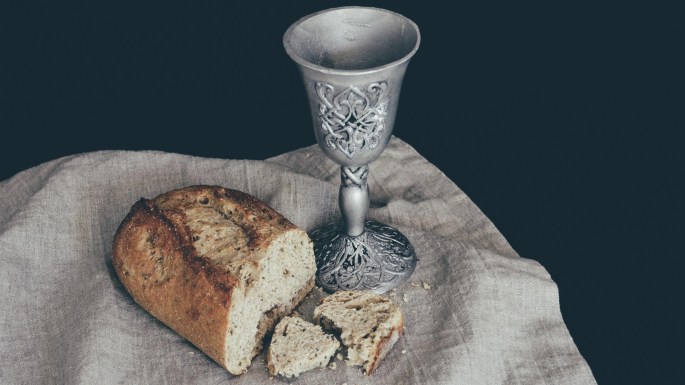
Communion at Home?

We trace our roots to the American Restoration Movement. Thomas & Alexander Campbell and Barton Stone were dedicated to seeing their churches return to simple Biblical Christianity. So many divisions had occurred in the Church over matters of opinion, and because over disagreements over things that are never enumerated in Scripture.

The Restoration Movement sought to restore simple Christianity in order to bring unity to all Christians everywhere. And one of the major ways they did this was through the Lord’s Supper.

If you grew up in the Church of Christ like me, you might be surprised to learn that the practice of the Lord’s Supper was once a battleground for division. We assume it’s always been done this way and there’s really nothing to consider that is new. But in the not-so-distant past the Lord’s Supper was a point of division, not unity. The Campbells ultimately broke their denominational ties over the issue of who could partake of the Lord’s Supper. The denomination they were a part of required people to pass a test and receive a coin as proof that they were worthy of partaking, and only ordained elders were allowed to distribute the elements. The Campbells saw no such exclusion in Scripture and welcomed all who professed faith in Christ to participate.

The desire to welcome all at the Lord’s Table led the Campbells, and similarly Barton Stone, to seek a way of practicing Christianity that was consistent with the Scriptures, and nothing more. They sought to unite in Christ, and in Christ alone. Nothing other than faith in Christ would be required for fellowship.

Some Christian traditions are struggling right now with how to share the Lord’s Supper. Sincere belief that only some can distribute the elements and only some can partake is causing real struggles for some congregations. But we view Scripture differently.

Here are some reasons why you can (and should) take communion at home, and why I believe you can do so on more than just Sunday.

  • If you are a believer in Jesus Christ, you are ordained by God as one of his priests. (1 Peter 2:5-9)
  • All the early believers were committed to “breaking bread” in their homes (Acts 2:42, 46)
  • It seems that the early church gathered to break bread on the first day of the week, at least in Troas (Acts 20:7). Historical writings from the 1st and 2nd century tell us that the practice varied from place to place.
  • Notice, however, that the church was ok with eating the Lord’s Supper after midnight, meaning this meal took place on Monday morning (Acts 20:7-11 shows they “broke bread and ate” after midnight).
  • Luke informs us that the early church had the practice of eating the Lord’s Supper daily (Acts 2:46).

I’m not trying to change your theology of the Lord’s Supper with this article, but I do want you to rest assured that you aren’t doing anything contrary to Biblical practice if you choose to eat the Lord’s Supper with your family at home.

I’m praying home church will be a blessing to you this week. Don’t forget to tune in to either our website, our Facebook page, our YouTube channel for some announcements, a time of prayer, and a message from God’s word on Sunday at 10:00am.

Sinning Against The Body and Blood of the Lord

What does Paul mean when he tells the Corinthians not to eat the Lord’s Supper in an “unworthy manner?” 

“So then, whoever eats the bread or drinks the cup of the Lord in an unworthy manner will be guilty of sinning against the body and blood of the Lord.”

1 Corinthians 11:27 NIV

I have heard many teachings on the Lord’s Supper over the years, and most of the conclusions based on this verse indicated we need to spend this time focusing on the sacrifice that Jesus made. We need to visualize the cross, the suffering of our Savior, and the blood that was spilled. This should be a somber, quiet, and sad occasion.

The problem is the above describes an altar (a place of sacrifice.) We have often confused the table with an altar. We, however, are called to gather around a table, not an altar!

The first thing we need to realize is the Lord’s Supper was originally part of a meal. It was a time of feasting and celebration, not mournful reflection. Yes, a full meal that fed hungry people. This was not a sip of juice and a pinch of cracker. People were eating their fill. “Supper” is the evening meal. And the explicit problem with the church in Corinth was the wealthy were arriving early and eating all the food, leaving the poor hungry. Paul indicates this type of “dinner” should be done at home, not in worship gatherings. (1 Cor. 11:20-21) Paul further states that their actions show that they “despise the church of God by humiliating those who have nothing.” (v. 22) So the problem Paul is referring to is the Church being divided by not eating the Lord’s Supper together as equals.

Paul reminds them that Jesus’ atoning sacrifice was for all of them (v. 24 – “you” is plural, as well as plural “drink” in verse 25). 

So how do we eat and drink in a worthy manner according to Paul? John Mark Hicks summarizes this passage well in his book, “Come To The Table.”

Consequently, to eat and drink worthily is not about private introspection, but about public action. Paul is not stipulating a kind of meditative silence on the cross of Christ or an introspective assessment of our relative holiness. On the contrary, to eat in an “unworthy manner,” in this context, is to eat in a divisive manner like that which existed in Corinth. The church must examine itself about the manner in which the supper is conducted (1 Cor. 11:28). There may be many ways to eat the supper unworthily (e.g., 1 Cor. 10:18-21 where Corinthians ate unworthily because they ate with a dual commitment, serving two masters), but the specific unworthiness in 1 Corinthians 11 is a communal problem, not an individualistic one. The church eats worthily when it eats as a united community embodying the values for which Christ died.”

John Mark Hicks, Come to the Table: Revisioning the Lord’s Supper (Abilene, TX: Leafwood Publishers, 2012).

3 Sins You Likely Ignore

Most followers of Jesus could probably recite the fruit of the Spirit. But Paul actually gives two lists in this passage; one list to live by, and one to avoid. Unfortunately we don’t do a very good job of avoiding the so called “acts of the flesh.” Do you know what’s on the list?

The acts of the flesh are obvious: sexual immorality, impurity and debauchery; idolatry and witchcraft; hatred, discord, jealousy, fits of rage, selfish ambition, dissensions, factions and envy; drunkenness, orgies, and the like. I warn you, as I did before, that those who live like this will not inherit the kingdom of God.

Galatians 5:19-21 NIV

Some of these are fairly self explanatory, but I’d like to focus on three that you may not have paid attention to. The first is discord. The Greek word is eris and is translated as discord, dissension, rivalry, arguments, strife, and quarrel in your New Testament. The second word I’d like to look at is dissensions. This Greek word dichostasia is only used here and in Romans 16:17 to instruct the church to stay away from those who cause “divisions.” The last word I want us to look at is factions. The Greek word is hairesis which is translated as factions, heresies, sect, and party (group).

Most of us would heartily agree that sexual immorality, fits of rage, drunkenness, orgies, idolatry and the like are clearly wrong. Of course living like this would keep someone out of the kingdom of God (v. 21). But causing division? Arguing? Rivalry? Really? Yes! A divisive person “will not inherit the kingdom of God.” 

It’s clear that Jesus and the writers of the New Testament hated division. It’s almost always listed along with all those sins that we hate. And yet we seem to be ok with division for some strange reason. The only time it’s really ok to divide is from a divisive person. The church is supposed to have nothing to do with people like that! (Rom. 16:17)

So before we speak we need to check our hearts, check your motives, and carefully watch our words. We are the people who are called to build up the body of Christ, not tear it down.

Do not let any unwholesome talk come out of your mouths, but only what is helpful for building others up according to their needs, that it may benefit those who listen.

Ephesians 4:9 NIV

The Only Thing That Counts

For the next 6 weeks the attention of our bulletin articles will be to support our readings from Immerse: Messiah. If you haven’t decided to join us for Immerse yet, it’s not too late. We have 5 groups meeting on 5 different days in 5 different locations. Hopefully you can make one of them fit into your schedule.

Our readings for this week will take us through the 1 & 2 Corinthians, Galatians, and Romans. One of the things that has really stood out to me in Paul’s letters is how he calls us to love as Christ has loved us! Paul comes back to this theme in practically all his writings, but let’s just look at a few verses in Galatians.

The only thing that counts is faith expressing itself through love.

Galatians 5:6 NIV

You, my brothers and sisters, were called to be free. But do not use your freedom to indulge the flesh; rather, serve one another humbly in love. For the entire law is fulfilled in keeping this one command: “Love your neighbor as yourself.”

Galatians 5:13-14 NIV

Paul is writing to a group of Gentiles (non-Jews) who are wrestling with their identity in Christ. Apparently there was a particular group of Jewish Christians who were discouraging the Gentiles in Galatia by putting them down, specifically as it related to following the law of Moses. I can almost hear them saying, “Of course you know you aren’t real followers of the Messiah unless you are just like us and keep the entire law of Moses, circumcision and all!”

Paul writes this part of Galatians to encourage the believers. Their identity isn’t found in the law of Moses. Their identity isn’t found in circumcision or non-circumcision. Rather their identity is found in the way they love others as Jesus had loved them. Through humble service to each other, and loving those around them, they were fulfilling all the requirements of the law. The only thing that counts is faith expressing itself through love.

I’ve been blessed to see some excellent examples of this in the lives of some of our East Side family members the last couple of weeks. I’ve seen people quietly and humbly tend to the needs of other church members. I’ve seen people abandon their own schedules in order to assist both members of our family, and people in our community we are trying to reach. I’ve seen people sacrifice time, money, and talents all in the name of loving others for the sake of Christ.

Jesus made it very clear. The world will know who his disciples are by the way we love.

So I ask you: How well are you loving your neighbors? How well are you loving the “others” in our community? When was the last time you went into the mess in order to lovingly bring someone else out of it?

Loving “others” is radical. Spending time with them, listening to them, praying with them, feeding them, caring for them…the Kingdom of God is made to do exactly this. Read Mark’s Gospel, and make note of what you see Jesus doing.

And then “go and do likewise.

Immerse: Messiah (Week 1)

For the next 8 weeks the attention of our bulletin articles will be to support our readings from Immerse: Messiah. If you haven’t decided to join us for Immerse yet, it’s not too late. The small groups don’t begin until this Friday, and you can still make it to a first time group until next Thursday. We have 5 groups meeting on 5 different days in 5 different locations. Hopefully you can make one of them fit into your schedule. (And if you’re reading this from some other part of the world, you can order the Immerse: Messiah book online and start your own small group wherever you are! Just go to www.immersebible.com.)

Our readings for this week will take us through the Gospel of Luke. One of the things that has really stood out to me in this reading is about the young Jesus being left at the Temple, and how that story sets up the rest of Luke’s Gospel. You can read about this on pg. 8 of your Immerse book (Luke 2 for everyone else).

First the story takes place at the Passover festival. His parents can’t find him anywhere on the way home, so they return to Jerusalem to look for him, and finally find him 3 days later at the Temple. Jesus’ responded: “But why did you need to search?…Didn’t you know that I must be in my Father’s house?” (Lk. 2:49 NLT) There’s also an alternate reading of this passage where Jesus says “Didn’t you realize that I should be involved with my Father’s affairs?”

Fast forward toward the end of Luke’s Gospel. The Passover festival is beginning (Lk. 22/Immerse pg. 52). Jesus is arrested that night, an unjust trial takes place in the middle of the night, he is handed over to the Romans, then sentenced. Jesus is crucified that Friday at the end of the Passover, and his death leaves his family and friends there in Jerusalem alone, and afraid. And when they see the resurrected Jesus after three days they are full of questions. After Jesus convinces them, his response is basically, “Didn’t you know?”

Then he said, “When I was with you before, I told you that everything written about me in the law of Moses and the prophets and in the Psalms must be fulfilled.” Then he opened their minds to understand the Scriptures. And he said, “Yes, it was written long ago that the Messiah would suffer and die and rise from the dead on the third day.

Lk. 24:44-46 NLT/Immerse pg. 59

Luke also carries this idea of 3 days of confusion forward into Acts (hint, look at Paul’s conversion).

I’m curious to see what you picked up on from the reading! Reading through a Gospel quickly like this helps you to see things/patterns/themes that you may not see when taking a longer time to read. Did you notice how many events happen around a table? Did you notice how often women are involved in the Jesus story? 

My prayer is that this short season of reading will be a blessing that ignites a passion for reading and rediscovering the story of Jesus again. Scripture tells us that the Word of God will never return void. 

I guess the question I’m asking is what will you allow the Word of God to do in your life as you read these Scriptures?

Mary’s Song

As we approach the last Sunday of Advent, I’d like to draw our attention to the words of a young teenage girl who just received news that she would become pregnant. 

46 And Mary said: 
“My soul glorifies the Lord 
47 and my spirit rejoices in God my Savior, 
48 for he has been mindful 
of the humble state of his servant. 
From now on all generations will call me blessed, 
49 for the Mighty One has done great things for me— 
holy is his name. 
50 His mercy extends to those who fear him, 
from generation to generation. 
51 He has performed mighty deeds with his arm; 
he has scattered those who are proud in their inmost thoughts. 
52 He has brought down rulers from their thrones 
but has lifted up the humble. 
53 He has filled the hungry with good things 
but has sent the rich away empty. 
54 He has helped his servant Israel, 
remembering to be merciful 
55 to Abraham and his descendants forever, 
just as he promised our ancestors.”

Luke 1:46–55 NIV

Rather than dread, and fear, Mary sees her life mission as a blessing. But look specifically at how she saw this as a blessing. First, she acknowledges that God has chosen to use someone of a “humble state.’ (v. 48) We know from Luke that Joseph and Mary lived in poverty (Lk. 2:24, Lev. 12:8). Second, she realizes this is a reversal of the power structure. Thrones will be toppled and humble (poor) will be elevated, the starving are filled and the rich are not. (vv. 52-53) The last statement I want us to consider is vv. 54-55. Within her womb resides the help of Israel, the mercy of God, and the fulfillment of the promise made to Abraham, and subsequent promises to his “descendants.” (Gen. 12:3)

This is the moment the prophets foretold, and would confirm again at the temple (Lk. 2:25-38). This is the promise of a Savior, of a King, of a Messiah. It is something brand new, and yet very old. It is the end of centuries of waiting, and the beginning of more. It is a moment on which everything that was, everything that is, and everything that will be hinges. 

Praise our faithful God! He has come, and He is coming again!

Sermon Text for 12/22/19 – Psalm 113; Psalm 146; Luke 1:67-80; Luke 1:46-56; Luke 2:1-14

Awaiting The Promised Messiah

Our faith heritage in the churches of Christ has often shied away from the season of Advent as being “unauthorized in Scripture.” However, the word “advent” simply means “coming.” The OT is full of hope in expectant waiting for the coming Messiah, the only one who could set the world aright.The NT is also full of the same hope as the church expectantly awaits Christ’s return. Advent is a season of expectant waiting for the return of Jesus at the Second Coming. We look forward to Christ’s return through the lens of those who waited for his first coming. 

“‘The days are coming,’ declares the Lord, ‘when I will fulfill the good promise I made to the people of Israel and Judah.”

Jeremiah 33:14 NIV

This week we turn our attention to Jeremiah 33 and Mark 8, and the promise of the Messiah. God had promised in the Garden that a descendant of Eve would eventually crush the head of the serpent, and in doing so the human would be struck (Gen. 3:15). God promised to Abraham “through your offspring all nations on earth will be blessed” (Gen. 22:18). God promised through Moses that he would “raise up for you a prophet like me from among you, from your fellow Israelites. You must listen to him.” (Deut. 18:15). 

This promise from God had been a long time in coming. Centuries of waiting for the one who would defeat evil, bless all nations, be the voice of God that we listen to, and many other prophecies, came at the perfect time, but for humans, the wait seemed endless.

And when the Messiah came, the majority of the people were not prepared.

As Israel and Judah awaited the fulfillment of God’s promise, we also wait for the fulfillment of the second coming of the Messiah Jesus. Many of us have forgotten that we are called to watch, to listen, and to open our hearts in expectant preparation for his coming (Matt. 25:1-13). 

We are called to listen to his Word. We look for signs of his presence in this world…a light in the darkness, a voice in the silence, and a stirring deep within us. We’re good at singing worship songs that reiterate these things, but do we truly expectantly wait and prepare for his return?

All of the Gospel writers want us to realize that the life of Jesus was the fulfillment of promises of old (Mt. 1:22-23; Mk. 1:1-4; Lk. 4:17-21; Jn. 1:45; etc.) and the renewal of promises yet to come (Isa. 65:17; Mt. 14:37; Lk. 12:40; Mk. 13:35; Jn. 14:2-3; Rev. 21:5). In Christ, God has and will continue to fulfill all promises.

And so we wait.

And the question that we all must answer is, “Am I ready for the coming of Christ?”

Josiah’s Passover & The Lord’s Supper

This week we wrap up our series Great Is Thy Faithfulness. We’ve taken an overview of the Hebrew Scriptures through the lens of God’s faithfulness. We’ve discovered that Yahweh keeps his promises regardless of what we humans do. We also discovered that our actions affect the way God’s faithfulness impacts us. When we live the life he calls us to then his faithfulness is a blessing. When we live contrary to his faithfulness, our sinful actions have painful consequences. This is what we saw the last two weeks as we looked to the 8th century BC in the prophecies of Hosea and Isaiah. The sin of Israel and Judah will bring painful consequences to the people, but God will remain faithful to heal and to save when they repent.

This week we turn to 2 Kings 22 and look at the story of Josiah. About 100 years after Hosea and Isaiah the 8 year old Josiah became king. Following the wicked reigns of his father and grandfather, Josiah chose not follow in their footsteps. We read that he was much like King David, and today is recognized as the 2nd greatest Davidic king.

All of Jerusalem had forgotten Yahweh. His temple had fallen into disrepair and had become the site of worship for Baal, Asherah, and star worship. Josiah ordered to restore the temple of Yahweh, and during that restoration a copy of the Torah was found (presumably Deuteronomy). Nobody knew about God’s word, or what to do with it. When Josiah heard the Torah read, he ripped his robes and sent his advisors to the prophet Huldah to confirm if what they were reading was true. 

The female prophet told these men that indeed the word of Yahweh was true and the punishment foretold in the Torah was coming. But she also had a word of peace for Josiah because of God’s appreciation for his heart. This destruction would come upon Jerusalem, but because of Josiah’s repentant heart, it would not happen during his lifetime.

Josiah calls all the people of Judah and reads aloud the Torah (as prescribed in Deuteronomy). When the people heard the words of Yahweh, they all pledged themselves to keeping the covenant. All of the idols and instruments of pagan worship were destroyed and removed and Josiah issued this decree:

“Celebrate the Passover to the LORD your God, as it is written in this Book of the Covenant.” – 2 Kings 23:21 NIV

In celebration of the renewed hearts and renewed commitment to Yahweh, the people eat the Passover.

Every Sunday at our gathering, we renew our hearts, we renew our commitment to Yahweh, and we eat the Lord’s Supper, a reapplication of the Passover by Jesus on the night he was betrayed (Mk. 14:16ff).

This week as we gather to worship, let us recommit to the mission and the covenant that Yahweh has made with us. And then let us eat the Passover of Jesus.

Sermon Text for 11/24/19 – 2 Kings 22:1-23:23; Mark 14:16-25

Give Us A King!

Great Is Thy Faithfulness continues this week by looking at the story of King David’s grandson, Rehoboam, and the division of the Kingdom of Israel. But before we talk about the actual split, we need to look at how Israel got to this point. They said they wanted a king like the nations around them, but God warned them what would happen if they chose an earthly king over him (1 Sam. 8). God knew all along the Israelites would choose this path, and even gave them guidelines on what a king should do before they ever entered the Promised Land (Deuteronomy 17). God’s way was better, but God gave Israel what they asked for.

Saul was the first king, and that went ok for a time. Eventually Saul had to be replaced because of his wickedness by King David (that was last week’s sermon). After David’s death, his son Solomon was chosen as king. Most of us know that Solomon was the wisest because he asked God for wisdom (1 Kings 3). Solomon ruled in this wisdom for a while, and did well as king. But pretty soon that all changed!

Deuteronomy 17 gives us 8 qualifications for an earthly king. Some of them are as follows:

  • He must not acquire great numbers of horses, especially from Egypt (v.16)
  • He must not take many wives or his heart will be led astray (v.17)
  • He must not accumulate large amounts of gold and silver (v. 17)
  • He is to be a Bible nerd and study it constantly to learn how to follow God (vv. 18-19)

David certainly failed at several of these points (and others not mentioned here), but Solomon is portrayed as the antithesis of Deuteronomy 17!

  • He acquired great numbers of horses, especially from Egypt (1 Kg. 10:28-29)
  • He took many wives and his heart was led astray (1 Kg. 11:1-6)
  • He must not accumulate large amounts of gold and silver (1 Kg. 10:2, 14-22, 27)
  • He ignored God even though God appeared to him twice! (1 Kg. 11:9)

The story of Solomon shows us that even the wisest, richest, most powerful and well respected king won’t follow God! And when Solomon’s son Rehoboam goes to be crowned as king, he decides to double down on Solomon’s evil practices (1 Kg. 12:14), the kingdom was divided. The earthly kingdom had failed. If only the people had trusted God, and not trusted in an earthly kingdom.

The northern kingdom has 20 kings that follow the split. According to the record of the Kings, none of them were faithful to God. In the southern kingdom, only 8 out of 20 were good kings, but even they ultimately failed the faithfulness test.

Israel needed a better king. They needed God as their King once again. And God promised just that through his prophets (Isa. 9:6-7). Unfortunately when King Jesus came to them, they once again chose an earthly king over him (John 19:15).

We too have a choice to make. Will we choose our earthly kingdom, or King Jesus?

(Sermon text for 10/27/19 – 1 Kings 12:1-17, 25-29; Mark 10:42-45)