Waiting Beyond Death

During this Season of Hope, we are studying texts related to the Advent, or coming of the fulfillment of God’s promises in the Messiah. Just like ancient Israel had to wait for his coming, we too wait for his second coming.

Isaiah 40 makes reference to this time of waiting.

6 A voice says, “Cry out.” 
And I said, “What shall I cry?” 
“All people are like grass, 
and all their faithfulness is like the flowers of the field. 
7 The grass withers and the flowers fall, 
because the breath of the Lord blows on them. 
Surely the people are grass. 
8 The grass withers and the flowers fall, 
but the word of our God endures forever.”

Isaiah 40:6–8 NIV

In these verses we have a heavenly voice (the speaker is unclear, perhaps Yahweh, an angel, or some other heavenly being) telling Isaiah that humans are like grass and their works like flowers. What the voice is reminding us is that grass and flowers are only around for a season before they wither and fade away. They do not last forever. But the word of God does indeed last forever.

Let’s put this in the context of Israel coming out of exile. They have been away from their homes for a generation, and there is this promise of return. God will make the path easy, he will restore Jerusalem, he will keep his promises. His word will not fail! But humans don’t live forever. We all die. God’s promises, however, do not die.

Isaiah is trying to remind us that we may wait for God to fulfill his promises, and they may not be fully fulfilled in our lifetime before we “wither.” Isaiah wants us to remember that our waiting does not negate God’s promises. Even if we never see them fulfilled, we can rest assured that they will be fulfilled because God’s word endures forever.

Centuries after this text was written, one would come as “a voice of one calling: In the wilderness prepare the way for the LORD.” (Isa. 40:3, Mark 1:3). Mark, as well as the other Gospel writers, want us to realize that God kept this promise fully in the ministry of John the Baptist, “and the glory of the LORD” was revealed in the Advent of Jesus (Isa. 40:5).

Though Isaiah’s words to exiled Israel were not fully realized in their lifetime, God fulfilled his promise through the Advent of Jesus. And though God’s kingdom has not fully come, we can rest assured that God will fulfill his promises through the Advent of Jesus.

Sermon text for 12/8/19: Isaiah 40:1-11; Mark 1:1-4 

Josiah’s Passover & The Lord’s Supper

This week we wrap up our series Great Is Thy Faithfulness. We’ve taken an overview of the Hebrew Scriptures through the lens of God’s faithfulness. We’ve discovered that Yahweh keeps his promises regardless of what we humans do. We also discovered that our actions affect the way God’s faithfulness impacts us. When we live the life he calls us to then his faithfulness is a blessing. When we live contrary to his faithfulness, our sinful actions have painful consequences. This is what we saw the last two weeks as we looked to the 8th century BC in the prophecies of Hosea and Isaiah. The sin of Israel and Judah will bring painful consequences to the people, but God will remain faithful to heal and to save when they repent.

This week we turn to 2 Kings 22 and look at the story of Josiah. About 100 years after Hosea and Isaiah the 8 year old Josiah became king. Following the wicked reigns of his father and grandfather, Josiah chose not follow in their footsteps. We read that he was much like King David, and today is recognized as the 2nd greatest Davidic king.

All of Jerusalem had forgotten Yahweh. His temple had fallen into disrepair and had become the site of worship for Baal, Asherah, and star worship. Josiah ordered to restore the temple of Yahweh, and during that restoration a copy of the Torah was found (presumably Deuteronomy). Nobody knew about God’s word, or what to do with it. When Josiah heard the Torah read, he ripped his robes and sent his advisors to the prophet Huldah to confirm if what they were reading was true. 

The female prophet told these men that indeed the word of Yahweh was true and the punishment foretold in the Torah was coming. But she also had a word of peace for Josiah because of God’s appreciation for his heart. This destruction would come upon Jerusalem, but because of Josiah’s repentant heart, it would not happen during his lifetime.

Josiah calls all the people of Judah and reads aloud the Torah (as prescribed in Deuteronomy). When the people heard the words of Yahweh, they all pledged themselves to keeping the covenant. All of the idols and instruments of pagan worship were destroyed and removed and Josiah issued this decree:

“Celebrate the Passover to the LORD your God, as it is written in this Book of the Covenant.” – 2 Kings 23:21 NIV

In celebration of the renewed hearts and renewed commitment to Yahweh, the people eat the Passover.

Every Sunday at our gathering, we renew our hearts, we renew our commitment to Yahweh, and we eat the Lord’s Supper, a reapplication of the Passover by Jesus on the night he was betrayed (Mk. 14:16ff).

This week as we gather to worship, let us recommit to the mission and the covenant that Yahweh has made with us. And then let us eat the Passover of Jesus.

Sermon Text for 11/24/19 – 2 Kings 22:1-23:23; Mark 14:16-25

Did God Kill An Innocent Man?

Great Is Thy Faithfulness continues this week by looking at the story of the ark of God coming to Jerusalem during the reign of King David. There is a part of this story that seems to perplex and worry many readers, and that is the account of Uzzah. I recall hearing several sermons and teachings in my past surrounding this story, but most of them didn’t fit within the theological narrative of the text. Both 2 Samuel 6 and 1 Chronicles 13 retell this story. 2 Samuel is not as nuanced and detailed as the Chronicler’s account, so I’ll use both texts. Let’s look at it together.

In Samuel’s account, David had become king and had been inquiring of God and operating under God’s guidance (2 Sam. 5:10, 18, 23). After this time David wanted to bring the ark of God, which is the very presence of God, to Jerusalem. This is a noble task because in contrast to Saul, David actually wanted to inquire of the LORD and wanted to be near the ark of God, the presence of God, when he did so (1 Chr. 13:3). The problem is that David did not actually inquire of God how to move the ark! (1 Chr. 15:13)

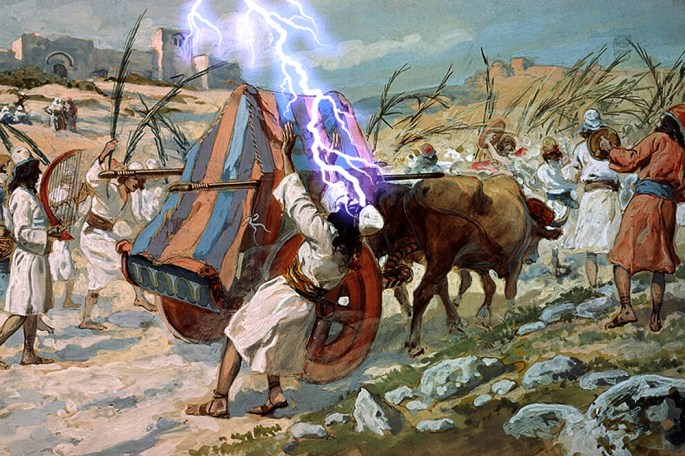
Careful attention is needed to what the text actually says here. “[David] and all his men” were the ones that undertook the movement of the ark of God (2 Sam 6:2). “They set the ark of God on a new cart” (2 Sam 6:3). As the cart travels along the ox stumbles so Uzzah takes hold of the ark and God strikes him down (2 Sam 6:6-7). 

Now on the surface it looks like God strikes down Uzzah because of a violation of a worship technicality. But keep in mind David and the whole group did this, not just Uzzah, and he is the only one struck down. That’s not what has happened. One might also think a vengeful God struck down an innocent concerned person who was only trying to help. That too is not what has happened. David, Uzzah, and all involved in the moving of the ark violated the law. Why did God only strike down Uzzah? This is where context comes into play.

The Chronicler has set a theme throughout his writings. To quote John Mark Hicks, that theme is “God seeks seekers.”  Chronicles uses the words “seek” more than any other biblical writing, and “heart” more than any except Jeremiah and Psalms. From the Chronicles we learn that to God it is the condition of the heart that matters. There are other clear examples of technical law violations in Chronicles (ex. 2 Chr. 30:18, 23), but God honors these violations (2 Ch. 30:20, 27).

The heart of the matter in this story is a matter of the heart.
-Why was Hezekiah’s unauthorized Passover celebration acceptable? His heart was set on seeking God. (2 Chr. 30:19)
-Why was David not struck down for moving the ark of God on a “new cart”? His heart was set on seeking God. (1 Sam. 16:7)

Why was Uzzah struck down? It’s clear Uzzah had no respect for the presence of God. Apparently his heart was not set on seeking God. Uzzah was struck down while others were not.

More could be said, but I think Hezekiah’s prayer in 2 Chronicles summarizes the story of Uzzah, and the Chronicles well.

“May the LORD, who is good, pardon everyone who sets their heart on seeking God – the LORD, the God of their ancestors – even if they are not clean according to the rules of the sanctuary.” And the LORD heard Hezekiah and healed the people.”

2 Chronicles 30:18-20 NIV (emphasis added)

Looking At Ruth And Seeing God

This week we continue our sermon series called Great Is Thy Faithfulness by looking at the character of God revealed to us in the life and actions of widowed pagan foreigner by the name of Ruth. We looked at Ruth in our sermon and our auditorium Bible class back on July 14th. But I think it’s a point that is important enough for us to look at again. But before we look at Ruth, let’s begin by looking at God.

The LORD passed before him, and proclaimed, “The LORD, the LORD, a God merciful and gracious, slow to anger, and abounding in steadfast love and faithfulness, keeping steadfast love for the thousandth generation, forgiving iniquity and transgression and sin, yet by no means clearing the guilty, but visiting the iniquity of the parents upon the children and the children’s children, to the third and the fourth generation.”

Exodus 34:6-7 NRSV

The phrase steadfast love is the Hebrew word hesed. It’s how God introduces himself to Moses. It’s the very character of God and can be described as a “joy, peace, patience, kindness, goodness, faithfulness, gentleness, self-control” kind of love. When Moses is reminding the people of God’s covenant with them in Deuteronomy 7, he once again reminds the people that they serve “the faithful God who maintains covenant loyalty with those who love him and keep his commandments…” (Deut. 7:9 NRSV) Again…hesed.

Now to the story of Ruth. Naomi has lost her husband, and her sons. She is going to return back from the land of Moab to Bethlehem in Judah to live out her days. She bids farewell to her two daughters-in-law (somewhat successfully) by saying “Go back, each of you, to your mother’s home. May the LORD show you kindness, as you have shown kindness to your dead husbands and to me.”  (Ruth 1:8 NIV)

Hopefully the bold words have tipped you off. The Hebrew word there is hesed. Notice that Ruth and Orpah are commended for showing hesed to Naomi and their husbands. Naomi is blessing them by asking Yahweh to do hesed to them as they have already done hesed to her and her sons.

This would be shocking to the original Israelite readers of this short story. The characters that most embody the character traits of Yahweh are not Israelites, nor faithful worshipers of Yahweh, nor wealthy, nor are they males. They are Moabite widowed women. Orpah quickly exits the narrative and we hear from her no more, but Ruth continues to be an example of Yahweh’s hesed through her relationship with Naomi.

Many different applications can be made here. But for now I want us to consider this one point. As we were reminded by the Deuteronomy 7 passage above, a clear example of God’s faithfulness is his hesed. To quote Bobby Valentine, “[Hesed] is the vertical and horizontal dimensions of the ’Jesus Creed.’” We discussed that last week. Sometimes God’s hesed is brought to us through our neighbor’s actions and faithfulness toward us and others. And we too are called to bring that hesed to others through our actions and relationships. 

When we look at the faithfulness Ruth shows Naomi, we begin to see a glimpse of the faithfulness of our God. To quote Jesus, “Go and do likewise.” (Lk. 10:37)

The Problem With the Ten Commandments

The Decalogue, otherwise known as the Ten Commandments, have impacted the world in ways that very few things have. They are the basis for many legal systems, they are foundational to our understanding of God, and unfortunately they are the source of much controversy in our day and time. They are a small portion of the sum of God’s Word given to Moses, and yet everyone seems to know (or know about) them. 

And still I think they are greatly misunderstood. The Decalogue is referenced throughout Scripture, and is present in its entirety in both Exodus 20 and Deuteronomy 5. And yet even in these two passages there are differences between the two lists. They are ten “words” to be literal with the Hebrew language, and even what exactly those ten are is debated. Jewish readers will tell you the first command is:

I am the Lord your God, who brought you out of Egypt, out of the land of slavery.

Deuteronomy 5:6 NIV

If one counts this as a command rather than an introduction, then you wind up with 11. Various groups have debated on how to settle that discrepancy, some by uniting 2 & 3 (Dt. 5:8 & 11), while other groups combine 1-3 as one command and divide up the last command into two parts (Dt. 5:21).

In reality, determining the exact grouping is not as important as the text itself. But even the text is problematic when removed from the context of the Torah…after all the Decalogue isn’t independent of the rest of Torah, and really serves as more of a summary, or a statement of understanding before we get into the more technical parts of the law. What kind of killing is defined as murder? That detail is not in the Decalogue. We need the rest of the Torah for that.

Many government buildings have had statues, or monuments removed because the Decalogue was printed upon them. And while I can understand the Christian’s desire to see these monuments remain, I’m also puzzled. If we want God’s Word present at these government buildings, then why not seek to have the Sermon on the Mount put on a monument instead of the Decalogue? Or better yet, why not the Greatest Commands?

When Jesus was asked what the greatest command was he gave two, not one. They are connected and inseparable. I would suggest you cannot fully keep one without the other. Fully loving God requires loving your neighbor, and truly loving your neighbor requires you know and love God. 

I think it’s worth noting that neither of the commandments Jesus gave came from the Decalogue. Rather they come from the Shema (Deut. 6:4-9) as well as the eighteenth verse of the various laws found in Leviticus 19.

“The most important one,” answered Jesus, “is this: ‘Hear, O Israel: The Lord our God, the Lord is one. Love the Lord your God with all your heart and with all your soul and with all your mind and with all your strength.’ The second is this: ‘Love your neighbor as yourself.’ There is no commandment greater than these.” 

Mark 12:28-31 NIV

Jesus said all the laws and prophets hang on these two commands (Mt. 22:40). Even the Decalogue falls short when compared to the Greatest Commands. Love God with all of your everything. Love your neighbor as yourself. “There is no commandment greater than these.” 

The real problem with any commandment from God is that if they simply exist in writing, they are useless. These monuments with the Ten Commandments inscribed have done little to prevent our culture from turning further and further from God.

Perhaps our world would be better served by Jesus’ followers living out the Greatest Commands instead of relying on words carved in stone. 

(Sermon text for 10/6: Deuteronomy 6:4-9; Mark 12:28-31)

“Can God Hear the Prayers of Sinners?”

“We know that God does not listen to sinners. He listens to the godly person who does his will.”

John 9:31 NIV

Upon first glance that seems like a pretty definite statement doesn’t it? “We know that God does not listen to sinners.”

I have read an article floating around Facebook recently that asserts basically the same thing. It cites many verses indicating that God hears the prayers of the righteous (and he does.) It gives examples of God’s promises to look out for the righteous (and he does.) And the article gives the impression that if one is “unrighteous” or a “sinner” that God doesn’t/can’t hear those prayers. In fairness to the context of the article, it seems the reason for its writing was to refute the idea that all you have to do to be pleasing to God is say a prayer. I would agree with that last statement, but let’s not argue an accurate point by stating an inaccurate point.

Context matters. The verse quoted above from John’s Gospel is not stated by Jesus or his apostles. It is an assumption on the part of the blind man that Jesus healed Jesus, and he uses that assumption to back his claim that Jesus is working through the power and will of God (which he was.) But that leaves the question, does God hear the prayers of sinners? Let’s look at a few passages.

The Lord said, “I have indeed seen the misery of my people in Egypt. I have heard them crying out because of their slave drivers, and I am concerned about their suffering. So I have come down to rescue them from the hand of the Egyptians…”

Exodus 3:7-8 NIV

The question is “were the Israelites unrighteous/sinners when God heard them?” That’s a good question. Context seems to indicate that they did not know Yahweh at this point in history because Moses would need to introduce them to their God (Ex. 3:13-15). Also note that the text does not say that Israel cried out to Yahweh, simply that they cried out and Yahweh heard them. What is clear is that God did hear their cries, and it had nothing to do with their righteousness, but rather the mistreatment they were receiving a the hands of the Egyptians.

One day at about three in the afternoon [Cornelius] had a vision. He distinctly saw an angel of God, who came to him and said, “Cornelius!” 

Cornelius stared at him in fear. “What is it, Lord?” he asked. 

The angel answered, “Your prayers and gifts to the poor have come up as a memorial offering before God.”

Acts 10:3-4 NIV

The timeline in the story of Cornelius is very clear. Cornelius worshipped God and prayed to God under what he knew through the Jewish worship practices. It seems clear that Peter’s presentation of the Gospel is the first time Cornelius and his family have heard this (Acts 10:47-48; 15:7-11). Cornelius was not saved by the blood of Jesus because he didn’t know about the blood of Jesus, yet God heard his prayers.

I share these two examples with you so that you think about the question a little, and maybe ask a better question. The Bible nowhere limits what our God can do. He is not limited to work in a certain way, and he is not bound by any rules we place upon him. So to ask the question if God can hear the prayers of sinners is shortsighted. Let’s stick with the question that one of the heavenly visitors asks Abraham:

“Is anything too wonderful for the LORD?”

Genesis 18:14 NRSV

Our God is the God of the impossible. He’s the one that brings 90 year old women and 100 year old men supernaturally born children. He’s the God that sends an 80 year old man with a stick to free his people from Egypt. He’s the God that parts the Red Sea. He’s the God that raises the dead. He’s the God that poured out his Spirit at Pentecost. He’s the God that appears to unsaved gentiles and then pours out his Spirit on them too. He sends rain on the righteous and the unrighteous, and nothing is too wonderful for the LORD!

Of course he can hear the prayers of anyone who cries out to him! And making that statement does not negate what the Scriptures teach about salvation.

5 Reasons Not To Obey God – The Calling of Moses

Last week our focus was on Jacob and the faithfulness God showed by keeping his promises, even while wrestling with Jacob. He also gave Jacob a new name, Israel – one who struggles with God.

This week we will talk about Moses, a complex character just like Jacob. Moses had been hiding out for about 40 years as a shepherd because he had committed murder back in Egypt. Now, at roughly the age of 80, Moses saw a burning bush and God called him to lead the nation of Israel out of slavery (Acts 7:23,30).  There are several points to ponder in this great text, but I want to focus on just one area: Moses didn’t want to do it!

At least 5 times in Exodus 3 & 4 Moses comes up with excuses for why he cannot do the job. “Who am I…what shall I tell them…what if they don’t believe…I have never been eloquent…” And the final excuse makes it abundantly clear what Moses wants:

But Moses said, “Pardon your servant, Lord. Please send someone else.”

Exodus 4:13 NIV

To state that Moses was a reluctant participant in the work of God through the Exodus is an understatement. He did not want to go! The text tells us that Moses made God angry through his excuses and hesitation, but once again notice the faithfulness of God through this statement:

“I will help both of you speak and will teach you what to do.”

Exodus 4:15 NIV

Even though Moses was not the most eager participant, God promised that he will “teach” Moses and Aaron what to do. God wasn’t going to just toss them to the wolves, he would be with them and would teach them.

Life is often difficult. And if we’re honest, God has called the church to do things that most of us don’t want to do. We would prefer being called to sit in the pews instead of obeying the command to make disciples (Mt. 28:19) Most of us can think of a hundred reasons why we aren’t qualified to do what God has called the church to do, but we forget that God is also a teacher at heart. 

There’s an old saying that I love:

God doesn’t call the equipped, he equips the called.

That’s the story of Abraham, Isaac, Jacob, Moses…and it’s our story too. We don’t have to rely on our own abilities if we are obeying the work God has called us to. He will prepare the way, he will take care of all the variables, and he will teach us as we go (Lk. 12:12, Jn. 14:26, 1 Jn. 2:27)

(Sermon text for 10/1 – Exodus 1:8-14; 3:1-15; Mark 12:26-27)

Wrestling with God

Last week our focus was on Abraham and the faithfulness God showed he and Sarah by keeping his promises even when they tried to take a shortcut.

This week we will talk about a difficult character to address: Jacob. Even from the beginning Jacob showed signs of who he would become as he exited the womb grabbing the heel of his brother. He’s given the name “Jacob” which means he grabs the heel. That’s an interesting little bit of information, but when you realize what he grabs the heel in Hebrew is an idiom for he takes advantage of, or he deceives, the story gets more interesting. Seriously, who would want to name their child “deceiver” when they are born?

As we look at the story of Jacob we find out he deceives and takes advantage of situations quite often. He extorts his brother’s birthright (Gen. 25:29-34), he stole his brother’s blessing (Gen. 27:5ff), he deceptively builds great herds and flocks from his father-in-law (Gen. 30:41-43), and the list goes on and on. Not exactly role model material in some ways.

And yet, in some ways he’s exactly who we should be. Our sermon this week will focus on Jacob wrestling with God. We’ll explore the details of the story Sunday, but for now I want you to consider if you ever find yourself wrestling with God about something? I would say most often those times of wrestling are brought on by our desires. We want something and initiate the wrestling in hopes of getting our way. In Jacob’s case it is God who initiates the wrestling.

Why would God physically wrestle with Jacob? 

That’s a great question to wrestle with ourselves. Jacob’s story is a strange one that ends in a strange way. But the episode ends with God changing Jacob’s name to Israel which means he struggles with God. Think about this for a moment. The entire nation of Jacob’s descendants came to be known as those who struggle with God. And that title applies to us as well since Scripture tells us we have been grafted into Israel (Eph. 2:11-22).

We’ll explore other points of this text on Sunday, but for now I want you to find peace if you are wrestling with God. Jacob persisted in wrestling with God because he wanted to receive a blessing. I pray that’s why you are wrestling with God, and that the blessing comes to you as well. 

We can wrestle with God, his promises, his purposes, his Word, and walk away blessed. Just as Jacob limped away we will be changed by the encounter, but if we are persistent in our wrestling we too can be blessed through the encounter.

(Sermon text for 9/22: Genesis 32:9-13; 22-30; Mark 14:32-36)

Daily Psalms – Psalm 82

Daily Psalm Reading – Psalm 81-85

Psalm 82 is a short psalm, but one that is debated as to its exact meaning. I’ll provide two summary explanations, the first as we traditionally view this psalm, and the second how the original readers would have likely understood this psalm. I intend later to do a more in depth analysis of this psalm and its implications on how we read the Bible, but today will serve simply to get us thinking.

The traditional reading of Psalm 82 goes something like this:

  • V. 1 states that God is present when his people gather together (“divine assembly”), and that he passes judgement upon false gods or idols (v. 1).
  • Vv. 2-4 scold the assembly for not pursuing justice in the world.
  • Verse 5 talks about the foolishness of idolatry…afterall, didn’t Paul tell us that idols aren’t anything anyway, sort of like what we read here?
  • V. 6-7 show that humans and false gods, or those who claim to be divine, will die like anyone else.
  • V. 8 calls for God to bring his judgement and acknowledges that God is over all nations, not idols.

There are variations to this view of Psalm 82, but this pretty much gives the gist of what is going on with this view. And I will say that nothing stated above is Scripturally inaccurate. God is the God of all…no idols or false gods compare. Our God will judge all. Israel failed time and again to bring about justice in the ways they dealt with others. Nothing said above is Scripturally inaccurate. What may be inaccurate is what we are missing by reading this psalm out of context with the worldview of ancient Israel, and the rest of Scripture.

If you are unfamiliar with the concept of the “Divine Council,” then this next section may really stretch your wineskins. I’m going to recommend a book up front, Unseen Realm by Dr. Michael Heiser, and you would also benefit from listening to a series of podcasts by The Bible Project called the God Series. There’s somewhere in the neighborhood of 24 hours worth of audio study and reflection on this concept. Again much more could, should, and has been said about this psalm in light of the Divine Council view. For now, I’m just cracking the door to a whole other way of seeing the Scriptures through the eyes of the ancients.

We need to lay a bit of understanding about this passage first. The Hebrew word elohim is a class of spiritual being. When you see “God” or “gods” in the text, it’s the same Hebrew word. This is a view of one elohim passing judgement upon other elohim. “God” is not a name, it’s a class of spiritual being. We tend to capitalize the “g” in God when we are referring to the God of the Bible, Yahweh (often notated in your bible as LORD).

The Divine Council helped Yahweh rule the nations. Yahweh is the God of Israel, but there was also a god of Babylon, a god of Canaan, etc. In other words, the nations and ruling bodies on earth have a spiritual elohim behind them. Read Genesis 6 with these eyes and see what you think. Again, this deserves much more than I am going to give here, but here is a brief summary of the Divine Council view of Psalm 82.

  • V. 1 shows our God (the divine name appears nowhere in this psalm), the supreme God among all gods (heavenly beings who have authority to rule portions of the earth). He pronounces judgement against their actions.
  • Vv. 2-4 recounts all of the failings that these governing gods have done. They haven’t promoted what the supreme God has commanded. The very things that Yahweh stands for in the Scriptures are being opposed by these gods.
  • V. 5 shows those who are oppressed and neglected by the gods have no direction…nobody to care for them. This lack of divine leadership has shaken the very foundations of the earth.
  • Vv. 6-7 show the Most High’s sentence against these guilty gods. They are all offspring of the Most High (Jesus being the only unique (begotten) Son – Jn. 3:16), yet they will die just like any other ruler. The same consequences for the rebellion of mankind now will fall upon the rebellion of the guilty in the Divine Council.
  • V. 8 is a call for our God, the supreme God, to bring this jugement to pass and rule over all nations.

The first response to the Divine Council reading of Scripture seems to be confusion about our God. “I thought there was only one God?” And Scripture contains verses like this:

Give thanks to the God of gods.
His faithful love endures forever.

Psalm 136:2 CSB

For even if there are so-called gods, whether in heaven or on earth—AS THERE ARE MANY “GODS” and many “lords”— YET FOR US THERE IS ONE GOD, the Father. All things are from him, and we exist for him. And there is one Lord, Jesus Christ. All things are through him, and we exist through him.

1 Corinthians 8:5-6 CSB – emphasis added

Even Scripture acknowledges there are other elohim/gods. But to us, there is only one God…or in other words, we only follow one elohim. The Elohim of elohim. We follow Yahweh alone.

So if you’ve stuck with me this far, I want to hear your take on this. Are you familiar with the concept of the Divine Council? Have you read Heiser’s book? What do you think of this understanding of Psalm 82, as well as Genesis 6? I’d love to hear your thoughts!

But whatever your take is, I hope this will at least get you to spend some time in God’s WOrd. Blessings to you today!

Daily Psalms – Psalm 76

Daily Psalm Reading – Psalm 76-80

Thank you to those who have reached out over the last week. It was pretty crazy with travel and family commitments. But now we return to our (mostly) daily posts from Psalms. Today we focus on Psalm 76.

Psalm 76 is a song of peace and salvation, though it may not look like it upon initial reading. It’s easy to read about Zion here and think this song is only about Jerusalem, the promised land, or some battle fought there. But we forget that Zion serves as a symbol for God’s sovereignty in all times and all places. That includes the world we live in today, as well as the new heavens and new earth to come (Rev. 21:1-4).

With this view of the Psalm, we are introduced to a God who is sovereign and is on a mission!

There he shatters the bow’s flaming arrows,
the shield, the sword, and the weapons of war.

Psalm 76:3 CSB

Where God is sovereign (which is everywhere) he is in the business of peace. This includes caring after the widow, orphan, and foreigner (Deut. 10:18), but also includes ending, and eliminating war (Isa. 2:4). It is God who shelters us and shatters the enemies efforts.

In verse 6 the psalmist reminds us of God’s efforts in the past, specifically the Exodus when Israel couldn’t fight, but God fought for them hurling horse and rider in the sea (Ex. 15:1). We are reminded through verses 7-10 of God’s might and justice that cannot be stopped (“Who can stand before you?”). And finally the summarizing point of the psalm:

Make and keep your vows
to the LORD your God;
let all who are around him bring tribute
to the awe-inspiring one.
He humbles the spirit of leaders;
he is feared by the kings of the earth.

Psalm 76:11-12 CSB

We must respond to the fact that God is sovereign in all the world! This isn’t some nugget of knowledge to stash away in our brains for future use. This is a call to live our lives in submission to him. God’s sovereignty should affect our interactions with others, our approach to the world, our pursuit of peace, the way we lead, the way we govern, the way we worship…the list is endless. God’s sovereignty should touch every aspect of our lives. And if it doesn’t, then we are living in rebellion against God. I’d like to share a quote from the New Interpreter’s Bible Commentary on this psalm:

“…Psalm 76 is finally an invitation to live under God’s sovereignty (v. 11), to adopt God’s values and God’s ways (vv. 8-9). But to stand for justice and peace in a world filled with war and injustice requires a particular understanding of sovereignty. God’s sovereignty is exercised not as sheer force but as the power of love. The world does not understand this kind of power, but it is power nonetheless (see 1 Cor 1:25). The invitation in v. 11 is ultimately an invitation to respond to God’s love.”

New Interpreter’s Bible Commentary – Vol. III, pg. 514

We have been invited to stand with God, or stand against him. To live under his reign, or in opposition to it. The choice is ours. To quote the old hymn, “What will your answer be?”