
The Only Thing That Counts

For the next 6 weeks the attention of our bulletin articles will be to support our readings from Immerse: Messiah. If you haven’t decided to join us for Immerse yet, it’s not too late. We have 5 groups meeting on 5 different days in 5 different locations. Hopefully you can make one of them fit into your schedule.

Our readings for this week will take us through the 1 & 2 Corinthians, Galatians, and Romans. One of the things that has really stood out to me in Paul’s letters is how he calls us to love as Christ has loved us! Paul comes back to this theme in practically all his writings, but let’s just look at a few verses in Galatians.

The only thing that counts is faith expressing itself through love.

Galatians 5:6 NIV

You, my brothers and sisters, were called to be free. But do not use your freedom to indulge the flesh; rather, serve one another humbly in love. For the entire law is fulfilled in keeping this one command: “Love your neighbor as yourself.”

Galatians 5:13-14 NIV

Paul is writing to a group of Gentiles (non-Jews) who are wrestling with their identity in Christ. Apparently there was a particular group of Jewish Christians who were discouraging the Gentiles in Galatia by putting them down, specifically as it related to following the law of Moses. I can almost hear them saying, “Of course you know you aren’t real followers of the Messiah unless you are just like us and keep the entire law of Moses, circumcision and all!”

Paul writes this part of Galatians to encourage the believers. Their identity isn’t found in the law of Moses. Their identity isn’t found in circumcision or non-circumcision. Rather their identity is found in the way they love others as Jesus had loved them. Through humble service to each other, and loving those around them, they were fulfilling all the requirements of the law. The only thing that counts is faith expressing itself through love.

I’ve been blessed to see some excellent examples of this in the lives of some of our East Side family members the last couple of weeks. I’ve seen people quietly and humbly tend to the needs of other church members. I’ve seen people abandon their own schedules in order to assist both members of our family, and people in our community we are trying to reach. I’ve seen people sacrifice time, money, and talents all in the name of loving others for the sake of Christ.

Jesus made it very clear. The world will know who his disciples are by the way we love.

So I ask you: How well are you loving your neighbors? How well are you loving the “others” in our community? When was the last time you went into the mess in order to lovingly bring someone else out of it?

Loving “others” is radical. Spending time with them, listening to them, praying with them, feeding them, caring for them…the Kingdom of God is made to do exactly this. Read Mark’s Gospel, and make note of what you see Jesus doing.

And then “go and do likewise.

Immerse: Messiah (Week 1)

For the next 8 weeks the attention of our bulletin articles will be to support our readings from Immerse: Messiah. If you haven’t decided to join us for Immerse yet, it’s not too late. The small groups don’t begin until this Friday, and you can still make it to a first time group until next Thursday. We have 5 groups meeting on 5 different days in 5 different locations. Hopefully you can make one of them fit into your schedule. (And if you’re reading this from some other part of the world, you can order the Immerse: Messiah book online and start your own small group wherever you are! Just go to www.immersebible.com.)

Our readings for this week will take us through the Gospel of Luke. One of the things that has really stood out to me in this reading is about the young Jesus being left at the Temple, and how that story sets up the rest of Luke’s Gospel. You can read about this on pg. 8 of your Immerse book (Luke 2 for everyone else).

First the story takes place at the Passover festival. His parents can’t find him anywhere on the way home, so they return to Jerusalem to look for him, and finally find him 3 days later at the Temple. Jesus’ responded: “But why did you need to search?…Didn’t you know that I must be in my Father’s house?” (Lk. 2:49 NLT) There’s also an alternate reading of this passage where Jesus says “Didn’t you realize that I should be involved with my Father’s affairs?”

Fast forward toward the end of Luke’s Gospel. The Passover festival is beginning (Lk. 22/Immerse pg. 52). Jesus is arrested that night, an unjust trial takes place in the middle of the night, he is handed over to the Romans, then sentenced. Jesus is crucified that Friday at the end of the Passover, and his death leaves his family and friends there in Jerusalem alone, and afraid. And when they see the resurrected Jesus after three days they are full of questions. After Jesus convinces them, his response is basically, “Didn’t you know?”

Then he said, “When I was with you before, I told you that everything written about me in the law of Moses and the prophets and in the Psalms must be fulfilled.” Then he opened their minds to understand the Scriptures. And he said, “Yes, it was written long ago that the Messiah would suffer and die and rise from the dead on the third day.

Lk. 24:44-46 NLT/Immerse pg. 59

Luke also carries this idea of 3 days of confusion forward into Acts (hint, look at Paul’s conversion).

I’m curious to see what you picked up on from the reading! Reading through a Gospel quickly like this helps you to see things/patterns/themes that you may not see when taking a longer time to read. Did you notice how many events happen around a table? Did you notice how often women are involved in the Jesus story? 

My prayer is that this short season of reading will be a blessing that ignites a passion for reading and rediscovering the story of Jesus again. Scripture tells us that the Word of God will never return void. 

I guess the question I’m asking is what will you allow the Word of God to do in your life as you read these Scriptures?

Mary’s Song

As we approach the last Sunday of Advent, I’d like to draw our attention to the words of a young teenage girl who just received news that she would become pregnant. 

46 And Mary said: 
“My soul glorifies the Lord 
47 and my spirit rejoices in God my Savior, 
48 for he has been mindful 
of the humble state of his servant. 
From now on all generations will call me blessed, 
49 for the Mighty One has done great things for me— 
holy is his name. 
50 His mercy extends to those who fear him, 
from generation to generation. 
51 He has performed mighty deeds with his arm; 
he has scattered those who are proud in their inmost thoughts. 
52 He has brought down rulers from their thrones 
but has lifted up the humble. 
53 He has filled the hungry with good things 
but has sent the rich away empty. 
54 He has helped his servant Israel, 
remembering to be merciful 
55 to Abraham and his descendants forever, 
just as he promised our ancestors.”

Luke 1:46–55 NIV

Rather than dread, and fear, Mary sees her life mission as a blessing. But look specifically at how she saw this as a blessing. First, she acknowledges that God has chosen to use someone of a “humble state.’ (v. 48) We know from Luke that Joseph and Mary lived in poverty (Lk. 2:24, Lev. 12:8). Second, she realizes this is a reversal of the power structure. Thrones will be toppled and humble (poor) will be elevated, the starving are filled and the rich are not. (vv. 52-53) The last statement I want us to consider is vv. 54-55. Within her womb resides the help of Israel, the mercy of God, and the fulfillment of the promise made to Abraham, and subsequent promises to his “descendants.” (Gen. 12:3)

This is the moment the prophets foretold, and would confirm again at the temple (Lk. 2:25-38). This is the promise of a Savior, of a King, of a Messiah. It is something brand new, and yet very old. It is the end of centuries of waiting, and the beginning of more. It is a moment on which everything that was, everything that is, and everything that will be hinges. 

Praise our faithful God! He has come, and He is coming again!

Sermon Text for 12/22/19 – Psalm 113; Psalm 146; Luke 1:67-80; Luke 1:46-56; Luke 2:1-14

Why You Really Need Joy and Sorrow

Our thoughts for the past couple of weeks have centered around a Season of Hope, and our theme at East Side this year has been “Hope.” Advent is a season of hopeful waiting for the fulfilment of God’s promises.

The last several weeks have been looks at the prophecies leading up to the destruction and exile of Jerusalem & Judah. Last week we looked at Isaiah 40 and the hopeful promise that God’s people would return home, and he would come to them! This week we see the fulfillment of God’s promise that the people will return home, but not all is joyful.

Ezra begins in the same way 2 Chronicles ends with a proclamation from Cyrus king of Persia. Ezra also wants us to remember that this fulfills the Jeremiah 25 & 29 prophecy that the people would return home from exile. God is keeping his promise to the people!

Ezra 3 tells the story of the reestablishment of worship in Jerusalem. The altar was rebuilt and the people celebrated the Festival of Tabernacles (Lev. 23:33-43). I find this a fitting first celebration for the newly resettled exiles. Tabernacles was to remind the Israelites of the time they lived in temporary huts during the journey out of Egypt. The entire festival recalls the journey out of Egyptian slavery/exile to the promised land; a fitting reminder to those having just journeyed back to the promised land from Babylonian exile. In both generations, God was faithful in keeping his promises.

Our text in Ezra this week ends with the end of chapter 3 and the laying of the foundation of the temple of Yahweh. I find this text both beautiful and haunting.

With praise and thanksgiving they sang to the Lord: “He is good; his love toward Israel endures forever.” And all the people gave a great shout of praise to the Lord, because the foundation of the house of the Lord was laid. But many of the older priests and Levites and family heads, who had seen the former temple, wept aloud when they saw the foundation of this temple being laid, while many others shouted for joy. No one could distinguish the sound of the shouts of joy from the sound of weeping, because the people made so much noise. And the sound was heard far away.

Ezra 3:11-13 NIV

Notice that everyone praised God in this moment, but the emotions were very mixed. Some were joyful to see this day come. Some were lamenting the loss of the original temple. What brought joy to some brought mourning to others. Excitement and weeping. Yet a great shout of praise came from all.

Our church family is much like this group in Jerusalem, a place of rejoicing and mourning. Sometimes those two feelings are so intertwined that we feel them all at once, especially this time of year. A friend recently reminded me Advent is a time for the church to come together as one, despite our emotions, in hopeful expectation of the second Advent of Christ.

For some the waiting brings joy, for others sorrow. We need both. We are called to rejoice together and mourn together because we are called to be together! The church becomes more like Christ when we rejoice and mourn together.

Wherever you find yourself in the emotional spectrum, you are welcome here. Join the body of Christ as we worship our God in hopeful expectation of his Advent! Come Lord Jesus!

Sermon text for 12/15/19 – Ezra 1:1-4; Ezra 3:1-4, 10-13; Luke 2:25-32

Waiting Beyond Death

During this Season of Hope, we are studying texts related to the Advent, or coming of the fulfillment of God’s promises in the Messiah. Just like ancient Israel had to wait for his coming, we too wait for his second coming.

Isaiah 40 makes reference to this time of waiting.

6 A voice says, “Cry out.” 
And I said, “What shall I cry?” 
“All people are like grass, 
and all their faithfulness is like the flowers of the field. 
7 The grass withers and the flowers fall, 
because the breath of the Lord blows on them. 
Surely the people are grass. 
8 The grass withers and the flowers fall, 
but the word of our God endures forever.”

Isaiah 40:6–8 NIV

In these verses we have a heavenly voice (the speaker is unclear, perhaps Yahweh, an angel, or some other heavenly being) telling Isaiah that humans are like grass and their works like flowers. What the voice is reminding us is that grass and flowers are only around for a season before they wither and fade away. They do not last forever. But the word of God does indeed last forever.

Let’s put this in the context of Israel coming out of exile. They have been away from their homes for a generation, and there is this promise of return. God will make the path easy, he will restore Jerusalem, he will keep his promises. His word will not fail! But humans don’t live forever. We all die. God’s promises, however, do not die.

Isaiah is trying to remind us that we may wait for God to fulfill his promises, and they may not be fully fulfilled in our lifetime before we “wither.” Isaiah wants us to remember that our waiting does not negate God’s promises. Even if we never see them fulfilled, we can rest assured that they will be fulfilled because God’s word endures forever.

Centuries after this text was written, one would come as “a voice of one calling: In the wilderness prepare the way for the LORD.” (Isa. 40:3, Mark 1:3). Mark, as well as the other Gospel writers, want us to realize that God kept this promise fully in the ministry of John the Baptist, “and the glory of the LORD” was revealed in the Advent of Jesus (Isa. 40:5).

Though Isaiah’s words to exiled Israel were not fully realized in their lifetime, God fulfilled his promise through the Advent of Jesus. And though God’s kingdom has not fully come, we can rest assured that God will fulfill his promises through the Advent of Jesus.

Sermon text for 12/8/19: Isaiah 40:1-11; Mark 1:1-4 

Josiah’s Passover & The Lord’s Supper

This week we wrap up our series Great Is Thy Faithfulness. We’ve taken an overview of the Hebrew Scriptures through the lens of God’s faithfulness. We’ve discovered that Yahweh keeps his promises regardless of what we humans do. We also discovered that our actions affect the way God’s faithfulness impacts us. When we live the life he calls us to then his faithfulness is a blessing. When we live contrary to his faithfulness, our sinful actions have painful consequences. This is what we saw the last two weeks as we looked to the 8th century BC in the prophecies of Hosea and Isaiah. The sin of Israel and Judah will bring painful consequences to the people, but God will remain faithful to heal and to save when they repent.

This week we turn to 2 Kings 22 and look at the story of Josiah. About 100 years after Hosea and Isaiah the 8 year old Josiah became king. Following the wicked reigns of his father and grandfather, Josiah chose not follow in their footsteps. We read that he was much like King David, and today is recognized as the 2nd greatest Davidic king.

All of Jerusalem had forgotten Yahweh. His temple had fallen into disrepair and had become the site of worship for Baal, Asherah, and star worship. Josiah ordered to restore the temple of Yahweh, and during that restoration a copy of the Torah was found (presumably Deuteronomy). Nobody knew about God’s word, or what to do with it. When Josiah heard the Torah read, he ripped his robes and sent his advisors to the prophet Huldah to confirm if what they were reading was true. 

The female prophet told these men that indeed the word of Yahweh was true and the punishment foretold in the Torah was coming. But she also had a word of peace for Josiah because of God’s appreciation for his heart. This destruction would come upon Jerusalem, but because of Josiah’s repentant heart, it would not happen during his lifetime.

Josiah calls all the people of Judah and reads aloud the Torah (as prescribed in Deuteronomy). When the people heard the words of Yahweh, they all pledged themselves to keeping the covenant. All of the idols and instruments of pagan worship were destroyed and removed and Josiah issued this decree:

“Celebrate the Passover to the LORD your God, as it is written in this Book of the Covenant.” – 2 Kings 23:21 NIV

In celebration of the renewed hearts and renewed commitment to Yahweh, the people eat the Passover.

Every Sunday at our gathering, we renew our hearts, we renew our commitment to Yahweh, and we eat the Lord’s Supper, a reapplication of the Passover by Jesus on the night he was betrayed (Mk. 14:16ff).

This week as we gather to worship, let us recommit to the mission and the covenant that Yahweh has made with us. And then let us eat the Passover of Jesus.

Sermon Text for 11/24/19 – 2 Kings 22:1-23:23; Mark 14:16-25

You Don’t KNOW God!

This week we continue with Great is Thy Faithfulness by looking at the book of Hosea. If you are unfamiliar with Hosea, it should only take about 10 minutes to read through the whole book. I’d encourage you to do so before our Sunday gathering. The focus of Hosea is to remind Israel (and us) of the painful consequences that come from rebelling against God, but at the same time reminding us that God’s love and mercy are far greater than all our sin.

Hosea does this by using two main images. The first is comparing Israel’s idolatry to prostitution/adultery. The second is more subtle, and involves the Hebrew root word yada which is frequently translated as “knowledge” or “acknowledge.” But yada is more than just knowing about someone. It is deeply and intimately knowing someone. In short, it’s true relationship that God desires from us. Over and over Hosea points the reader back to this truth. Let’s look at a few uses of this word in Hosea. (I’ll italicize the related word to yada in each verse.)

  • Hosea 4:1 – “There is no faithfulness, no love, no acknowledgment of God in the land.”
  • Hosea 4:6 – …my people are destroyed from lack of knowledge. “Because you have rejected knowledge, I also reject you as my priests…
  • Hosea 5:4 – “Their deeds do not permit them to return to their God. A spirit of prostitution is in their heart; they do not acknowledge the Lord.”
  • Hosea 6:3 – Let us acknowledge the Lord; let us press on to acknowledge him.
  • Hosea 6:6 – For I desire mercy, not sacrifice, and acknowledgment of God rather than burnt offerings.

Did you notice that last verse? Jesus quoted that on several occasions, and Mark’s gospel ties it to the Greatest Commands (Mk. 12:33-34). In Matthew 9:13 Jesus quotes this verse to explain to the Pharisees why he is eating with sinners and tax collectors. In Matthew 12:7, it is in regards to the Pharisees accusation of Jesus and his disciples breaking the Sabbath laws.

It seems to me that Jesus was trying to get the Pharisees to realize that they were acting quite a bit like the northern kingdom of Israel that Hosea was speaking to. They “knew” God, but they didn’t have the kind of relationship that He wanted them to have. They had exchanged relationship for ritual. This caused them to see Jesus’ actions as violations of rules rather than the Kingdom of Heaven on display. They became spiritually blind because they didn’t yada God.

This same sin plagues the church today. Some of us get so wrapped up in the ritual (wanting our worship the way we want it) rather than the relationship our God seeks from us. Hosea’s message is that God’s ultimate purpose is to heal and save. If we aren’t doing the same in our churches, our communities, and our families, then we don’t yada God! I’ll let Hosea have the last word.

Who is wise? Let them realize these things. Who is discerning? Let them understand. The ways of the LORD are right; the righteous walk in them, but the rebellious stumble in them.

Hosea 14:9 NIV

Sermon Text for 11/10 – Hosea 11; Mark 10:13-15

Give Us A King!

Great Is Thy Faithfulness continues this week by looking at the story of King David’s grandson, Rehoboam, and the division of the Kingdom of Israel. But before we talk about the actual split, we need to look at how Israel got to this point. They said they wanted a king like the nations around them, but God warned them what would happen if they chose an earthly king over him (1 Sam. 8). God knew all along the Israelites would choose this path, and even gave them guidelines on what a king should do before they ever entered the Promised Land (Deuteronomy 17). God’s way was better, but God gave Israel what they asked for.

Saul was the first king, and that went ok for a time. Eventually Saul had to be replaced because of his wickedness by King David (that was last week’s sermon). After David’s death, his son Solomon was chosen as king. Most of us know that Solomon was the wisest because he asked God for wisdom (1 Kings 3). Solomon ruled in this wisdom for a while, and did well as king. But pretty soon that all changed!

Deuteronomy 17 gives us 8 qualifications for an earthly king. Some of them are as follows:

  • He must not acquire great numbers of horses, especially from Egypt (v.16)
  • He must not take many wives or his heart will be led astray (v.17)
  • He must not accumulate large amounts of gold and silver (v. 17)
  • He is to be a Bible nerd and study it constantly to learn how to follow God (vv. 18-19)

David certainly failed at several of these points (and others not mentioned here), but Solomon is portrayed as the antithesis of Deuteronomy 17!

  • He acquired great numbers of horses, especially from Egypt (1 Kg. 10:28-29)
  • He took many wives and his heart was led astray (1 Kg. 11:1-6)
  • He must not accumulate large amounts of gold and silver (1 Kg. 10:2, 14-22, 27)
  • He ignored God even though God appeared to him twice! (1 Kg. 11:9)

The story of Solomon shows us that even the wisest, richest, most powerful and well respected king won’t follow God! And when Solomon’s son Rehoboam goes to be crowned as king, he decides to double down on Solomon’s evil practices (1 Kg. 12:14), the kingdom was divided. The earthly kingdom had failed. If only the people had trusted God, and not trusted in an earthly kingdom.

The northern kingdom has 20 kings that follow the split. According to the record of the Kings, none of them were faithful to God. In the southern kingdom, only 8 out of 20 were good kings, but even they ultimately failed the faithfulness test.

Israel needed a better king. They needed God as their King once again. And God promised just that through his prophets (Isa. 9:6-7). Unfortunately when King Jesus came to them, they once again chose an earthly king over him (John 19:15).

We too have a choice to make. Will we choose our earthly kingdom, or King Jesus?

(Sermon text for 10/27/19 – 1 Kings 12:1-17, 25-29; Mark 10:42-45)

Daily Psalms – Psalm 84

Daily Psalm Reading – Psalm 81-85

How happy are those who reside in your house,
who praise you continually. Selah

Psalm 84:4 CSB

Psalm 84, perhaps my favorite of the songs of Zion, focuses on this point. Being in the presence of God, where he resides, is our ultimate goal and longing.

The psalmist begins by proclaiming a desire to be where the presence of Yahweh is, and then moves into an almost play-by-play of a pilgrim traveling to the temple (vs. 5-10). Each verse brings us closer and closer to God’s presence until the arrival in the temple courts.

Better a day in your courts than a thousand anywhere else.
I would rather stand at the threshold of the house of my God
than live in the tents of wicked people.

Psalm 84:10 CSB

The presence of Yahweh dwelt in the temple. In the Israelite context, do draw near to God meant a pilgrimage to the temple. But to the Christian, you and I are now the temple of the Holy Spirit of God because of the atoning blood of Jesus (Eph. 2:19-22; 1 Pet. 2:4ff).

So how do we encounter the presence of God? It starts with Jesus. We can only enter through Christ. His life, ministry, death, and resurrection was the fulfillment of the promised Messiah to Israel. This fulfillment of God’s promise changed the way God interacted with his people! When we commit ourselves to Christ, God’s Spirit dwells within us, and we can and should ask God for his Spirit to be ever present and powerful in our lives. He also promises his presence when we gather together with other believers. (see Rom. 8:9ff, John 14:6-7, 1 Cor. 6:19ff, Acts 2, Luke 11:13, Matthew 18:20)

We should all long for the presence of God daily in this life, to gather in his presence with fellow believers as often as possible, and to dwell eternally in his presence in the next life.

Happy is the person who trusts in you,
LORD of Armies!

Psalm 84:12 CSB

Did God Kill An Innocent Man?

Great Is Thy Faithfulness continues this week by looking at the story of the ark of God coming to Jerusalem during the reign of King David. There is a part of this story that seems to perplex and worry many readers, and that is the account of Uzzah. I recall hearing several sermons and teachings in my past surrounding this story, but most of them didn’t fit within the theological narrative of the text. Both 2 Samuel 6 and 1 Chronicles 13 retell this story. 2 Samuel is not as nuanced and detailed as the Chronicler’s account, so I’ll use both texts. Let’s look at it together.

In Samuel’s account, David had become king and had been inquiring of God and operating under God’s guidance (2 Sam. 5:10, 18, 23). After this time David wanted to bring the ark of God, which is the very presence of God, to Jerusalem. This is a noble task because in contrast to Saul, David actually wanted to inquire of the LORD and wanted to be near the ark of God, the presence of God, when he did so (1 Chr. 13:3). The problem is that David did not actually inquire of God how to move the ark! (1 Chr. 15:13)

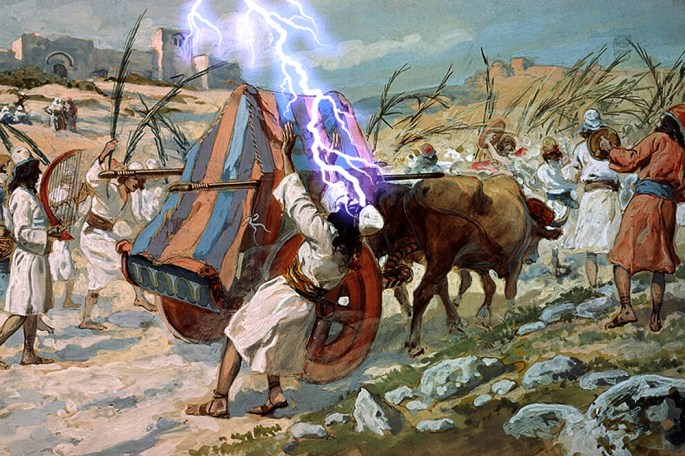
Careful attention is needed to what the text actually says here. “[David] and all his men” were the ones that undertook the movement of the ark of God (2 Sam 6:2). “They set the ark of God on a new cart” (2 Sam 6:3). As the cart travels along the ox stumbles so Uzzah takes hold of the ark and God strikes him down (2 Sam 6:6-7). 

Now on the surface it looks like God strikes down Uzzah because of a violation of a worship technicality. But keep in mind David and the whole group did this, not just Uzzah, and he is the only one struck down. That’s not what has happened. One might also think a vengeful God struck down an innocent concerned person who was only trying to help. That too is not what has happened. David, Uzzah, and all involved in the moving of the ark violated the law. Why did God only strike down Uzzah? This is where context comes into play.

The Chronicler has set a theme throughout his writings. To quote John Mark Hicks, that theme is “God seeks seekers.”  Chronicles uses the words “seek” more than any other biblical writing, and “heart” more than any except Jeremiah and Psalms. From the Chronicles we learn that to God it is the condition of the heart that matters. There are other clear examples of technical law violations in Chronicles (ex. 2 Chr. 30:18, 23), but God honors these violations (2 Ch. 30:20, 27).

The heart of the matter in this story is a matter of the heart.
-Why was Hezekiah’s unauthorized Passover celebration acceptable? His heart was set on seeking God. (2 Chr. 30:19)
-Why was David not struck down for moving the ark of God on a “new cart”? His heart was set on seeking God. (1 Sam. 16:7)

Why was Uzzah struck down? It’s clear Uzzah had no respect for the presence of God. Apparently his heart was not set on seeking God. Uzzah was struck down while others were not.

More could be said, but I think Hezekiah’s prayer in 2 Chronicles summarizes the story of Uzzah, and the Chronicles well.

“May the LORD, who is good, pardon everyone who sets their heart on seeking God – the LORD, the God of their ancestors – even if they are not clean according to the rules of the sanctuary.” And the LORD heard Hezekiah and healed the people.”

2 Chronicles 30:18-20 NIV (emphasis added)