Gone – How Time Slips Away

I have to be honest, I got the inspiration for today’s post from The Daily Post, but it’s something that has been on my mind quite a lot lately…the lyrics to one of my favorite Willie Nelson songs.

It’s been so long now but it seems now,
That it was only yesterday.
Gee, ain’t it funny how time slips away?

The idea of time slipping away has been front and center. My oldest daughter recently turned four. My youngest turns two on Saturday.

I’ve been thinking a lot lately about “should have done” and “what if’s” and how life would have turned out if some different choices had been made along the way.

Every so often I look around and wonder where the time went, only to feel lost as to where my time should go. Click to Tweet

We try so hard to plan out our lives, to control our own destiny, to organize everything just so…but then I remember the words of James.

James 4:14 – How do you know what your life will be like tomorrow? Your life is like the morning fog—it’s here a little while, then it’s gone.

And as I have seen friends this week deal with the tragic loss of their loved one that was taken from this life far too soon, I’m reminded that we really have to make the most of every opportunity we have because we really don’t have time to waste.

So hug your loved ones a little tighter, treat others a little kinder, and don’t waste your time worrying about the things you can’t change.

Because before you know it, your time will be gone.

Radical Disrupts Place of Worship

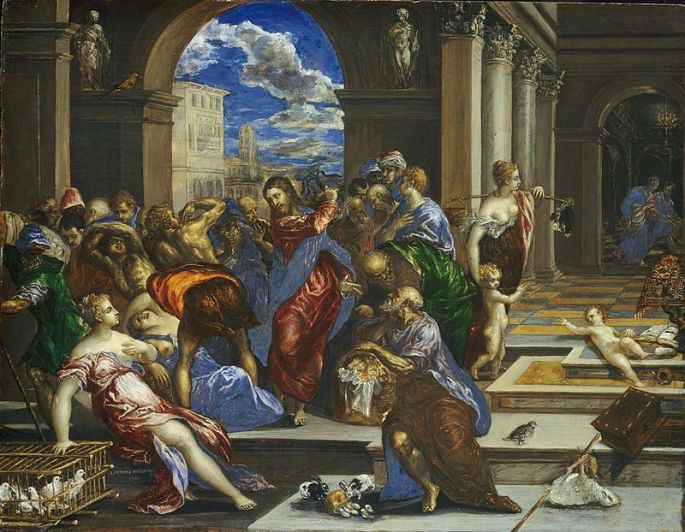
No this isn’t a recent headline from the New York Times. It’s likely what the Jerusalem Daily Gazette would have published the morning after Jesus cleared the Temple.

There is so much we can learn from this passage, but it so rarely gets brought up in churches. Questions about this passage always pop up. “Why would Jesus do such a thing?” or “Doesn’t Jesus love everyone? Why would he cause such a scene in a place of worship?”

There are two accounts of this happening in the Bible. One recorded by Matthew, the other by John. Today we’ll look at John’s account of this event.

John 2:13-17 New Living Translation (NLT)
Jesus Clears the Temple
13 It was nearly time for the Jewish Passover celebration, so Jesus went to Jerusalem. 14 In the Temple area he saw merchants selling cattle, sheep, and doves for sacrifices; he also saw dealers at tables exchanging foreign money.15 Jesus made a whip from some ropes and chased them all out of the Temple. He drove out the sheep and cattle, scattered the money changers’ coins over the floor, and turned over their tables. 16 Then, going over to the people who sold doves, he told them, “Get these things out of here. Stop turning my Father’s house into a marketplace!”
17 Then his disciples remembered this prophecy from the Scriptures: “Passion for God’s house will consume me.”
Holy Bible, New Living Translation, copyright © 1996, 2004, 2015 by Tyndale House Foundation. Used by permission of Tyndale House Publishers Inc., Carol Stream, Illinois 60188. All rights reserved.

When I was growing up, I would hear someone reference this passage the moment a fundraising catalog entered the church building. But that’s just not the context for what Jesus is reacting to here. So if you don’t want to buy that stale popcorn, you may have just lost your scriptural basis for doing so. To fully understand what Jesus was so outraged about, we have to look back into history and take a look at what it took to worship at the temple.

Ever since the temple was rebuilt by Ezra and Nehemiah, it was the national place of worship for all Jewish people. As many as 2.5 million Jews would travel vast distances to worship God in His temple on holy days! And as we all know, there’s always cost involved when traveling.

Besides the cost of travel, a Jew wishing to worship would also have other monetary demands put upon them as they arrived at the temple. The “Temple Tax” offset the cost of maintaining the temple, and was equal to 1 day’s wage. If you were traveling with a foreign currency, you must exchange your money at a rate of 2 days wages. If you brought your own animal to offer as a sacrifice, there was a fee of 1/2 days wage for someone to inspect the animal. If you failed inspection, or couldn’t afford to travel with your animal sacrifice in tow, you could normally purchase doves at the cost of 2 days wage. But in the temple courts prices had been raised to nearly 40 days wages!

If you calculate the cost in modern day figures, it would cost anywhere from $3,000 to $5,000 just to worship at the temple!

These services that Jew’s had set up as a convenience to traveling worshippers had instead become a roadblock preventing the poor from being able to worship God in his temple, all the while lining the pockets of the religious leaders. No wonder Jesus was upset!

It’s stunning to think that something which started out so noble by aiding God’s people in worship turned out to be just the opposite. God’s people lots sight of what they were doing, and what they were causing to happen around them.

Question: What sort of things stand in the way of worshippers today, and what can we do as the Church to remove those obstacles?

Long Absence!

I’m sorry for the long absence everyone.  It has been a very busy start to this year, but it is my intention to post more regularly in the coming weeks, and also to expand the topic areas discussed.  In case you don’t know, I work as a Junior High/High School band director and will be shedding light on the struggles and great rewards of teaching music in a small school.   Of course, we’ll still discuss the same issues as always.

In the mean time I hope you enjoy your week, and just for kicks, do something this week to make others smile…it’s contagious!  Adios!

Warning! What Is Your Heart Really Telling You?

I have this theory about our hearts.  I think our hearts tend to deceive us when it comes to our true intentions.  When we try to examine the condition of our hearts, I don’t feel that we always get an accurate picture.  I believe that our hearts try to convince us that our intentions and feelings are genuine and noble, but our hearts lie.

 Mark 7:20-22 20 He went on: “What comes out of a person is what defiles them. 21 For it is from within, out of a person’s heart, that evil thoughts come—sexual immorality, theft, murder, 22 adultery, greed, malice, deceit, lewdness, envy, slander, arrogance and folly.

Let me give you an example of what I mean.  All four of the Gospelʼs record the last entry into Jerusalem by Jesus before he was crucified. Iʼm going to use Markʼs account for a reference point.

Mark 11:8-10 8Many people spread their cloaks on the road, while others spread branches they had cut in the fields. 9Those who went ahead and those who followed shouted,

“Hosanna!”

“Blessed is he who comes in the name of the Lord!” 10″Blessed is the coming kingdom of our father David!”

“Hosanna in the highest!”

Now most of us recognize this event in the life of Jesus and have heard it read and referenced time and time again. But today Iʼd like to focus in on just what the people were saying as Jesus rode into Jerusalem on a donkey. Now most of us have heard the word hosanna so many times we couldnʼt even begin to count. We sing it in hymns, read it in the Bible, hear preachers say it and people pray using the word hosanna. But I think most of us wouldnʼt be able to give a very accurate definition of the word if asked.

Hosanna is a Hebrew word that literally means “save, we pray,” and throughout the course of time it became a term of praise as well as a prayerful statement of sorts. But when we put this understanding into the context of what was about to happen in the life of Jesus, we can definitely see a drastic change in the hearts and minds of these people in Jerusalem. Here we see the people shouting “Hosanna! Save, we pray!” Theyʼre acknowledging that Jesus was their savior! They are indicating that he has come to them in the name of the Lord! That he is part of the coming of the kingdom promised through the line of David! And in just a few days they would be persuaded by the Pharisees to cry out to Pilate to have Jesus crucified.

How could these people be so double minded? How could they praise Jesus as the savior and then trample him under foot the next moment? Well, maybe we should ask ourselves. After all, donʼt we basically do the same thing when we profess Jesus as Lord and Savior on Sundays, and live the rest of the week as though he were nobody?

We always have feelings, and most of the time those feelings are influenced by what happens around us.  I am extremely happy or angry and sad when I watch the Dallas Cowboys play…it all depends on their play.  My feelings are influenced by my surroundings.  I think this is true in the case of the citizens of Jerusalem as Jesus entered.  It’s easy to cheer when everyone around you is cheering.    It’s easy to confess Christ when everyone around you is doing the same thing, but when you are all alone, or surrounded by non-believers, it becomes much more difficult…just ask Peter!

I think the true nature of our heart is exposed when we’re alone.  When we’re not surrounded by the cheering crowds, or by the safety of our church family.  It’s how we act when we’re alone…when we’re in the difficult situations, when we’re frustrated, upset, and stressed.  What do our hearts say about us then?

Don’t judge the condition of your own heart when you’re in the middle of the cheering moments, but look at the lonely moments…when you find yourself in a similar situation to Peter.  When everything is going wrong, when we’re scared and alone and we have to make a choice…at that moment can we still cry Hosanna?

Can’t Keep Up? 8 Ways to Simplify Your Bible Reading Plan for 2012

Each year I try to set new goals for myself and one of the goals that I started early this year is to read my Bible daily.  Actually, it’s a goal I’ve had for several years now, but it tends to get off track not long after I start, causing my Bible reading for the rest of the year to suffer.  Knowing my tendencies, I began working on this goal a few months ago and I now have a routine in place that helps me keep up with all of the daily responsibilities of work and home, but still keeps plenty of time each day for reading my Bible.  It has been such a blessing to have the daily reminders and reinforcement of God’s Word in my life.  So much, in fact, that I want you to be able to experience the benefits I have.

So to help you get started, here are 8 Ways to Simplify Your Bible Reading Plan for 2012.

1.     Start with something you want to read.

Reading material or studying topics that you want to study will help you keep interest in reading your Bible.  It’s practically guaranteed that if you start reading something you want to read, new questions and new curiosities will arise, leading to the desire for more reading and study.  Do you like Paul?  Read about him.  Do the miracles of Jesus interest you?  Read about them.  Don’t let the traditional reading plan of starting in Genesis and falling asleep in Leviticus derail your reading goals for this year.  Start with your favorite part of the Bible and go from there.

2.     Start at the beginning of a book. (Not wherever the page opens!)

Would you enjoy reading a murder mystery novel if you started half way through chapter 6?  Maybe…but you definitely wouldn’t be as engaged in the story and you’d miss out on most of the details.  It’s always easier to get engaged in what you are reading if you start from the beginning. Use the guidelines from tip #1, but try to start at the beginning of that book so you can develop some context for what you are reading.  Knowing the context of a particular verse (what comes before and after) will certainly effect its meaning, so be sure you know what a verse means by starting at the beginning and understanding the context!

3.     Keep it short.

The last thing you need is for something as beneficial and enjoyable as reading your Bible to feel like a time burden right from the start.  Start by setting a goal of reading for 5 or 10 minutes at a time.  You could also begin with one of the short books of the New Testament, like Jude, Philemon, Titus, or James.  All of these books have tons of information you can immediately apply to your lives, and answer some of the deep questions of faith.  All of the books listed above can be read in one sitting or less.  Almost all of us can find 10 minutes of time right before bed, or first thing in the morning, to read a chapter or two.  The goal is to start small and get hooked on reading.  An additional advantage to this approach is having more time to digest smaller portions of Scripture, leading to deeper understanding.

4.     Read with a highlighter and pencil.

I have always found that I get much more reading done when I’m looking for important information.  But I must confess, I don’t always know what I’m looking for!  I have developed the habit of reading my Bible with a pencil or highlighter so that I can underline, highlight, or make notes about any verses that I find interesting and meaningful. The verse may have something to do with a topic I’m studying, a verse I don’t understand and want to come back to, or a verse I really like and want to remember.  It becomes almost like a game to find the next verse I am going to underline. (By the way, I’m going through a new copy of the New Testament this way right now…it really does work!)

5.     Have a designated reading time.

Sticking to a routine can help you stick with your Bible reading.  Make a plan to spend a few minutes at the same time every day (morning, lunch break, before bed, etc.) and most importantly, stay consistent!  Let’s face it, life happens and our routine will need to be a little flexible.  But if this schedule varies drastically from day to day, it just becomes harder to get into a routine of reading daily.  Try to not read at breakfast one morning, and the next day at lunch, and the next at bed.  Have your Bible reading attached to roughly the same time every day so that it becomes as routine as brushing your teeth.

6.     Have a designated reading location.

This might sound like a strange idea, but keep your reading location the same, and leave everything you use in your Bible reading (see #4) in that location.  Reading in the same place every day has helped me greatly because every time I walk past my reading place, I see my Bible and pencil and I’m reminded that I need to get my daily reading in. Having a designated location becomes a memory trigger throughout the day.  Suddenly the chair I watch TV in is now the chair I read my Bible in. If you are a coffee drinker, then read your Bible where you drink your coffee in the morning (most of my Bibles have coffee stains on the pages.) Having the physical connection of a place that you read will greatly improve your chances of keeping your routine. (If you are a person who likes to read in different locations like the porch in nice weather, that’s fine.  Just have a “home base” for your regular Bible reading that will trigger your memory.)

7.     Let others know your plan.

This tip will help you in more ways than one.  If you let your friends and family know that you are making an effort to read your Bible daily, they will probably be willing to help you remember that you need to complete your daily reading.  Another way this will help is that if you stick to tip #5 and #6, your friends and family will know that you are reading, and where you are reading.  This will allow them to do their best not to bother you while you are reading.  Another suggestion here is to share with your friends and family what you are reading.  This can open up avenues of conversation about God’s Word that you may not have any other way.  Just sharing a little of God’s Word with someone may completely change their lives.  It will probably change your life too!

8.     Increase your prayer time.

Anything worth doing is worth doing with God’s help. Philippians 4:13 reminds us that with God’s help anything is possible.  Through prayer we can reach our goals, especially when they are focused on Him.  Increasing our time in prayer continues to focus our minds on God, and on His Word.  It draws us into a closer relationship with our Creator and Savior and allows us to communicate our deepest feelings of hope, anger, despair, and anything else that life throws our way.  Communicating with God will most likely increase your desire for Him to communicate with you.  And how does he do that? Through his Word, the Bible.

All of these tips can be put to use immediately. So don’t just make it a goal to read your Bible more this year.  Make it an all-out Bible reading routine.

What are some of your Bible reading routines?

Merry Christmas

Merry Christmas! May the peace that surpasses all understanding in Christ be with you and your family!

God’s Will…or Ours?

Several years ago I heard a preacher ask a very thought-provoking question that I have never been able to forget.  The question went something like this:

During the Civil War in the United States, the North was motivated, in part, by the fact that slavery was evil and not in keeping with the way that God would want us to treat other people.  The North reasoned that slavery was against God’s wishes, and they were carrying out God’s will.  God, therefore, supported the efforts of the North.

The South was motivated, in part,  by the fact that the Bible is full of examples of God’s people living in slavery, and the New Testament is full of examples of Christians both being and owning slaves.  The South reasoned that slavery was in keeping with God’s wishes, and they were carrying out God’s will.  God, therefore, supported the efforts of the South.

Whose side was God on?

I’ve never forgotten that question, mostly because of the discussion that arose afterward.  Many Christians in this Bible class had no idea how to answer the question, mostly because of the way the question is worded.  Let me reword the question for you:  Did God’s will conform to the ideals of the North, or the ideals of the South?

Obviously when we ask the question this way, the answer is that God’s will doesn’t conform to anyone’s ideals!  God doesn’t choose sides!  God is God.  God is unchanging!  God is truth, his word is truth, and his word is eternal!

James 1:16-18 – New International Version (NIV)

 16 Don’t be deceived, my dear brothers and sisters. 17 Every good and perfect gift is from above, coming down from the Father of the heavenly lights, who does not change like shifting shadows. 18 He chose to give us birth through the word of truth, that we might be a kind of firstfruits of all he created.

This idea of God choosing sides came around again in Bible class tonight while discussing Saul and David both believing they were acting on God’s will (see 1 Samuel 23-26).  Someone brought up the idea that if the United States goes to war with another country, there may be Christians fighting on both sides of the conflict.  Who’s side is God on?

This idea of God choosing sides has also been circulating in the media recently with regards to Tim Tebow.  Many are believing that God has decided to become a Bronco’s fan because of Tim Tebow, and in turn he allows them to win. I don’t know Tim Tebow personally, but I greatly respect his ability to live his faith in Christ while using his talents to honor God in a way that other people take notice.

The point is God doesn’t choose sides.  People have the choice of being on God’s side or not, but the fact remains: God does not choose sides.  God is not choosing to be on Tim Tebow’s side. Each one of us chooses what side to be on.  Either we are on God’s side, or we are not.  Each of us has been given the opportunity to understand God’s Word (1 Timothy 2:1-7), everything has been revealed so we have everything we need to know (Romans 16:25-27), and to have the ability to choose whether we will be on God’s side or not (Joshua 24:15).

Tim Tebow has made his choice.  I have made mine.  And believe it or not, you have already made your choice.  Either you have chosen to follow Christ, or you have chosen not to.  There’s no in-between.  The good news is that if you don’t like your choice, you can change your mind!  God gives us that freedom!

So, whose side are you going to be on?

No Internet and other fun stuff!

So no blog posts recently because our Internet has been down for a week, and the wife has been sick, but it looks as though everything is getting back to normal. So keep checking back…new blog posts are on the way!

Zephaniah

Sometimes when we’re faced with grief, or distress, or abuse, persecution, looming punishment and the like, we develop a feeling of hopelessness. When those situations evolve we often feel completely surrounded, as if there’s no way out. If only there were something to give us hope, then we’d be alright…if only.

Zephaniah was a prophet who’s ministry came to an end just six years after Jeremiah’s began.  And God’s people at the time had just come out of being under the rule of two very evil kings, Manasseh and Amon. And as we too often see, corrupt rulers corrupt their people.  God’s people had become very wicked themselves during this time and had turned their backs on God’s will.  The situation gets more interesting when we learn that they knew they had drifted away…they knew they had major problems, and they had lost hope.  And into this mix comes Zephaniah preaching a message of repentance and hope.

Zephaniah 2:3 – Seek the LORD, all you humble of the land, you who do what he commands. Seek righteousness, seek humility; perhaps you will be sheltered on the day of the LORD’s anger.

Zephaniah called the people to repent, and the people knew that God would eventually bless them, but Zephaniah made it clear that there would be judgement first, then blessing.  Our actions do cause us to face consequences. Sometimes even after we have repented, we still must deal with the consequences of our past actions against God, and that’s what happened to Judah.  They would see Judah fall to the Babylonians in 586 BC, but the good news is that they did repent!  And as a result they had hope for the future.  They were able to weather the storm, the destruction, and the hard times because they had hope in God’s promise to bless them for their repentance and righteous living!

Zephaniah 3:14,17 – Sing, O Daughter of Zion; shout aloud, O Israel! Be glad and rejoice with all your heart, O Daughter of Jerusalem! … 17 The LORD your God is with you, he is mighty to save. He will take great delight in you, he will quiet you with his love, he will rejoice over you with singing.

There is a lot to be learned from the small book of Zephaniah.  God does not take sin lightly, and it will be punished.  But we can take hope from the words of Zephaniah because our God reigns, and he will rescue the faithful remnant of his people who worship him, and obey his Word.

Actions

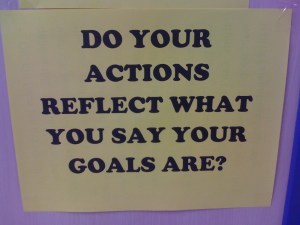
I saw a sign recently at a school that made me stop and think.  So much so that I had to take a picture.

“Do your actions reflect what you say your goals are?”  That’s a great, and very deep question that applies to many areas of our lives.  It also raises so many more questions that I have to ask myself from time to time.  I thought I’d take a minute and share a few with you.

Spiritual: Am I walking daily as Christ calls me to?

Matthew 7:15-20 –  15 “Watch out for false prophets. They come to you in sheep’s clothing, but inwardly they are ferocious wolves. 16By their fruit you will recognize them. Do people pick grapes from thornbushes, or figs from thistles? 17 Likewise, every good tree bears good fruit, but a bad tree bears bad fruit. 18A good tree cannot bear bad fruit, and a bad tree cannot bear good fruit. 19 Every tree that does not bear good fruit is cut down and thrown into the fire. 20 Thus, by their fruit you will recognize them.

This passage always gets me wondering…do people view me as a good tree, or a bad tree?  How does God view my fruit?  After all, he is the chief fruit inspector.  Do my actions always show others I am a Christian?  If a film crew followed me around for a day without me knowing they were watching, would those viewing the tape know I was a Christian from my actions?

Professional: Is my career where I truly want it to be?  If not, what can I do to make my goal a reality?  Am I working toward my dream job/professional goals, or am I endlessly spinning my wheels while claiming that I’m “trying” to reach them? (Thanks Tyler for the heads-up on “trying!”)

Relational: Am I truly doing the things I need to do every day to be a good friend to others?  Am I constantly working to improve my relationship with my wife?  Am I working toward being a better husband? A better friend?  A better co-worker?

Financial:  Am I sticking to my financial plan? Am I managing my money in a way that honors God, provides for my family, and plans for my future?  Am I constantly making frivolous purchases while there are still financial commitments that need to be met?  Am I truly doing all I can to get out of debt and change my family tree?

There are many other topics and questions that I could mention, but I won’t do that here.  I can’t say that I answer all of these questions perfectly all the time, but they are questions that constantly run through my mind to help guide my decisions.  The tricky part isn’t asking the questions, or really answering them.  It’s making adjustments and corrections as needed once the answers have been given.

“Do your actions reflect what you say your goals are?”

What are some of your goals, and how can you change your actions to accomplish them?