Warning! What Is Your Heart Really Telling You?

I have this theory about our hearts.  I think our hearts tend to deceive us when it comes to our true intentions.  When we try to examine the condition of our hearts, I don’t feel that we always get an accurate picture.  I believe that our hearts try to convince us that our intentions and feelings are genuine and noble, but our hearts lie.

 Mark 7:20-22 20 He went on: “What comes out of a person is what defiles them. 21 For it is from within, out of a person’s heart, that evil thoughts come—sexual immorality, theft, murder, 22 adultery, greed, malice, deceit, lewdness, envy, slander, arrogance and folly.

Let me give you an example of what I mean.  All four of the Gospelʼs record the last entry into Jerusalem by Jesus before he was crucified. Iʼm going to use Markʼs account for a reference point.

Mark 11:8-10 8Many people spread their cloaks on the road, while others spread branches they had cut in the fields. 9Those who went ahead and those who followed shouted,

“Hosanna!”

“Blessed is he who comes in the name of the Lord!” 10″Blessed is the coming kingdom of our father David!”

“Hosanna in the highest!”

Now most of us recognize this event in the life of Jesus and have heard it read and referenced time and time again. But today Iʼd like to focus in on just what the people were saying as Jesus rode into Jerusalem on a donkey. Now most of us have heard the word hosanna so many times we couldnʼt even begin to count. We sing it in hymns, read it in the Bible, hear preachers say it and people pray using the word hosanna. But I think most of us wouldnʼt be able to give a very accurate definition of the word if asked.

Hosanna is a Hebrew word that literally means “save, we pray,” and throughout the course of time it became a term of praise as well as a prayerful statement of sorts. But when we put this understanding into the context of what was about to happen in the life of Jesus, we can definitely see a drastic change in the hearts and minds of these people in Jerusalem. Here we see the people shouting “Hosanna! Save, we pray!” Theyʼre acknowledging that Jesus was their savior! They are indicating that he has come to them in the name of the Lord! That he is part of the coming of the kingdom promised through the line of David! And in just a few days they would be persuaded by the Pharisees to cry out to Pilate to have Jesus crucified.

How could these people be so double minded? How could they praise Jesus as the savior and then trample him under foot the next moment? Well, maybe we should ask ourselves. After all, donʼt we basically do the same thing when we profess Jesus as Lord and Savior on Sundays, and live the rest of the week as though he were nobody?

We always have feelings, and most of the time those feelings are influenced by what happens around us.  I am extremely happy or angry and sad when I watch the Dallas Cowboys play…it all depends on their play.  My feelings are influenced by my surroundings.  I think this is true in the case of the citizens of Jerusalem as Jesus entered.  It’s easy to cheer when everyone around you is cheering.    It’s easy to confess Christ when everyone around you is doing the same thing, but when you are all alone, or surrounded by non-believers, it becomes much more difficult…just ask Peter!

I think the true nature of our heart is exposed when we’re alone.  When we’re not surrounded by the cheering crowds, or by the safety of our church family.  It’s how we act when we’re alone…when we’re in the difficult situations, when we’re frustrated, upset, and stressed.  What do our hearts say about us then?

Don’t judge the condition of your own heart when you’re in the middle of the cheering moments, but look at the lonely moments…when you find yourself in a similar situation to Peter.  When everything is going wrong, when we’re scared and alone and we have to make a choice…at that moment can we still cry Hosanna?

Actions

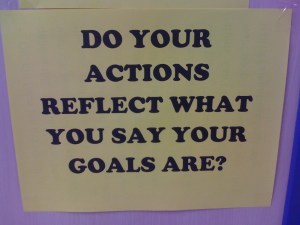
I saw a sign recently at a school that made me stop and think.  So much so that I had to take a picture.

“Do your actions reflect what you say your goals are?”  That’s a great, and very deep question that applies to many areas of our lives.  It also raises so many more questions that I have to ask myself from time to time.  I thought I’d take a minute and share a few with you.

Spiritual: Am I walking daily as Christ calls me to?

Matthew 7:15-20 –  15 “Watch out for false prophets. They come to you in sheep’s clothing, but inwardly they are ferocious wolves. 16By their fruit you will recognize them. Do people pick grapes from thornbushes, or figs from thistles? 17 Likewise, every good tree bears good fruit, but a bad tree bears bad fruit. 18A good tree cannot bear bad fruit, and a bad tree cannot bear good fruit. 19 Every tree that does not bear good fruit is cut down and thrown into the fire. 20 Thus, by their fruit you will recognize them.

This passage always gets me wondering…do people view me as a good tree, or a bad tree?  How does God view my fruit?  After all, he is the chief fruit inspector.  Do my actions always show others I am a Christian?  If a film crew followed me around for a day without me knowing they were watching, would those viewing the tape know I was a Christian from my actions?

Professional: Is my career where I truly want it to be?  If not, what can I do to make my goal a reality?  Am I working toward my dream job/professional goals, or am I endlessly spinning my wheels while claiming that I’m “trying” to reach them? (Thanks Tyler for the heads-up on “trying!”)

Relational: Am I truly doing the things I need to do every day to be a good friend to others?  Am I constantly working to improve my relationship with my wife?  Am I working toward being a better husband? A better friend?  A better co-worker?

Financial:  Am I sticking to my financial plan? Am I managing my money in a way that honors God, provides for my family, and plans for my future?  Am I constantly making frivolous purchases while there are still financial commitments that need to be met?  Am I truly doing all I can to get out of debt and change my family tree?

There are many other topics and questions that I could mention, but I won’t do that here.  I can’t say that I answer all of these questions perfectly all the time, but they are questions that constantly run through my mind to help guide my decisions.  The tricky part isn’t asking the questions, or really answering them.  It’s making adjustments and corrections as needed once the answers have been given.

“Do your actions reflect what you say your goals are?”

What are some of your goals, and how can you change your actions to accomplish them?

Grand Opening

Many people wonder why God doesnʼt send big, visual, miracles our way anymore. They read about people speaking in tongues, miraculous healing, casting out demons, and they wonder why God seems so distant. We read about the empowerment of the Holy Spirit. Why are none of us recipients of the miraculous empowerment of the Holy Spirit? Why isnʼt God allowing his people to perform miracles here and now? Well, we can find out in the book of Hebrews.

Hebrews 2:3b-4 – This salvation, which was first announced by the Lord, was confirmed to us who heard him. God also testified to it by signs, wonders and various miracles, and gifts of the Holy Spirit distributed according to his will.

According to the writer of Hebrews, God used signs, wonders, miracles, and gifts of the Holy Spirit as a way of testifying that his son, Jesus, did in fact bring salvation to those who chose to obey him. The signs were a way for God to indicate to humans that this shift in the way of doing things was divinely orchestrated! Simply put, God was using the empowerment of the Holy Spirit and the miracles kind of like a grand opening at a new store. Letʼs say that a store that has been around for quite a while is purchased by some new owners, and they come in and renovate. Of course they want everyone to know about the changes, so they do this by having a big grand opening where they give away prizes, and do big and very showy things to alert the people of the changes. Now the grand opening doesnʼt last forever, and it doesnʼt need to. Thereʼs no reason for you to have a grand opening several years after the fact because it serves a purpose, and then itʼs no longer needed. The same is true with the empowerment of the Holy Spirit, and miracles in Godʼs church.

These people were so used to the Old Testament way of doing things that when Godʼs people were bought by the blood of Christ, and they were now under new ownership, God wanted to get the message out. He had a grand opening with all kinds of wonderful and very visual miracles, healings and the like that announced to the world once and for all that a new way of doing things was here. Out with the old covenant (or old testament) and in with the new covenant (or new testament)! So what about us today? We donʼt need the grand opening. Instead, we need to be looking forward to the time when the store gets relocated into itʼs permanent location in Heaven. Until then, we are the word of mouth. We are the means by which Godʼs church keeps growing and developing new members.

Scripture taken from the HOLY BIBLE, NEW INTERNATIONAL VERSION®. Copyright © 1973, 1978, 1984 International Bible Society. Used by permission of Zondervan. All rights reserved.

“Casual Christians”

I received an email containing an article that I’d like to share with you.

From the Barna Update 6/15/2009 – “Casual Christians, spiritually middle-of-the-road, perhaps even ambivalent about their faith, represent 66% of the adult U.S. population, according to Barna Research. Pollster George Barna describes this “tribe” as “faith in moderation.” It allows them to feel religious without having to prioritize their faith. Christianity is a low-risk, predictable proposition for this tribe and provides a faith perspective that isn’t demanding. A Casual Christian can be all the things they esteem: a nice human being, a family person, religious, an exemplary citizen, a reliable employee—and never have to publicly defend or represent difficult moral or social positions or even lose much sleep over their private choices, as long as they mean well and generally do their best. From their perspective, their brand of faith practice is genuine, realistic and practical. To them, Casual Christianity is the best of all worlds; it encourages them to be a better person than if they had been irreligious, yet it is not a faith into which they feel compelled to heavily invest themselves.”

I feel that a big reason that churches all across this country are struggling with worship practices, remaining true to the Bible’s teachings, reaching out to their communities, and carrying out mission work oversees is that 66% of all adults in the US are content to be Christians in NAME ONLY!  It’s apathy at its worst!  They say they want X,Y, and Z, yet when it comes around to actually working for it…well, they’re content to just sit back and not “invest themselves.”  John wrote about such a group of Christians in Revelation 3, specifically, the church in Laodicea.  Here’s John writing the words of Jesus:

Revelation 3:15-17 – 15I know your deeds, that you are neither cold nor hot. I wish you were either one or the other! 16So, because you are lukewarm—neither hot nor cold—I am about to spit you out of my mouth. 17You say, ‘I am rich; I have acquired wealth and do not need a thing.’ But you do not realize that you are wretched, pitiful, poor, blind and naked.

1 John 3:16 – This is how we know what love is:  Jesus Christ laid down his life for us.  And we ought to lay down our lives for our brothers.

Does it sound like we’re called to simply be “Casual Christians?” NOT AT ALL!  Churches that are filled with this type of attitude will end up like the church in Laodicea…so despicable to Jesus that we make him want to vomit?  Is that what the church is called to do?  Christians must shake off the “lukewarm” attitude that we’ve developed and once again serve Christ faithfully!  We must be fully committed to Christ!!!!

Scripture taken from the HOLY BIBLE, NEW INTERNATIONAL VERSION®.  Copyright © 1973, 1978, 1984 International Bible Society. Used by permission of  Zondervan. All rights reserved.