
How To Know You’re Interpreting The Bible Correctly.

For the last five weeks we’ve been discussing reading the Bible as story. We’ve discussed Scot McKnight’s description of Scripture where he suggests that there are three “chapters,” or clearly defined sections to the Bible’s overarching story: theocracy (Gen. 1-1 Sam. 8), monarchy (1 Sam. 8 – Mal. 4), and Christocracy (Matthew 1-Rev. 20). It’s important to realize that God’s ultimate goal is to return us back to a theocracy through the redemptive work of Christ, and the final judgement of all people. Seriously, go read the last two chapters of Revelation and you’ll see an image of how God intended our existence to be in the beginning in the Garden.

Today we talk about the concept of Biblical interpretation. In my church heritage there has been a very big emphasis placed on the “plain reading of the Bible.” In other words, “…we don’t interpret the Bible, we simply do what it plainly says.” Lovely idea, but terribly inaccurate. Whether you like it or not, and whether you realize it or not, the Bible is interpreted by everyone.

Don’t believe me? When was the last time your church put an adulterer to death? (Lev. 20:10) Is your clothing made out of a blend of different materials? (Lev. 19:19) Did you greet everyone at worship with a holy kiss? (commanded 4 times in the NT, Rom. 16:16, 1 Cor. 16:20, 2 Cor. 13:12, 1 Thess. 5:26) Did all the men in your assembly lift their hands during every prayer? (1 Tim. 2:8)

If you didn’t do these things, even though a “plain reading” of Scripture clearly shows you should, then you are interpreting Scripture. And you should interpret Scripture! The only question is, “Am I interpreting Scripture properly?”

Bobby Valentine gives us the following suggestions for doing just that:

“Christian hermeneutics will always begin as a response to the God of all grace who has done great things. Christian interpretation will be rooted in the soul that is seeking to reflect God’s glorious image back into the created world around us. Christian biblical interpretation will begin in prayer and will be understood as ‘an act of worship.’ Thus, interpretation that does not begin in prayer and worship and result in the Spirit flowing through us to a vandalized world means we have a right to question if it is a valid hermeneutic or Christian interpretation. Prayer, Worship and reflecting God’s image: these are the beginning points and the ends/goals of interpretation.”

Bobby Valentine

Again the question isn’t if we interpret the Bible. The question is how we interpret. McKnight put sit this way:

“God speaks to us for a reason – I call this ‘missional’ listening. In brief, God tells his story so we can enter into a relationship with him, listen to him, and live out his Word in our day and in our way.”

Scot McKnight, The Blue Parakeet, 2nd Ed., pg. 113

If our interpretation of Scripture doesn’t affect our daily lives, it’s worthless. If our interpretation brings us into a place where we better reflect the image of Christ (Rom. 8:29 – remember we’re living in a Christocracy), then we can be confident in our approach to the Scriptures.

So, how is your interpretation of Scripture reflecting the image of Christ to others in your life?

You Are What You Love – 2018 Blog Tour

Today’s post is part of the 2018 Blog Tour from Thomas Pruett.

I sat across the table with one of my closest friends and mentors, lamenting to him, “Since when did discipleship become only about Bible study?” Later that day, I read this: “You are hungry for knowledge; you thirstily drink up biblical ideas; you long to be Christlike; yet all of that knowledge doesn’t seem to translate into a way of life. It seems we can’t think our way to holiness.”* You’re good, God…

“Would you disciple this person?” I remember asking a mature Christian of a new Christian. “Sure, but I don’t have a lesson plan or a bunch of studies ready,” was the reply. It was a reasonable response, after all, as part of my schooling I was tasked to write a 12-month discipling study; it’s little wonder that many people don’t have that lying around…

“Let’s form a teaching schedule from real-life principles that our teens face, with every lesson geared towards reinforcing that one principle a quarter,” came the cry at the educational curriculum meeting. “But, how do we make sure we teach all of Scripture?” came the earnest, if expected, critique…

“What’d you think of the lesson?” I asked of someone visiting a class taught by one of my favorite in-house Bible teachers. “Fine,” she replied, “but he didn’t use very many verses…” 

For 4 months the fly fishing rod produced no fish but much suffering, yet here in my hand it was again. I had only just learned the (still too thick) line and (way too big) bug to tie on, and so I cast with hope. With barely any knowledge of how or why it would, a hooked trout shook my rod for the first time, and a passion for the sport, nurtured in suffering, was born that continues today. 

In a tradition that emphasizes Bible study as the goal of assembly, a contrast strikes me. Is there value in knowledge and study? Absolutely. But to what end? Often, this leads to assumptions that the more we know, the more God-like we are. Personal experience has taught me that’s vehemently false as a rule. This also assumes humans are mainly thinking beings, and that learning can and will change habits. This is how services and Bible classes are geared, and we lament when those raised to know everything from Scripture fall away. Except we don’t apply this logic to exercise, or on-the-job training, or nutrition, or even fly-fishing. 

Jesus didn’t ask Peter what he knew about Himself in John 21:15, Jesus asked if Peter loved him. Jesus didn’t say in John 14:15 that if you know more about Me you’ll keep My commands, but if you love Me. This isn’t a false dichotomy – what we love is what drives us, motivates us, and orients our life, far more than knowledge alone. We know this because we can know the benefits of exercise all we want, and never do it. We can know that cake is bad for us, and still eat it. And we can know about Jesus without ever truly loving Him. 

What if discipleship was less about learning about Jesus, and more about loving Jesus more? What if church services were less about information and more about transformation? What if our goal was less about making sure the whole Bible is covered and more about covering our whole selves with the love of God seen in Jesus? What if our goal was less a habit of church attendance and more about attending the habits of the church that lead us to be more, or less, like Jesus? What if we spent less time learning about being a Christian, and more time living like Jesus? 

Bible study is essential, no doubt. Should the whole Bible be taught and preached? Absolutely. But knowledge alone isn’t the thing which will keep Christians faithful. Simply knowing about your spouse isn’t what keeps you married. Love: what you love, whom you love, and why you love, is what God is after – that you desire Him above all else, and orient your life to keep Him oriented as your goal. We’re not to know as Christ knew, are to love as Christ loved.

Four months of habitual fishless fly-fishing that finally produced one fish lead to a passion, one that then produced a love to learn more, fish more, and do what was needed to transform into a better fly-fisher. If a tiny little trout could produce that much life-change in the hobbies of a man, where could truly discipling, not just teaching, someone to where they catch the smallest glimmer of true Christ-likeness in themselves lead? Perhaps, just perhaps, it could lead to truly becoming what we love. In one case, an able fly-fisher. I’ll take Christ over a trout every day. 

 * Smith, James K. A.. You Are What You Love: The Spiritual Power of Habit (p. 5). Baker Publishing Group. Kindle Edition. 

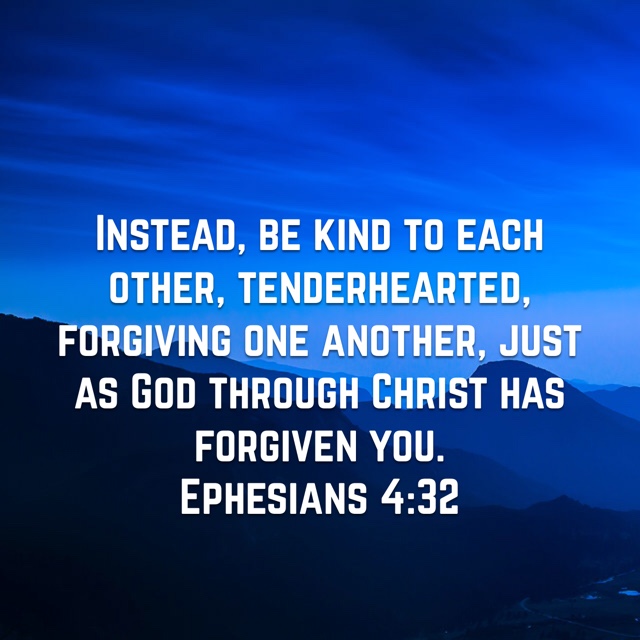
Forgiveness!

Ephesians 4-32

Praise God for his forgiveness! May we be as forgiving toward one another as he is to us!

Beyond the Comfort Zone

In Mark 5 we find Jesus leaving his native area to sail across the lake and go into the gentile region of the Gerasenes. They got out of the boat and immediately were approached by a demon possessed man who had been living in the tombs. In addition to this we’re told that there were large herds of pigs in the area.

Understanding exactly what Jesus is doing here can be missed pretty easily by our 21st century eyes, so let’s get an understanding of the background first. Jews did not want to associate with Gentiles in any way, yet Jesus is leading the twelve into Gentile country. Jews avoided people with unclean spirits, yet Jesus leads them right to a man who’s possessed by a “Legion” of demons. Jews avoided tombs because they felt it was unclean, yet here Jesus leads them right into that area with a man who lived in them. Jews thought pigs were the most unclean animals on the planet, yet Jesus leads his followers right into a heard of them. I think it’s fair to say that the disciples were well outside of their comfort zone during this encounter! And it’s very clear that Jesus wanted them there.

In healing the demon possessed man, Jesus is giving the disciples a preview that the Gospel would be for all people, and their location, ethnicity, history, past or current demons, place of residence, and present state in life truly didn’t matter. The Gospel of Jesus needs to go everywhere, especially the areas that make us feel the most uncomfortable!

Jesus was a true friend to sinners, and spent time with the people and in the places that the current religious leaders wouldn’t think of going. Yet that’s the command we’re given! “Go and make disciples of all nations,…” (Matt. 28:19)  The Greek word for “all nations” is ethnos. Literally every ethnicity, no matter where they are or what they’ve been doing.

So who do you cross paths with in your life that fits this description? Jesus says share the Gospel with them. That’s our job. What becomes of the message? That’s the Spirit’s job. And I trust Him to do powerful things with the powerful message that we weak humans share.

The Worst Advice I’ve Ever Heard About Stress

What is it with stress? Why are we so overwhelmed about stress? Did you know that over 30 million Americans are currently on antidepressants?

We are a stressed out society that thrives on the idea of working yourself to death, being miserable, and wearing it as a badge of honor. And we get absolutely nothing for it! (Click to Tweet)

As a high school band director, 16-18 hour days are more common than not during the school year. During marching season, I put in 82 hours a week for three straight weeks.  Yes, you read that correctly.

Just this week I overheard someone at school say “Feeling stressed is how you know you are working hard enough!”

It’s been a rough year for sure, and the holiday season only adds stress. But last night I sat by my Magnavox Astro-Sonic stereo (I inherited from my great aunt), listened to Christmas music, drank apple cider, felt the warmth of the fire in the fireplace, and watched my daughters play in the glow of the Christmas tree, everything seemed right. I took a deep breath, sat back in my chair, and the stress melted away. While relaxing I heard the words of Jesus playing through my head:

Matthew 6:25-34
25 “That is why I tell you not to worry about everyday life—whether you have enough food and drink, or enough clothes to wear. Isn’t life more than food, and your body more than clothing? 26 Look at the birds. They don’t plant or harvest or store food in barns, for your heavenly Father feeds them. And aren’t you far more valuable to him than they are? 27 Can all your worries add a single moment to your life?

28 “And why worry about your clothing? Look at the lilies of the field and how they grow. They don’t work or make their clothing, 29 yet Solomon in all his glory was not dressed as beautifully as they are. 30 And if God cares so wonderfully for wildflowers that are here today and thrown into the fire tomorrow, he will certainly care for you. Why do you have so little faith?

31 “So don’t worry about these things, saying, ‘What will we eat? What will we drink? What will we wear?’ 32 These things dominate the thoughts of unbelievers, but your heavenly Father already knows all your needs. 33 Seek the Kingdom of God above all else, and live righteously, and he will give you everything you need.

34 “So don’t worry about tomorrow, for tomorrow will bring its own worries. Today’s trouble is enough for today.”

Our lives are so upside down. We spend our days worrying about all kinds of things and neglect our families, our friends, and our Father. Instead, Jesus says focus on the Kingdom, the things that truly matter, and everything else will fall into place. Why do you have so little faith?

Lord, help our unbelief. Help us to trust in you, and to not let the distractions of this world steal the joyful peace that only you can give.

It’s my prayer that we can all rest in Christ, divert our energy and attention into serving Him, and allow everything else to be under the control of God.

Blessings to you and your family!

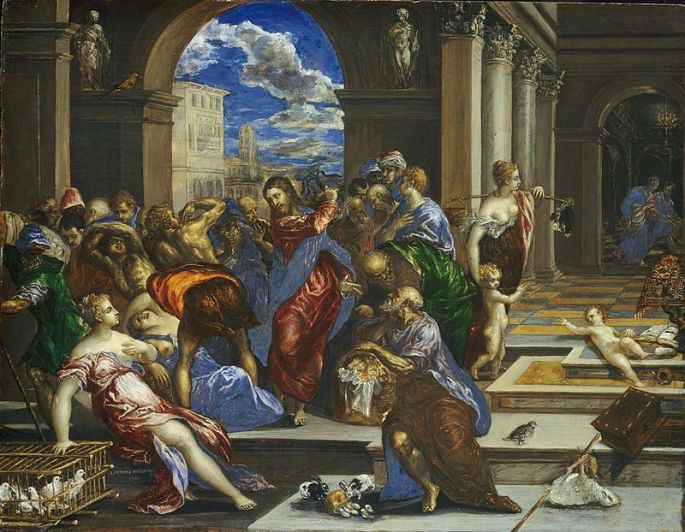
Radical Disrupts Place of Worship

No this isn’t a recent headline from the New York Times. It’s likely what the Jerusalem Daily Gazette would have published the morning after Jesus cleared the Temple.

There is so much we can learn from this passage, but it so rarely gets brought up in churches. Questions about this passage always pop up. “Why would Jesus do such a thing?” or “Doesn’t Jesus love everyone? Why would he cause such a scene in a place of worship?”

There are two accounts of this happening in the Bible. One recorded by Matthew, the other by John. Today we’ll look at John’s account of this event.

John 2:13-17 New Living Translation (NLT)
Jesus Clears the Temple
13 It was nearly time for the Jewish Passover celebration, so Jesus went to Jerusalem. 14 In the Temple area he saw merchants selling cattle, sheep, and doves for sacrifices; he also saw dealers at tables exchanging foreign money.15 Jesus made a whip from some ropes and chased them all out of the Temple. He drove out the sheep and cattle, scattered the money changers’ coins over the floor, and turned over their tables. 16 Then, going over to the people who sold doves, he told them, “Get these things out of here. Stop turning my Father’s house into a marketplace!”
17 Then his disciples remembered this prophecy from the Scriptures: “Passion for God’s house will consume me.”
Holy Bible, New Living Translation, copyright © 1996, 2004, 2015 by Tyndale House Foundation. Used by permission of Tyndale House Publishers Inc., Carol Stream, Illinois 60188. All rights reserved.

When I was growing up, I would hear someone reference this passage the moment a fundraising catalog entered the church building. But that’s just not the context for what Jesus is reacting to here. So if you don’t want to buy that stale popcorn, you may have just lost your scriptural basis for doing so. To fully understand what Jesus was so outraged about, we have to look back into history and take a look at what it took to worship at the temple.

Ever since the temple was rebuilt by Ezra and Nehemiah, it was the national place of worship for all Jewish people. As many as 2.5 million Jews would travel vast distances to worship God in His temple on holy days! And as we all know, there’s always cost involved when traveling.

Besides the cost of travel, a Jew wishing to worship would also have other monetary demands put upon them as they arrived at the temple. The “Temple Tax” offset the cost of maintaining the temple, and was equal to 1 day’s wage. If you were traveling with a foreign currency, you must exchange your money at a rate of 2 days wages. If you brought your own animal to offer as a sacrifice, there was a fee of 1/2 days wage for someone to inspect the animal. If you failed inspection, or couldn’t afford to travel with your animal sacrifice in tow, you could normally purchase doves at the cost of 2 days wage. But in the temple courts prices had been raised to nearly 40 days wages!

If you calculate the cost in modern day figures, it would cost anywhere from $3,000 to $5,000 just to worship at the temple!

These services that Jew’s had set up as a convenience to traveling worshippers had instead become a roadblock preventing the poor from being able to worship God in his temple, all the while lining the pockets of the religious leaders. No wonder Jesus was upset!

It’s stunning to think that something which started out so noble by aiding God’s people in worship turned out to be just the opposite. God’s people lots sight of what they were doing, and what they were causing to happen around them.

Question: What sort of things stand in the way of worshippers today, and what can we do as the Church to remove those obstacles?

Merry Christmas

Merry Christmas! May the peace that surpasses all understanding in Christ be with you and your family!

True Faith

Hebrews 11:1-2 (NIV) – Now faith is being sure of what we hope for and certain of what we do not see. 2This is what the ancients were commended for.

Letʼs break this verse down for a moment. What is faith according to the Hebrew writer? Itʼs being sure! Thatʼs the NIV translation, but other translations render the word as “assurance” or “confidence.” The actual Greek word means “firm trust, steadfastness of mind, firm foundation!” Itʼs not a brief fleeting thought, itʼs not a doubt filled state of mind! Itʼs being sure!

Ok great…sure of what? Once again, according to the Hebrew writer, its being sure of what we hope for. So as a follower of Christ, what do we hope for? We hope for Godʼs promises to be fulfilled…or in other words, we hope for God to do what he says he will do. Now, the word hope here doesnʼt have the same meaning as we often think. Itʼs not a wish like hoping the Texas Rangers actually win the World Series this year…itʼs not that at all!  Strongʼs Greek Definition of the word means “to wait for salvation with joy and full confidence…hopefully to trust in.” Hereʼs the mention of full confidence again! “Being sure of what we hope for” is having a full confidence that God will do what He says He will do! FULL CONFIDENCE!

And let us not forget the last part of verse 1, “certain of what we do not see.” The definition, again from Strongʼs Greek Definitions for the word “certain” is “a proof, that by which a thing is proved or tested…a conviction.” So if I were to paraphrase this verse, using the definitions of the words in Hebrews 11:1-2, to summarize what weʼve just covered, then the definition of faith would be something like this:

“Now faith is being sure and having a firm trust and confidence of the salvation that we hope for, with joy and full confidence, and certain of the proof and conviction in what we do not see!”

Now that doesnʼt leave much room for doubt or being unsure, does it? And letʼs not forget verse 2! “This is what the ancients were commended for.”

So, how does your faith measure up?