
Daily Psalms – Psalm 23

Daily Psalm Reading – Psalm 21-25

Today our meditation is on Psalm 23, perhaps the most famous passage of Scripture, and one that our western experience doesn’t really understand. We don’t live in a shepherding culture, and we certainly don’t live in the landscape of rural Israel. But that’s the context in which this passage speaks most clearly.

We often read this psalm with images of God’s abundant blessings. “I lack nothing” seems to indicate “I have everything I want!” “Green pastures” seems to indicate a feast of epic proportions in belly deep alfalfa hay. But have you ever seen pictures of Israel? Do we really understand what David is writing here?

Keep in mind that Psalms 20-23 are Messianic in nature; they describe the coming (returning) Messiah and how he would live. Did Jesus have all the physical possessions he wanted? Was his a wealthy and luxurious existence? Something seems to be off with our American understanding of this famous psalm.

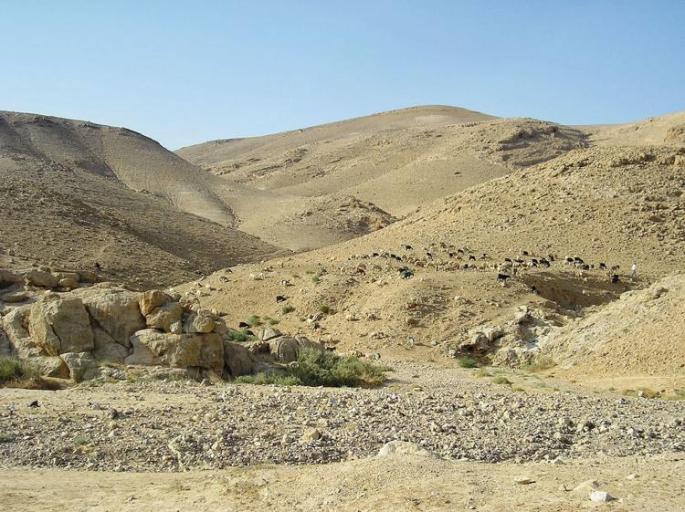
If you look at the picture I have attached to this post, you will see the “green pastures” of Israel. Look closely. Do you see the sheep grazing on the hillside? Can you see the little tufts of green grass on the hillside in the desert? These are the green pastures of David’s world, of Jesus’ world, and of Psalm 23.

In the desert that is very little water and virtually no grass, yet this is where you can raise sheep in Israel. Each night a strong wind from the west blows humid air from the Mediterranean Sea against the hot desert hills and the condensation occurs. Overnight this moisture causes green tufts of grass to sprout that in the morning provide grass for the sheep, but by mid afternoon the sun has scorched everything there. Unless the sheep are in the right place at the right time they will have nothing to eat.

Do you know the most common cause of death in the desert? Drowning. Seriously, I’m not making this up! Though it doesn’t rain in the desert, it pours in the mountains and the mountains cannot absorb the water. These torrential runoffs stream through dry riverbeds (wadi’s) into the desert. Often there is water left over in the bottom of these wadi’s, and that’s the problem. When you attempt to get water out of these wadi’s you leave the rock often get stuck in the miry mud that is left.

People drown like this every year because they see water, their thirst in the desert drives them into these wadi canyons and when 70 feet of floodwater rushes through the canyon at once they cannot get out. Desert people will tell you instead to get your water from springs, also known as “still” or “quiet waters.” In these places there is no danger.

So who knows where the grass will appear in the morning? Who knows the difference between flood waters and quiet waters? The sheep? No, it’s the Shepherd that knows these things. So what does it mean to have Yahweh as your shepherd? And what what might happen if we don’t listen to our Shepherd?

I could write about this psalm all day, but hopefully I’ve provided enough to get you thinking. Here’s a couple of takeaways. First, read this psalm with the cultural and geographical information from above and see what David might be saying. Is he saying we will have everything we want because we follow Yahweh, or is he saying we don’t have to worry because because the Shepherd will always give us just what we need when we need it? The words of Jesus seem to echo here as well!

“Therefore I tell you, do not worry about your life, what you will eat or drink; or about your body or what you will wear. Is not life more than food, and the body more than clothes?…But seek first the kingdom and his righteousness, and all theses things will be given to you as well.”

Matthew 6:25, 33 NIV

Second, if Psalm 23 is Messianic in nature, then read this as if Jesus were speaking. Can you see his story here? And finally, read this in your voice. What does it mean to dwell in the house of Yahweh forever? What does it look like to dwell in his house now?

May Yahweh bless you as you spend time wrestling with his word today. Shalom.

Daily Psalms – Psalm 20

Daily Psalm Reading – Psalm 16-20

(Sunday’s are hard. It’s very tiring on those of us who preach regularly. Saturday nights offer little sleep as God shapes our sermons in our heads. We awake early Sunday and arrive early to pray and seek the voice and wisdom of God. We pour ourselves out and then come home and crash, only to do it all over again. All this to say the tank is pretty empty on Sundays, so don’t expect this to be an overly deep, or lengthy reflection today.)

Today we meditate on Psalm 20 and the promised Messiah. Psalm 20 – 23 focus on David’s seed (the Messiah, Jesus) and his deliverance and rule over the nations. Here we encounter psalms of prophecy that tell us about Jesus.

Verse 6 states: “Now this I know: The LORD gives victory to his anointed.” The Hebrew word for anointed is “messiah.” No matter how upside down this world seems, no matter how chaotic and out of control, victory will be given to our Messiah Jesus!

After the first 5 verses of prayer and blessing over the coming (returning) Messiah, verses 6-9 point us to what the Messiah will do and where we should put our trust. The admonition to not trust in earthly power, but in the name of Yahweh our God is one we need to hear today. In a time where most pray “Our god which art in Washington…” we need to remember our help comes from Yahweh!

I’ll confess it is a struggle not to trust in our own strength. As the psalmist says we want to “trust in chariots and…horses.” The idea of picking ourselves up by our bootstraps isn’t a Biblical one. Rather we are encouraged time and time again to rely on our God, not our own abilities. Trusting in anything other than our God results in failure (v.8).

Today I pray we all learn to trust our God, to believe that our Messiah has been given victory over evil, and will return soon to eliminate it completely. Come Lord Jesus!

To echo the final words of the psalm, “Yahweh, give victory to King Jesus! Answer our prayers!” Shalom.

CLICK HERE TO READ TODAY’s DAILY PSALM READING – PSALM 16-20

Daily Psalms – Psalm 13

Our Psalm reading today is Psalm 11-15.

I was planning on focusing on a different Psalm today, but in light of the tragedy unfolding, I will save that for another time. Today we just need to lament and pray.

Why is there such evil in the world? Why does it seem like wickedness rules? At the time of this writing NBC confirms at least 19 people have been murdered in a mass shooting today in El Paso, TX. Though I seek for answers I know the cause: The sinful nature of humans.

Psalms 11-14 are a series of laments. They ask questions of why evil exists, why wicked people inflict pain upon the innocent, and pleads to Yahweh for salvation. And then Psalm 15 gives us a glimpse of the coming (returning) Messiah Jesus. The reading seems to say “weeping may stay for the night, but rejoicing comes in the morning.”

Yahweh calls us to love him above all else, and love our neighbor as ourselves. Jesus called these the Greatest Commands. And yet our culture says that God is not real, and promotes a culture of violence in television, movies, and video games that glorifies shooting whomever you don’t agree with. Our entertainment is death and destruction, and we wonder why these things happen.

We are not alone in our laments when evil seems to rule. Psalm 13, a psalm of David begs these same questions. “Has Yahweh forgotten us? How long will evil rule?”

Today we mourn great loss. Today we lament great tragedy. We beg Yahweh to move so nothing like this ever has to happen again. But David reminds us that Yahweh has not forgotten us, that he will not forget us, and that salvation is coming.

But I trust in your unfailing love;
    my heart rejoices in your salvation.
 I will sing the Lord’s praise,
    for he has been good to me.

Psalm 13:5-6 NIV

May the God of all comfort heal our broken land. Shalom.

Click here for today’s PSALM READING

Daily Psalms – Psalm 8

Daily Psalm Reading – Psalms 6-10

Today we will spend some time reflecting on Psalm 8, a psalm of David that is closely tied to the narrative of both Job, and the writer of Hebrews (as well as several other passages in Scripture.)

Psalm 8 is the first psalm of praise in the psalter, and comes at the end of a series of Psalms about suffering (Ps. 3-7) that certainly resonate with Job. Yet just like Job, the Psalter brings us into a time of great praise of Yahweh at the end of the suffering, almost as if the suffering itself has allowed us to see God’s glory and majesty in every aspect of creation, and the result is praise!

I think the key to understanding Psalm 8 is verse 4:

“…what is mankind that you are mindful of them, human beings that you care for them?”

Psalm 8:4 NIV

Again, this verse resonates with Job’s questions as well:

“What is mankind that you make so much of them, that you give them so much attention…”

Job 7:17 NIV

When we consider the vastness of creation, the glory of God proclaimed in the heavens, why in the world would God care so much for us?

Verses 5-8 answer the question posed in verse 4 by returning to the Garden of Eden and the mission we are given to co-rule creation with Yahweh (Gen. 1:26-28). David then lists out all the creatures from the days of creation (Gen. 1). God has subjected creation to us! He created us to co-rule creation with him. What an awesome responsibility!

This is the imagery that the writer of Hebrews draws upon, directly quoting verses 4-6, and then makes the following statements:

“In putting everything under them (mankind), God left nothing that is not subject to them. Yet at present we do not see everything subject to them. But we do see Jesus, who was made lower than the angels for a little while, now crowned with glory and honor because he suffered death…the pioneer of our salvation perfect through what he suffered.”

Hebrews 2:8-9, 10 NIV

Psalm 1 gives us a great picture of who the Messiah should be; one who mediates on God’s scripture day and night. Psalm 2 ends by telling us “Blessed are all who take refuge in him (Messianic King).” Then we see a period of suffering in Psalms 3-7, and Psalm 8 celebrates that humanity has all creation subject to them, and the Hebrew writer points that image to Jesus, the firstfruits of the resurrection. We too will ultimately join with Jesus in our resurrection, but at the moment we are still bound by the constraints of our human bodies, and the effects of sin in our lives.

But for now we do have a job. We have responsibility from Yahweh to co-rule creation under the Lordship of our Messiah Jesus, in order to establish his kingdom “on earth as it is in heaven.” Since everything has already been subjected to Jesus (including you and me), we serve at his pleasure. We follow him and him alone! We carry out his mission on earth.

What an awesome responsibility we have! And the only fitting answer to such an awesome responsibility is praise!

“Yahweh, our Lord, how majestic is your name in all the earth!”

Psalm 8:9

Blessings!

DAILY PSALM READING – PSALMS 6-10

Daily Psalms – Psalm 1

I’ve started doing something on Facebook recently that I will now carry over to my blog: A daily Psalm meditation in conjunction with my daily psalm readings. I picked up a practice from N.T. Wright some time back of daily reading the psalms. I read 5 Psalms per day, and begin and end each day by reading and meditating on them. 5 psalms per day X 30 days per month = 150 psalms. Thus, each month (we flex a bit for February) we read through the entire Psalter. Why? I really appreciate Dr. Tim Mackie’s summary of the Psalms:

Psalms: The prayerbook of God’s people who are striving to be faithful to the Torah, and waiting for the Messianic Kingdom.

Dr. Tim Mackie – The Bible Project

“But wait, didn’t the Messianic Kingdom come at Pentecost? After all Jesus has already established his church!” The answer to that is Yes, and No. The kingdom is here, and not yet. While it has been established, we eagerly await his return to destroy evil once and for all, and establish the new Jerusalem where all of God’s people will spend eternity with him (read the end of Revelation if this is new material for you.)

So in a way we are just like those original readers of the Psalter who are awaiting the Messiah to set everything straight, though we have the advantage of knowing our Messiah Jesus and his teachings as we wait for his ultimate return. In addition, the Psalms are what Jesus would have meditated on in his lifetime. These were the worship songs of his day. As a Jewish boy he would have memorized the entire psalter. The words of the Psalms saturated the mind, heart, and life of Jesus. Shouldn’t we seek to have them do the same for us?

Each day I’ll choose one psalm from my daily reading and reflect/meditate on it a bit. My hope is that after 5 months I will have written at least a little reflection on the entire Psalter. Today we will look at Psalm 1. I memorized this psalm in middle school for a competition, and it has never left my memory. Probably my favorite psalm.

In Psalm 1 we have the anonymous psalmist reminding us that it is meditation on the word of Yahweh that leads to life. In contrast, the psalmist looks at the wicked and says they are “like chaff.” If you are unfamiliar with that term, chaff is the little shell that encases a grain of wheat. In the process of harvesting the wheat, the chaff is removed from the grain through a process called “winnowing” where the wheat is thrown into the air which separates the grain from the chaff. The wind blows away the light chaff, but the grain falls back down to the ground and is used.

In other words, the wicked are compared to useless the useless byproduct of wheat that isn’t fit for consumption. They will be “blown away” and destroyed. But those who dwell on the Torah of Yahweh are like a never ending source of nourishment and peace. It’s almost as if the arrangers of the psalter are saying, “Spend time in this book and you will be a blessing to everyone as you yourself are blessed by God in doing so.”

Spend time in Scripture. Spend time in the Psalms. Spend time in the Gospels. Spend time getting the story and the very words of Jesus in your head and your heart. And you will be blessed, and be a blessing, in doing so. Grace and Peace.

Click here for today’s reading of Psalms 1-5

The Church and Politics: What We Haven’t Learned

As we explore how the history of the Church affects the practice of the Church today, we need to take a look at culture. No congregation is immune from cultural influence, and indeed it needs to be influenced to some degree in order to reach the lost. But at various times in the history of the Church, culture has ruled the day. I frequently tell people when politics and Church combine, the Church always suffers. This is the case with the examples contained in this article.

In 1054 AD an event historians refer to as “The Great Schism” occurred in Constantinople, forever changing the Church, and creating a wound that took until the 20th century to begin to heal. The “West” division of the church, based in Rome, began to be viewed as the seat of power in the Church. This political position, in many ways, led to the Roman Church passing edicts that affected the church as a whole. For the purposes of this writing we don’t need to dive too deeply into specifics, but many of these were received negatively by the East from a cultural standpoint.

In the book Turning Points: Decisive Moments in the History of Christianity, Mark Noll summarizes the cultural divide between the East and West.

“As early as the end of the first century, it was possible to perceive pointed differences between major representatives of what would one day be called West and East. Thus, historian Henry Bettenson thinks that the Epistle of Clement sent from Rome to Corinth about the year 96 displays ‘the emergence of the characteristic Roman Christianity. Here we find no ecstasies, no miraculous ‘gifts of the Spirit,’ no demonology, no preoccupation with an imminent ‘Second Coming.’ The Church has settled down in the world, and is going about its task ‘soberly, discreetly, and advisedly.” By the end of the second century, such ‘Roman’ characteristics were thoroughly matched by ‘Greek’ tendencies arising from the other end of the Mediterranean.”

Turning Points: Decisive Moments in the History of Christianity, Mark Noll

As you can clearly see, cultural differences influenced the beliefs and practice within the two branches of the Christian Church. At this meeting in 1054 representatives from both groups excommunicated the other which lead to the body of Christ, the Church, being divided. This was exacerbated by the Crusades which indiscriminately killed Muslims, Jews, and even other Christians because they looked different than the invading Europeans. European Christians were killing Middle Eastern Christians because they looked and sounded different.

Sadly this was not the only time in Church history that we see cultural differences affecting the unity of the Church. We’ll return to history next week, but I want to end with a modern look. What cultural issues are causing division in the church today? We are on the heels of one of the largest denominations wrestling with homosexuality in part because culture has become combined with the Church.

But let’s get personal. What cultural issue is in play in your congregation that is, or could cause division? Is it who someone votes for? Is it cultural stereotypes placed on people groups? And here’s the real question: How do you go about addressing the problem?

What is the Best Way to Read the Bible?

Last week we looked at examples from the New Testament of people coming together in community to study the Scriptures. We also looked at the first few centuries after the New Testament to see the council at Nicea surrounding the deity of Christ. Christians came together around the Scriptures in order to clarify beliefs and put an end to false teaching. This council resulted in what we commonly call The Nicene Creed.

This community study of the Scriptures happened on many other occasions as well. As the years passed, again the Church saw need of solidifying doctrine amongst all believers. The decision was made to collect the writings held highly by the community and combine them into an authoritative collection. There was some debate concerning some of the writings we have today in our New Testament, and some differences still exist today (does your Bible contain the Apocrypha?) But when the Church came together in community, the most trusted writings were compiled to solidify the documents of our faith – the New Testament.

We are so used to having our sacred writings in one book. Can you imagine going through life and having to search from city to city to find a copy of John’s Gospel? The fact that you own a Bible, or have access to a Bible online, or in app form is because 1600 years ago the Church, the Body of Christ, came together in community in order to compile (not create) the writings we know and love.

Today, we must take the same approach toward interpreting Scripture. Renowned theologian, seminary professor, and author Scot McKnight has a suggestion for how we are to read and interpret Scripture today in his book, The Blue Parakeet. In this quote, he speaks of the “Great Tradition,” that is the understanding of the historical Christian community.

“I suggest we learn to read the Bible with the Great Tradition. We dare not ignore what God has said to the church through the ages (as the return and retrieval folks often do), nor dare we fossilize past interpretations into traditionalism. Instead, we need to go back to the Bible so we can move forward through the church and speak God’s Word in our days in our ways. We need to go back without getting stuck (the return problem), and we need to move forward without fossilizing our ideas (traditionalism). We want to walk between these two approaches. It’s not easy, but I contend that the best of the evangelical approaches to the Bible and the best way of living the Bible today is to walk between these approaches.”

Scot McKnight, The Blue Parakeet

The history of the church shows that Scripture has been best interpreted in community. When believers come together and wrestle with the Scriptures to find truth, error is avoided, God is honored, and Scripture is upheld and interpreted in a relevant way. As history and the New Testament has shown us, it is the best way.

We Must Take This More Seriously!

I just sat on my couch in Snyder, TX, USA and watched a live (and powerful) sermon streamed over YouTube from Australia. I got to watch and hear the same message preached that my brothers and sisters in Christ are hearing on the other side of the world at the same time they were hearing it. What a time we live in that the Word of God can be transmitted in such a way.

And yet it worries me that we don’t take the Word of God as seriously as we should. We have more opportunity to interact with the Word than any other time in human history. Our access to Scripture is unprecedented, the resources we have to study Scripture and access to quality teaching us seemingly unending. And I think therein lies the problem.

Can you imagine living in a world where every sermon you ever heard was in a language you didn’t understand? And there was no copy of the Bible in your own language? I’m reading a biography on William Tyndale and it’s reminding me of the immense blessing God has given us through having the Bible in our own native language. Tyndale died because he dared to translate the Bible into English, and yet we often find it a bother to carry a Bible around. It’s “inconvenient.”

Can you imagine for the first time in your life hearing these words in your own language for the first time:

“For God so loved the world that he hath given his only son that none that believe in him should perish, but should have everlasting life.” (Tyndale New Testament)

Friends, don’t ever let interacting with the Word of God become routine. Don’t ever let it become so “common” that we don’t take it seriously. About 10 hours from now I’ll gather with brothers and sisters and we’ll open God’s Word once again. I pray you do the same, wherever you are, whatever is going on in your life. I pray you stop and open God’s Word again with the same excitement and passion as if you were hearing it for the very first time. Because for some of you reading this, the Word just might come alive as though it were the very first time.

May God bless you as you gather with the saints and as you dwell in His Word.

Follow Me

Our final Gospel reading for the year comes from the end of John’s Gospel, chapters 20 & 21. I have always loved the personal touches John includes in this section, including the fact that he was a faster runner than Peter (20:4).

One of the interesting debates surrounding this portion of Scripture has to do with the occasion of the writing of chapter 21. It certainly appears that 20:30-31 is the ending of the Gospel. And yet there’s chapter 21. I could bore you with all of the scholarly arguments back and forth, but the truth of the matter is that all early manuscripts of John contain chapter 21. What does this mean? Chapter 21 was written by John as well. It appears that John completed his Gospel with chapter 20, and was then moved by the Spirit to include one more episode in the life of Jesus, likely for the reason given in 21:22-23. It’s an important story with a message we need today!

If you remember in John 18, we see Peter deny Christ three times around a charcoal fire (see 18:18). This so devastated Peter that it appears he had given up on his ability to follow Christ and had returned to fishing (21:3). Jesus performs yet another fishing miracle among them, a clear signal to Peter about who was talking to him, and the disciples come to shore where they find Jesus cooking breakfast, once again around a charcoal fire (21:9). In a way, Jesus has once again placed Peter at a charcoal fire in an effort to give him another chance. Three times Jesus asks Peter to confirm his love for the Savior. Each time Peter does, and each time Jesus invites Peter to feed his sheep, an expression basically telling Peter to act like the pastor he has been called to be. But Jesus also gives Peter an ominous prediction.

Jesus said, “Feed my sheep. I tell you the truth, when you were younger you dressed yourself and went where you wanted; but when you are old you will stretch out your hands, and someone else will dress you and lead you where you do not want to go.” Jesus said this to indicate the kind of death by which Peter would glorify God. Then he said to him, “Follow me!” – John 21:17-19

Did you notice what just happened? Peter returned to Christ. He has been reinstated, and called to shepherd the flock of believers. As Jesus is calling Peter he basically tells him that the pain and suffering he himself had just endured would also be endured by Peter. It’s almost as if he’s saying, “Peter, you too will be crucified. Now follow me.” And the shocking thing is Peter did. Peter followed him! And in case you are wondering, church history tells us that Peter was crucified, but differently than Jesus. Peter claimed he was unworthy to die in the same manner as his Lord, so Peter was crucified hanging upside down from the cross.

Jesus calls us to deny ourselves and follow him. He calls us to die to ourselves and follow him. He calls us to give up everything, including our own lives to follow him. It’s radical. It’s extreme. It’s Jesus. My question is this: What is Jesus calling you to do that you have not done? Is he calling you to change something in your life? Is he calling you to share the Gospel with a friend? What is he calling you to do that you haven’t done?  Just like Peter, if you have denied him or ignored his call, it’s not to late. He will welcome you back, with open arms. But the call remains: Follow me!

What Jesus Knew and When

The Gospel reading for this week is John chapters 18 & 19. We have one more week to go before we have completed 50 weeks of study on the life and ministry of Jesus. Today we focus on his crucifixion.

John reminds us of several key points as we read his account. Jesus is in complete control the entire time he goes through being arrested, his trials, and his death. Even his surrender to the authorities shows his power (18:6). He is fully aware that all this was happening to fulfill prophecy (18:9). Jesus also knew what he was facing. He predicted the betrayal of Judas (13:21), the denial by Peter (13:38), the manner of his death (12:32-33), and his resurrection (2:21-22).

John also includes a detailed listing of everything that Jesus suffered during this time. He was bound (18:12), he was put on trial in the middle of the night (18:13), he was interrogated (18:19), he was struck in the face (18:22), they kept him awake all night (18:28), they called him a criminal (18:30), they detained him and released Barabbas as well (18:40). They flogged him (19:1), the crowned him with thorns and put a purple robe on his shredded back (19:2), they mocked him and struck him again in the face (19:3), they forced him to carry his cross (19:17), they crucified him (19:18), they killed him (19:30), and they pierced his side with a spear (19:34).

Now, put yourself in Jesus’ shoes. If you knew what was coming, would you have gone through this? Knowing everything that was about to unfold, would you have allowed yourself to be treated this way by the very creation that you yourself created? (John 1:1-3) Would you have deemed the human race worthy of saving? Would you willingly humble yourself so much and allow your creation to pummel the life out of your earthly body all the while you have the power to wipe out all creation and start over with just a word?

Jesus did.

Jesus felt you and I were worth the unbearable pain and agony of the cross. If that doesn’t move you to follow him, I don’t know what will. The Creator of all things gave up everything for you. How will you live in light of that? How will you serve him knowing his servant heart through this process? That is the Christian life in a nutshell. We live each day seeking to serve him because of what he did for us on that cross.

As we enter the Christmas celebrations, keep in mind that he willingly came into this world. But that’s not the end of the story. The story of the cross is key to understanding why we follow him. But we must also remember that the story didn’t end at the cross. It continues each day in the lives of his followers until the day he returns. How will you live in light of that?