
Daily Psalms – Psalm 23

Daily Psalm Reading – Psalm 21-25

Today our meditation is on Psalm 23, perhaps the most famous passage of Scripture, and one that our western experience doesn’t really understand. We don’t live in a shepherding culture, and we certainly don’t live in the landscape of rural Israel. But that’s the context in which this passage speaks most clearly.

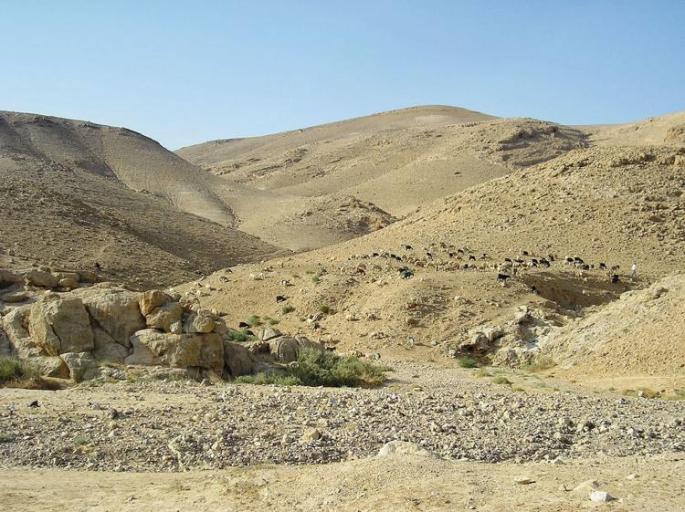
We often read this psalm with images of God’s abundant blessings. “I lack nothing” seems to indicate “I have everything I want!” “Green pastures” seems to indicate a feast of epic proportions in belly deep alfalfa hay. But have you ever seen pictures of Israel? Do we really understand what David is writing here?

Keep in mind that Psalms 20-23 are Messianic in nature; they describe the coming (returning) Messiah and how he would live. Did Jesus have all the physical possessions he wanted? Was his a wealthy and luxurious existence? Something seems to be off with our American understanding of this famous psalm.

If you look at the picture I have attached to this post, you will see the “green pastures” of Israel. Look closely. Do you see the sheep grazing on the hillside? Can you see the little tufts of green grass on the hillside in the desert? These are the green pastures of David’s world, of Jesus’ world, and of Psalm 23.

In the desert that is very little water and virtually no grass, yet this is where you can raise sheep in Israel. Each night a strong wind from the west blows humid air from the Mediterranean Sea against the hot desert hills and the condensation occurs. Overnight this moisture causes green tufts of grass to sprout that in the morning provide grass for the sheep, but by mid afternoon the sun has scorched everything there. Unless the sheep are in the right place at the right time they will have nothing to eat.

Do you know the most common cause of death in the desert? Drowning. Seriously, I’m not making this up! Though it doesn’t rain in the desert, it pours in the mountains and the mountains cannot absorb the water. These torrential runoffs stream through dry riverbeds (wadi’s) into the desert. Often there is water left over in the bottom of these wadi’s, and that’s the problem. When you attempt to get water out of these wadi’s you leave the rock often get stuck in the miry mud that is left.

People drown like this every year because they see water, their thirst in the desert drives them into these wadi canyons and when 70 feet of floodwater rushes through the canyon at once they cannot get out. Desert people will tell you instead to get your water from springs, also known as “still” or “quiet waters.” In these places there is no danger.

So who knows where the grass will appear in the morning? Who knows the difference between flood waters and quiet waters? The sheep? No, it’s the Shepherd that knows these things. So what does it mean to have Yahweh as your shepherd? And what what might happen if we don’t listen to our Shepherd?

I could write about this psalm all day, but hopefully I’ve provided enough to get you thinking. Here’s a couple of takeaways. First, read this psalm with the cultural and geographical information from above and see what David might be saying. Is he saying we will have everything we want because we follow Yahweh, or is he saying we don’t have to worry because because the Shepherd will always give us just what we need when we need it? The words of Jesus seem to echo here as well!

“Therefore I tell you, do not worry about your life, what you will eat or drink; or about your body or what you will wear. Is not life more than food, and the body more than clothes?…But seek first the kingdom and his righteousness, and all theses things will be given to you as well.”

Matthew 6:25, 33 NIV

Second, if Psalm 23 is Messianic in nature, then read this as if Jesus were speaking. Can you see his story here? And finally, read this in your voice. What does it mean to dwell in the house of Yahweh forever? What does it look like to dwell in his house now?

May Yahweh bless you as you spend time wrestling with his word today. Shalom.

Daily Psalms – Psalm 20

Daily Psalm Reading – Psalm 16-20

(Sunday’s are hard. It’s very tiring on those of us who preach regularly. Saturday nights offer little sleep as God shapes our sermons in our heads. We awake early Sunday and arrive early to pray and seek the voice and wisdom of God. We pour ourselves out and then come home and crash, only to do it all over again. All this to say the tank is pretty empty on Sundays, so don’t expect this to be an overly deep, or lengthy reflection today.)

Today we meditate on Psalm 20 and the promised Messiah. Psalm 20 – 23 focus on David’s seed (the Messiah, Jesus) and his deliverance and rule over the nations. Here we encounter psalms of prophecy that tell us about Jesus.

Verse 6 states: “Now this I know: The LORD gives victory to his anointed.” The Hebrew word for anointed is “messiah.” No matter how upside down this world seems, no matter how chaotic and out of control, victory will be given to our Messiah Jesus!

After the first 5 verses of prayer and blessing over the coming (returning) Messiah, verses 6-9 point us to what the Messiah will do and where we should put our trust. The admonition to not trust in earthly power, but in the name of Yahweh our God is one we need to hear today. In a time where most pray “Our god which art in Washington…” we need to remember our help comes from Yahweh!

I’ll confess it is a struggle not to trust in our own strength. As the psalmist says we want to “trust in chariots and…horses.” The idea of picking ourselves up by our bootstraps isn’t a Biblical one. Rather we are encouraged time and time again to rely on our God, not our own abilities. Trusting in anything other than our God results in failure (v.8).

Today I pray we all learn to trust our God, to believe that our Messiah has been given victory over evil, and will return soon to eliminate it completely. Come Lord Jesus!

To echo the final words of the psalm, “Yahweh, give victory to King Jesus! Answer our prayers!” Shalom.

CLICK HERE TO READ TODAY’s DAILY PSALM READING – PSALM 16-20

Daily Psalms – Psalm 13

Our Psalm reading today is Psalm 11-15.

I was planning on focusing on a different Psalm today, but in light of the tragedy unfolding, I will save that for another time. Today we just need to lament and pray.

Why is there such evil in the world? Why does it seem like wickedness rules? At the time of this writing NBC confirms at least 19 people have been murdered in a mass shooting today in El Paso, TX. Though I seek for answers I know the cause: The sinful nature of humans.

Psalms 11-14 are a series of laments. They ask questions of why evil exists, why wicked people inflict pain upon the innocent, and pleads to Yahweh for salvation. And then Psalm 15 gives us a glimpse of the coming (returning) Messiah Jesus. The reading seems to say “weeping may stay for the night, but rejoicing comes in the morning.”

Yahweh calls us to love him above all else, and love our neighbor as ourselves. Jesus called these the Greatest Commands. And yet our culture says that God is not real, and promotes a culture of violence in television, movies, and video games that glorifies shooting whomever you don’t agree with. Our entertainment is death and destruction, and we wonder why these things happen.

We are not alone in our laments when evil seems to rule. Psalm 13, a psalm of David begs these same questions. “Has Yahweh forgotten us? How long will evil rule?”

Today we mourn great loss. Today we lament great tragedy. We beg Yahweh to move so nothing like this ever has to happen again. But David reminds us that Yahweh has not forgotten us, that he will not forget us, and that salvation is coming.

But I trust in your unfailing love;
    my heart rejoices in your salvation.
 I will sing the Lord’s praise,
    for he has been good to me.

Psalm 13:5-6 NIV

May the God of all comfort heal our broken land. Shalom.

Click here for today’s PSALM READING

Daily Psalms – Psalm 8

Daily Psalm Reading – Psalms 6-10

Today we will spend some time reflecting on Psalm 8, a psalm of David that is closely tied to the narrative of both Job, and the writer of Hebrews (as well as several other passages in Scripture.)

Psalm 8 is the first psalm of praise in the psalter, and comes at the end of a series of Psalms about suffering (Ps. 3-7) that certainly resonate with Job. Yet just like Job, the Psalter brings us into a time of great praise of Yahweh at the end of the suffering, almost as if the suffering itself has allowed us to see God’s glory and majesty in every aspect of creation, and the result is praise!

I think the key to understanding Psalm 8 is verse 4:

“…what is mankind that you are mindful of them, human beings that you care for them?”

Psalm 8:4 NIV

Again, this verse resonates with Job’s questions as well:

“What is mankind that you make so much of them, that you give them so much attention…”

Job 7:17 NIV

When we consider the vastness of creation, the glory of God proclaimed in the heavens, why in the world would God care so much for us?

Verses 5-8 answer the question posed in verse 4 by returning to the Garden of Eden and the mission we are given to co-rule creation with Yahweh (Gen. 1:26-28). David then lists out all the creatures from the days of creation (Gen. 1). God has subjected creation to us! He created us to co-rule creation with him. What an awesome responsibility!

This is the imagery that the writer of Hebrews draws upon, directly quoting verses 4-6, and then makes the following statements:

“In putting everything under them (mankind), God left nothing that is not subject to them. Yet at present we do not see everything subject to them. But we do see Jesus, who was made lower than the angels for a little while, now crowned with glory and honor because he suffered death…the pioneer of our salvation perfect through what he suffered.”

Hebrews 2:8-9, 10 NIV

Psalm 1 gives us a great picture of who the Messiah should be; one who mediates on God’s scripture day and night. Psalm 2 ends by telling us “Blessed are all who take refuge in him (Messianic King).” Then we see a period of suffering in Psalms 3-7, and Psalm 8 celebrates that humanity has all creation subject to them, and the Hebrew writer points that image to Jesus, the firstfruits of the resurrection. We too will ultimately join with Jesus in our resurrection, but at the moment we are still bound by the constraints of our human bodies, and the effects of sin in our lives.

But for now we do have a job. We have responsibility from Yahweh to co-rule creation under the Lordship of our Messiah Jesus, in order to establish his kingdom “on earth as it is in heaven.” Since everything has already been subjected to Jesus (including you and me), we serve at his pleasure. We follow him and him alone! We carry out his mission on earth.

What an awesome responsibility we have! And the only fitting answer to such an awesome responsibility is praise!

“Yahweh, our Lord, how majestic is your name in all the earth!”

Psalm 8:9

Blessings!

DAILY PSALM READING – PSALMS 6-10

Jesus and the Female Disciples – Part 2

Today we continue our look at the female disciples that Luke mentions throughout his Gospel. Their introduction in the opening verses of chapter 8 leads to a thread throughout Luke’s story of the “others,” or the “rest” of those that followed Jesus. Luke makes it clear that his story isn’t one of Jesus and the 12. It is also a story of the “others.”

As Luke’s narrative unfolds, we find Jesus arrested and on trial after being betrayed by Judas. At this point the 12 disappear from the story, except for Peter. Peter follows Jesus through part of the trial, but ultimately denies his relationship with Jesus three times, then disappears from the narrative until after the resurrection. Luke does focus on a particular group throughout the crucifixion and resurrection: the women. 

“A large number of people followed him, including women who mourned and wailed for him.”

Luke 23:27 NIV

After Jesus breathes his last, and the centurion confesses Jesus’ righteousness, we are told that many of the witnesses of the crucifixion leave, except for some who stayed.

“But all those who knew him, including the women who had followed him from Galilee, stood at a distance, watching these things.”

Luke 23:49 NIV

“The women who had come with Jesus from Galilee followed Joseph and saw the tomb and how his body was laid in it. Then they went home and prepared spices and perfume.”

Luke 23:55-56 NIV

“On the first day of the week, very early in the morning, the women took the spices they had prepared and went to the tomb.”

Luke 24:1 NIV

“When they (women) came back from the tomb they told all these things to the Eleven and to all the others. It was Mary Magdalene, Joanna, Mary the mother of James, and the others with them who told this to the apostles.”

Luke 24:9-10 NIV

“While they were still talking about this, Jesus himself stood among them and said to them, “Peace be with you.”

Luke 24:36 NIV

So who were the first preachers of the resurrection? The women. Who did they tell? The Eleven and “the others,” both male and female.  And who does Jesus appear to and commission after the resurrection? All of them! (And in case you are unsure of this, go to Acts 1:13-15 to see this continue.)

Luke makes it very clear. The commission to preach this news starting in Jerusalem (Lk. 24:47-48, Acts 1:8) is the responsibility of the Eleven, the women, and the others, as we’ve already seen them do! This commission by Jesus has not been retracted. Next week we’ll see how Luke carries this commission into the mission of the early church in Acts 1 & 2.

Jesus and the Female Disciples

Today we continue our look at Luke’s gospel and some of the women he includes in his story about Jesus. Luke has a major focus on the role of women in the ministry of Jesus and this week we look at some of the female disciples and supporters of Jesus’ ministry.

Luke 8:1-3 tells us about “many” single and married women who not only traveled with Jesus, but supported his ministry financially. These women are not the twelve, but they are disciples and benefactors nonetheless. Benefactors (financial supporters) in the ancient world would financially support an effort they supported, but that did not mean they would physically participate in that effort. These women are not simply benefactors, they are disciples traveling with Jesus, involved physically in his ministry, and learning to be just like the Messiah. A disciple would eventually go on to have their own students and teach in a way similar to their own teacher.

The fact that Luke tells us of Jesus and these women as disciples, a very unusual practice in the ancient world, tells us something about Jesus. Their presence in support and practice of Jesus’ ministry shows that Jesus wasn’t constrained by, nor concerned with cultural ideas about the roles of women. Culture considered them property to be kept in the home, but Jesus included them as disciples, ones who could travel along side, support, and assist in his ministry.

This detail sets up the often misunderstood story of Mary and Martha at the end of Luke 10. Many tell this story as a lesson on priorities; Jesus is more important than housework. While this is true, it misses the context of what Luke is telling us about Jesus. Luke always gives a female counterpart to the males in his gospel, showing that following Jesus and serving in the Kingdom is not a job relegated to men. Luke gives us Elizabeth and Zechariah, Mary and Joseph, Simeon and Anna, the widow of Zarephath and Naaman (ch. 4), the centurion and the widow (ch. 7), the widow with the coins and the shepherd (ch. 15). Here in chapter 8 and chapter 10 we see the female complement to the male disciples.

Luke tells us that Mary “sat at the Lord’s feet listening to what he said” (10:39). In doing so, Mary is taking up the role of a disciple, something a male would do in that culture. She is breaking a cultural rule (that many other women from ch. 8 did as well). Martha wants Jesus to rebuke Mary, but Jesus affirms that “Mary has chosen what is better, and it will not be taken away from her.” (10:42)

This story goes with the preceding story of the good Samaritan, and is an example of the Greatest Commands lived out. The Samaritan is the hero of the first story, and a female disciple is the hero of the second story. These are two upside down images of obeying the Greatest Commands in a culture that valued neither of these heroes. Luke is clearly portraying Jesus as being against the rules and boundaries of the culture in which they lived. The Kingdom of Heaven doesn’t follow societal norms, it follows Jesus. These stories also call us to radically break with tradition and culture, disregard all else, and follow the example of Jesus. In Luke’s Gospel, the teachings and actions of Jesus remind us that the Kingdom of Heaven is a place where Jews and Samaritans, as well as men and women can serve as equals. (See Gal. 3:28)

What is the Best Way to Read the Bible?

Last week we looked at examples from the New Testament of people coming together in community to study the Scriptures. We also looked at the first few centuries after the New Testament to see the council at Nicea surrounding the deity of Christ. Christians came together around the Scriptures in order to clarify beliefs and put an end to false teaching. This council resulted in what we commonly call The Nicene Creed.

This community study of the Scriptures happened on many other occasions as well. As the years passed, again the Church saw need of solidifying doctrine amongst all believers. The decision was made to collect the writings held highly by the community and combine them into an authoritative collection. There was some debate concerning some of the writings we have today in our New Testament, and some differences still exist today (does your Bible contain the Apocrypha?) But when the Church came together in community, the most trusted writings were compiled to solidify the documents of our faith – the New Testament.

We are so used to having our sacred writings in one book. Can you imagine going through life and having to search from city to city to find a copy of John’s Gospel? The fact that you own a Bible, or have access to a Bible online, or in app form is because 1600 years ago the Church, the Body of Christ, came together in community in order to compile (not create) the writings we know and love.

Today, we must take the same approach toward interpreting Scripture. Renowned theologian, seminary professor, and author Scot McKnight has a suggestion for how we are to read and interpret Scripture today in his book, The Blue Parakeet. In this quote, he speaks of the “Great Tradition,” that is the understanding of the historical Christian community.

“I suggest we learn to read the Bible with the Great Tradition. We dare not ignore what God has said to the church through the ages (as the return and retrieval folks often do), nor dare we fossilize past interpretations into traditionalism. Instead, we need to go back to the Bible so we can move forward through the church and speak God’s Word in our days in our ways. We need to go back without getting stuck (the return problem), and we need to move forward without fossilizing our ideas (traditionalism). We want to walk between these two approaches. It’s not easy, but I contend that the best of the evangelical approaches to the Bible and the best way of living the Bible today is to walk between these approaches.”

Scot McKnight, The Blue Parakeet

The history of the church shows that Scripture has been best interpreted in community. When believers come together and wrestle with the Scriptures to find truth, error is avoided, God is honored, and Scripture is upheld and interpreted in a relevant way. As history and the New Testament has shown us, it is the best way.

We Must Take This More Seriously!

I just sat on my couch in Snyder, TX, USA and watched a live (and powerful) sermon streamed over YouTube from Australia. I got to watch and hear the same message preached that my brothers and sisters in Christ are hearing on the other side of the world at the same time they were hearing it. What a time we live in that the Word of God can be transmitted in such a way.

And yet it worries me that we don’t take the Word of God as seriously as we should. We have more opportunity to interact with the Word than any other time in human history. Our access to Scripture is unprecedented, the resources we have to study Scripture and access to quality teaching us seemingly unending. And I think therein lies the problem.

Can you imagine living in a world where every sermon you ever heard was in a language you didn’t understand? And there was no copy of the Bible in your own language? I’m reading a biography on William Tyndale and it’s reminding me of the immense blessing God has given us through having the Bible in our own native language. Tyndale died because he dared to translate the Bible into English, and yet we often find it a bother to carry a Bible around. It’s “inconvenient.”

Can you imagine for the first time in your life hearing these words in your own language for the first time:

“For God so loved the world that he hath given his only son that none that believe in him should perish, but should have everlasting life.” (Tyndale New Testament)

Friends, don’t ever let interacting with the Word of God become routine. Don’t ever let it become so “common” that we don’t take it seriously. About 10 hours from now I’ll gather with brothers and sisters and we’ll open God’s Word once again. I pray you do the same, wherever you are, whatever is going on in your life. I pray you stop and open God’s Word again with the same excitement and passion as if you were hearing it for the very first time. Because for some of you reading this, the Word just might come alive as though it were the very first time.

May God bless you as you gather with the saints and as you dwell in His Word.

Will We Learn From Our Past?

Paul’s admonition to Timothy is to correctly handle the Scriptures. Does any true follower of Christ seek to do otherwise? I’m sure we can find spurious people that misuse Scripture for ulterior motives. Yet Paul needs to caution Timothy about handling the Word. Surely this caution would extend to us, and we have more need of concern.  Timothy saw Paul’s ministry firsthand, and thoroughly understood the culture in which the New Testament was written, and Paul still feels the need to caution him in the correct handling of God’s Word. What are we to do when it comes to the handling of Scripture? This is where a basic understanding of church history comes into play.

The community of believers in Christ has always worked together to study and interpret the Scriptures, and this community approach is still needed today. From the time of Paul we see the Bereans working together to compare the truth of Scripture with Paul’s message (Acts 17:11), or the need in Philippi for the members to be of the same mind (Phil. 4:1-3). We also see the leaders of the church come together in community to discuss how to apply Scripture to these new Gentile converts (Acts 15). There are many other examples of the church coming together in community to interpret the Scriptures in the pages of the New Testament alone, but what about after the first century? Should Christians continue to read and understand Scripture in community? Absolutely! And many of the beliefs you hold today are a direct result of this process.

Most Christians understand that our New Testament was written in the first century AD. What we often forget is that the New Testament didn’t exist in a leather bound, easy to carry book for all believers to read. Many Christians went their entire lives never having the opportunity to read the New Testament. How could they ever live the Christian life without a personal copy of the Scriptures? Community! Believers came together and summarized the teachings of the apostles in the second century with the Old Roman Creed, which eventually became known as The Apostles Creed. While it is not a complete retelling of the New Testament, it does summarize many of the facts of Bible in a format that believers could memorize and discuss.

These discussions eventually raised some questions concerning the deity of Jesus. What did it mean to be “the Son of God,” or the “Word,” or “one with the Father?” Has Jesus existed for all eternity like the Father, or was he created first before all things? In 325 AD, over two hundred Church leaders gathered in the town of Nicaea to sort these matters out. Like the Bereans two centuries before, they searched the Scriptures in community to give language to the deity of Christ. The core Christian belief today that Jesus was “fully God and fully man,” or as The Nicene Creed states “true God from true God…became human,” came out of this meeting.  With Christians coming together in community to interpret the Scriptures, major questions were answered, heresies were silenced, and Scripture was upheld.

We’ll continue to look at other examples from Church History next week, but today I want to leave you with a question: What’s the best way to study Scripture in community today?

2 Rules for Reading Scripture

Last week we looked at the human component in Scripture. All Scripture is from God, but it comes through the mind and hand of humans, sometimes humans writing in community as we noted last week in many of Paul’s writings. This makes the Bible more special in my eyes, that God was willing to partner with humans in getting his word to the world, just as he partners with us today in doing the same thing (See Matthew 28:19). Today we’ll unpack the last part of Bobby Valentine’s quote: “God’s word addressed them in that situation and may not be God’s directive for all time and all places.”

There are two rules for reading Scripture: Context, and Context. Because of the historical nature of revelation we must pay close attention to the historical occasion of the text.  Why was it said or written in the first place? For instance, Ezekiel records many times of coming calamities upon Israel and Jerusalem “from the north.” This does not mean that Americans should be arming our border with Canada and preparing for war. This is a ridiculous example, I admit, but there are some who take equally specific texts meant for a specific people group in a specific time and place and try to apply it to everyone today. We must honor the context of the statements in order to accurately derive their meaning.

Let’s take a look for a moment and look at another example.

I can do all things through Christ who strengthens me.

Philippians 4:13 NKJV

I’ve seen this verse applied to people trying to make a difficult decision, athletes wanting to win a game, couch potatoes that want to work up to running a marathon, churches hoping to begin a new ministry, people hoping to buy a new car or find a new house, and the list goes on and on. This verse is poorly translated in the KJV/NKJV (the word “Christ” doesn’t even appear in the Greek text), and its meaning is poorly applied to our lives because we don’t understand the context of Paul’s statement.

Paul has been arrested for preaching about Christ, but he doesn’t view this as a bad thing. In fact, Paul believes this is good because believers now see their faith in Christ is worth even going to prison over, and therefore they are spreading the Gospel message more intensely (Phil. 1:12-18). Fast forward a few chapters. Paul exhorts the church to rejoice always, no matter your circumstances…even if you are in chains for the Gospel (4:4). They should focus on Godly ways rather than worrying about the things of this world (4:5-9). Paul acknowledges that for a while the church was unable to support him, or provide for his needs (after all, he is in prison so he doesn’t have much – 4:10) Then Paul writes:

I am not saying this because I am in need, for I have learned to be content whatever the circumstances. I know what it is to be in need, and I know what it is to have plenty. I have learned the secret of being content in any and every situation, whether well fed or hungry, whether living in plenty or in want. I can do all this through him who gives me strength.

Philippians 4:11-13 NIV

Paul is saying he doesn’t need money or possessions in order to preach the Gospel. God gives him strength, and that is enough. Want to apply this to your life? You should go preach the Gospel and God will give you the ability in whatever situation you find yourself to do just that. And no, that doesn’t include winning your softball game.