
Regaining the search for the Search – 2018 Blog Tour

I’m excited to share with you a guest post from John Dobbs as part of our 2018 Blog Tour. Our theme for this year is “What are you seeking?” 

John Dobbs is the preaching minister for the Forsythe Church of Christ (http://facoc.org) in Monroe, Louisiana. He can be found on Facebook, followed on Twitter (@johndobbs) and read on his blog (http://johndobbs.com). He’s been married for 31 years to the lovely Maggy. He has two children and two grandchildren. I hope you enjoy this article as much as I do!

God created mankind upright, but they have gone in search of many schemes. – Ecclesiastes 7:29

In one respect I think we can say that people are always searching for something. There’s some unmet need, some empty place that needs to be filled, some missing component that has left our hearts lacking. Epic poems and long novels have been written about the search for that unidentifiable something. So I do stipulate that this is a realistic expectation for many. Most? I don’t know.

“Overstimulated and Overwhelmed” is how one article describes the condition so many are facing today. “This overstimulation can come from a variety of sources including excessive noise, multitasking, and cluttered surroundings.  Overuse of electronic media is a modern phenomena particularly linked to issues of anxiety, depression, and isolation.  This is unfortunately wide-reaching, as the average American spends most of their waking hours (about 11) on electronic media and internet.” Can we make the case that we are so intent on searching for meaning and connection with God that we’ve exhausted ourselves? Or could we make the case that we’ve exhausted ourselves and the search is no longer interesting to us. We’ve given up.

…There is no one who understands; there is no one who seeks God. – Romans 3:11

Maybe it’s just me, but American Christians (some? most?) are suffering a slump of sorts. Any search we can identify seems to be on hold while we explore some of those ‘many schemes’ the wise man wrote about in Ecclesiastes. Sometimes I feel that the spiritual search has fallen off of our radar while we seek fulfillment and excitement elsewhere.  If that’s true, why is this? Could it be that we have taken our eye off of the Savior? Instead of intentionally being committed disciples of Jesus, we sought to have bigger, better, brighter experiences in life, in relationships, in worship. Something to make us feel something.  Have we chased after the experience but forgotten to love and serve the people around us in the name of Jesus?

“I began to wonder if what we were doing in evangelical circles had more to do with redeeming ourselves to culture than it did with showing Jesus to a hurting world, a world literally filled with outcasts.” ― Donald Miller, Searching for God Knows What

God has promised that if we search for HIM, He will be found. Jesus said that if we seek the Kingdom first, our other needs would be met.

You will seek me and find me when you seek me with all your heart.- Jeremiah 29:13

But seek first his kingdom and his righteousness, and all these things will be given to you as well. – Matthew 6:33

And without faith it is impossible to please God, because anyone who comes to him must believe that he exists and that he rewards those who earnestly seek him. -Hebrews 11:6 

For everyone who asks receives; the one who seeks finds; and to the one who knocks, the door will be opened. – Luke 11:10

If you are feeling empty these days, look in the mirror and ask that person if they have been searching for God with their whole heart. I can’t prove it, but I think there are many people suffering from a spiritual emptiness they cannot identify. It’s not that they do not desire God. It’s more than that. It is that somehow the noise and distraction of life has kept them from desiring to desire God. The search for the Search has been put on hold. Indefinitely? How do we break out of spiritual disenchantment and renew the search for the Search? How do I learn once again to be captivated by the beauty of the Savior and in awe of the power of the Father and feel the fire of the Holy Spirit?

I hope you’re not looking for something to dazzle you here. I can’t offer you more of the stuff that has us numbed to the Spirit’s call. I can only think we must go back to basics. Have I been spending time in the Word? I’m going to suggest paper, not screen. Too many distractions and temptations when we’re staring at the glow. Break free. Have I asked God to reignite the passion for Kingdom living in my heart? Am I talking to Abba about the distance between us? What have I done for someone else lately? Not for pay, not for recognition, not for anything except the opportunity to serve. Have I been quiet? No tv, no small screens, just me and God and… no words. (It’s ok if you fall asleep… fall asleep in His presence… He loves you. You can grow in this area of listening prayer.) Am I walking alone or do I have fellow disciples to serve, study, pray and love alongside? Contemporary Christian group Building 429 sang a song about The Space In Between Us. That’s what we’re trying to bridge. Regaining the search for the Search is my desire for us.

God, for the days when I’m so distracted by the world around me and in front of me, give me the energy and strength to turn it off, turn away, and turn toward you. Grow within me the burning desire to know you more completely and serve you more faithfully. I not only desire to seek you, I desire to desire to seek you. Thank you for knowing what that means. Amen.

 Resources:
Overstimulated And Overwhelmed: Sensory Overload, Anxiety, And Depression http://www.yoursunshine.org/overstimulated-and-overwhelmed-sensory-overload-anxiety-and-depression/

What I Wish Everyone Knew About Hope

Genesis 1:1–2 (NIV): In the beginning God created the heavens and the earth. 2 Now the earth was formless and empty, darkness was over the surface of the deep, and the Spirit of God was hovering over the waters.

Isn’t that powerful? That’s the way the Bible begins. But that story isn’t over. Do you see those words “formless” and “empty?” They can also be translated as “chaos” and “desolation” respectively.

“Now the earth was chaos and desolation, and darkness was over the surface of the deep, and the Spirit of God was hovering over the waters.”

Sounds more like our world today, doesn’t it? But here’s the thing: God’s Spirit is still hovering over the waters. God is still active and alive. His Spirit is not dead, or hiding in witness protection somewhere. It’s here with us to this day (John 14:6). And because of this we can have hope. Honestly, He’s our only hope.

This is what we will be talking about at East Side starting this week and going throughout the summer months. I hope you will join us in person, or online through podcasts or live stream as we rediscover the God who is with us and in his believers to help us navigate the chaos and desolation of this world.

Blessings! – Matt

Nobody Else Can Claim This!

We’re doing something different this year with our church, and I’d like for you, my readers to join us. The goal is as a church family we will read through the Gospel of Matthew by Easter, and the other three Gospels by the end of the year. I will be writing at least one article per week that goes along with the reading…not really a complete commentary on the Gospels, but rather a reading guide. We’ll be reading roughly two chapters per week (four short chapters this week). This is an easy to accomplish reading plan for the year, but at the same time we will spend the entire year focused on the life of our Lord and Savior, Jesus Christ. I hope you choose to read with us! Click here to download the Yearly Gospel Reading Plan

This week we’re looking at the first four chapters of Matthew. The Gospel of Matthew was written by a Jew to a Jewish audience, so there are some major Jewish themes, explanations, and topics that Matthew brings up. The major focus of these first few chapters is who Jesus is, and where Jesus came from. The genealogy that many might skim over was very important to Jews, and is full of information that teaches us about Jesus.

Because space is limited I’ll only focus on the women mentioned, which in itself is odd. Women were never included in official Jewish genealogies because during this time they had no legal rights and were considered property rather than people. But notice that God doesn’t see it that way! He includes Tamar the adulteress (Gen. 38), Rahab the prostitute (Joshua 2), Ruth the Moabite (Ruth), and Bathsheba the adulteress (2 Sam 11&12). Here Matthew shows us two things: 1) The barriers the religious elite had put in place are being removed, 2) Somehow God can even use those who have gone through tragic and sinful situations to accomplish His purposes, even bringing His Son into the world through their lineage!

Chapter 2 covers the Christmas story, the birth of Jesus and the fulfilled prophecies that further point to who Jesus was and where he comes from. Because this is January most of us have studied the Christmas story recently, and we’ll not dwell here.

Finally we arrive at chapter 3 where we meet John the Baptist who is preparing the way for the Messiah (another prophecy fulfilled) and we see the baptism of Jesus. (Personally I’ve never understood people wanting to be a follower of Jesus, to be like Jesus, but not wanting to be baptized. Even Jesus said he needed to do this “to fulfill all righteousness.” Shouldn’t we want to follow his example, and command? (Mt. 28:19)) In this passage we see two events we often overlook that would be important to Matthew’s readers: Jesus receiving smicha (pronounced smee-hah), which your Bible likely translates as “authority“, or “one who had authority.” 

When Jesus had finished saying these things, the crowds were amazed at his teaching, because he taught as one who had authority, and not as their teachers of the law. – Matthew 7:28-29

Great teachers became Rabbi’s, meaning they had the “authority” to interpret,  apply, and create new teachings about scripture when they themselves were granted smicha by other Rabbi’s who had smicha. Apparently John the Baptist had smicha (Mt. 21:23-27). The other grantor of smicha? God himself!

“This is my beloved Son, with whom I am well-pleased.” – 3:17 

Matthew’s Jewish readers would realize that Jesus was the only Rabbi in history who received his smicha directly from God himself. Jesus isn’t some ordinary teacher. Jesus is the Messiah, the Son of God!

Our reading this week ends with chapter 4. Jesus faces temptation without sin in the wilderness, begins his ministry, and calls his first disciples. But the chapter ends with a message to Matthew’s Jewish readers, as well as to us today, that Jesus’ message and salvation was for a much broader audience than anyone expected.

“Large crowds followed him from Galilee, the Decapolis, Jerusalem, Judea, and beyond the Jordan.” – Matthew 4:25

Here we have a listing of areas that were the home of the most well educated religious scholars, and the common folk.  Extremely traditional and conservative teachers, and extremely liberal and radical ones. But it also includes gentiles from the Decapolis. Matthew is reminding us that even early in his ministry we can see that Jesus came from God to save everybody!

Be blessed as you read Matthew’s story of Jesus this week! – Matt

The Problem with Parenting

There’s a wealth of wisdom to be gleaned when it comes to being a good parent, but there’s something we tend to overlook.  When it comes to kids making poor choices, often the finger is pointed at the parents. “If they had taught that kid better…” has been said so many times, and for no other reason than to cast blame on an already hurtful situation. But what exactly does the Bible say about parenting? Let’s look at a few examples.

Ephesians 6 tells us: “Children, obey your parents in the Lord, because this is right. Honor your father and mother, which is the first commandment with a promise, so that it may go well with you and that you may have a long life in the land. Fathers, don’t stir up anger in your children, but bring them up in the training and instruction of the Lord.

I think we would all agree that children should obey parents, and parents should train up their children to know and honor God. And let me add that if you are a parent and not teaching your children about God, you’re ignoring one of the key commands of parents in Scripture. Teach your children! Let the church help! Bring them to Bible classes, youth events, and small group. Don’t teach them about life and neglect teaching them about God in the process. Teach your children!

But every good teacher will tell you that teaching only goes so far. In the end, it is entirely up to the student what they will choose to do. So do we blame the teacher/parent if they are doing their part? Surely if they were a good parent their kids would turn out perfect, right? Scripture tells us that King David was a man after God’s own heart. You would assume everything he did as a parent would go well. It didn’t. One child turned out ok. His name was Solomon and he was the wisest man to ever live. You would assume everything he did as a parent would go well. It didn’t. Scripture shows his children didn’t inherit any of Solomon’s great wisdom, and even less of a relationship with God. In just a couple of generations we went from a man after God’s own heart to grandchildren who refused to obey God.

Maybe we should look back at the perfect Father. God is perfect in all of his ways. He is the perfect example, the perfect law, the perfect teacher, and surely His children would be perfect as well…after all He did say we are to be perfect as He is perfect. But God is another “parent” whose children fell into sin. God does everything perfectly, yet His children sin. Does this make God a bad parent? Absolutely not!

The problem, which is also a blessing, is a concept called free will. God created us with the ability to choose. We can be filled with all the information in the world as to right and wrong, wise and foolish, and yet we still have the choice of how to use that information in our actions. The Creator of the universe saw fit to let tiny, insignificant humans choose to do what we wish! And because we have that freedom we will make some bad choices, often as a result of letting the wrong voices influence us.

Parents, hang in there. When a child falls into sin, or unbelief it doesn’t mean a bad parent is behind that situation. It means the child may have made, or is continuing to make bad choices. Something is influencing the child more than their faithful parents. Keep speaking truth and wisdom into the situation, and continue to pray that the child will accept your influence, but know in the end that free will is in play. Being a lifelong influencer of another human is a difficult job. Bad decisions by a child shouldn’t immediately become a reflection on the parent, just as a sinful person isn’t a condemnation of God’s perfection.

The Problem with The Bible

The Bible is not a book.

No, I’m not suffering from a head injury. The Bible is not a book…at least when compared to most people’s definition of books.

If you or I were to sit down and write a book, we’d start at the beginning and write in a linear manner. We’d start at the beginning of our thought, then proceed until we had a completed book. We would proofread our work, and go back and make changes if necessary. We would ask our friends to make suggestions and make changes where we thought improvements could be made. We might even reorder some of the chapters to make the book flow better. But in the end, the book would be written by one person.

Occasionally authors will work together to write a book. They will decide which parts each will write, and will work as a team to reach the finished product. Lots of planning and lots of communication between the authors will lead to a cohesive final product.

That’s not how the Bible was written at all! And that’s the problem. We look at the Bible often as just another book. The problem is we don’t really understand how we got it, and what difference it makes. Let me show you a bit of what I mean.

The Bible is a collection of writings. This is why we call the individual sections of the Bible “books.” Although, that’s sort of a misnomer as it’s made up of historical accounts, poetry, wisdom literature such as Proverbs, as well as letters sent between writers and Christians as a means of encouragement and instruction.

The Bible was written by more than 40 people, most of whom never knew or conversed with each other. It was written over the span of about 1,600 years, in at least 3 languages, on 3 continents, and somehow has a unifying theme that ties everything together. Every part of every section relates to another, all telling the story of God’s love for his creation, and His perfect plan to save the people from their sins.

No book has faced more persecution, scrutiny, and attempted destruction than the Bible, yet it is available today in nearly every language, in thousands of translations, in paper and digital copy, for very little or no cost to its readers. There’s no way that this is possible without the Spirit of God being the influence and inspiration behind every word recorded, and without His provision to ensure you have the ability to own one.

And sadly most people never bother to read it.

The Bible is not a book. It’s the Word of God. A book informs, the Bible is designed to transform. And if we fail to realize the difference, we’ll miss out on an amazing gift that our God has created just for our benefit. It’s time to start reading!

But how? Where do I start? What should I be looking for? We’ll discuss that next time. I’m beginning a series of posts on the history, and delivery of the Bible into our hands as we have it today. I hope you’ll follow along!

Decisions…

Why is it so hard to make decisions, let alone good decisions? Most of our time is spent making decisions.

Can I hit the snooze alarm and still make it to work on time?  Can I hit the snooze alarm again and still make it to work on time? Do I need a shower? What do I want to wear?  What will I eat for breakfast?  If I climb back in bed for a few minutes can I still make it to work on time?

It’s one thing to make meaningless decisions that affect virtually no one but yourself, but some decisions are far reaching…life changing…and they can affect hundreds of people. How do we handle those?

Psalm 86

11 Teach me your ways, O Lord,
    that I may live according to your truth!
Grant me purity of heart,
    so that I may honor you.
12 With all my heart I will praise you, O Lord my God.
    I will give glory to your name forever,
13 for your love for me is very great.
    You have rescued me from the depths of death.

When we enter into decisions with a pure heart, seeking the Lord’s guidance, and praise our God no matter the outcome, we can be confident in our decision. My prayer today is for both you and me…that we may honor God with our choices, that we may be rely on God’s wisdom, and be confident of his love and guidance in our lives.

I’ll be teaching Bible class, and preaching in Wheeler, TX this weekend. If you’re anywhere near the panhandle region, come on out and say hi!

John Glenn and Jesus

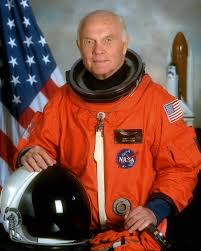
john-glennThe world has lost a giant among men. John Glenn, Astronaut on Mercury 7 and Discovery, U.S. Senator, U.S. Marine, and a Christian, made an indelible impression on human history.
One would guess that such a man, surrounded by science and fame, might lose his way. During his historic return to outer space aboard Discovery in 1998, Glenn gave the following statement that showed his faith in God.

“Looking at the Earth from this vantage point, looking at this kind of creation and to not believe in God, to me, is impossible…To see (Earth) laid out like that only strengthens my beliefs.” – John Glenn, Nov. 1, 1998

Thank you Mr. Glenn for sharing your amazing gifts with us. For teaching us more about the world we live in, and showing us that we can believe in the one yet to come.

I doubt I will ever be able to see the earth and the universe in a way equal to Glenn. But even without that stellar view, we can still arrive at the same conclusion!

We first have to stop and consider how improbable our lives really are. According to this article in the Wall Street Journal the chances of our existence just happening through natural means is infinitesimally small, it should have never happened. And when we realize how improbable the existence of human life is, we should look to a Creator far greater than ourselves. click-here-to-tweet

In the beginning God created the heavens and the earth. – Genesis 1:1

The prologue to John’s gospel goes into a bit more detail.

In the beginning the Word already existed.
    The Word was with God,
    and the Word was God.
He existed in the beginning with God.
God created everything through him,
    and nothing was created except through him.
The Word gave life to everything that was created,
    and his life brought light to everyone.
The light shines in the darkness,
    and the darkness can never extinguish it.

There’s simply no other way to explain how our universe was created. No theory can explain how something came from nothing. That is, unless you account for our Creator.

God has blessed us with such an amazing creation. He even designed it so that when we explore the magnitude and complexity of our surroundings, it points a huge arrow right back at Him.

19 They know the truth about God because he has made it obvious to them. 20 For ever since the world was created, people have seen the earth and sky. Through everything God made, they can clearly see his invisible qualities—his eternal power and divine nature. So they have no excuse for not knowing God. – Romans 1:19-20

We serve an amazing God. One who created us, surrounded us with a creation that points back to Himself, sent us a Savior to help us when we fail, and continue to provide for our every need.

Today, be proud that God saw fit to create you too! Of all the places, and all the times of history, God saw fit to place you where you are today. John Glenn changed the future of humankind with the life and time he was given. What will you do with today?

God’s Will…or Ours?

Several years ago I heard a preacher ask a very thought-provoking question that I have never been able to forget.  The question went something like this:

During the Civil War in the United States, the North was motivated, in part, by the fact that slavery was evil and not in keeping with the way that God would want us to treat other people.  The North reasoned that slavery was against God’s wishes, and they were carrying out God’s will.  God, therefore, supported the efforts of the North.

The South was motivated, in part,  by the fact that the Bible is full of examples of God’s people living in slavery, and the New Testament is full of examples of Christians both being and owning slaves.  The South reasoned that slavery was in keeping with God’s wishes, and they were carrying out God’s will.  God, therefore, supported the efforts of the South.

Whose side was God on?

I’ve never forgotten that question, mostly because of the discussion that arose afterward.  Many Christians in this Bible class had no idea how to answer the question, mostly because of the way the question is worded.  Let me reword the question for you:  Did God’s will conform to the ideals of the North, or the ideals of the South?

Obviously when we ask the question this way, the answer is that God’s will doesn’t conform to anyone’s ideals!  God doesn’t choose sides!  God is God.  God is unchanging!  God is truth, his word is truth, and his word is eternal!

James 1:16-18 – New International Version (NIV)

 16 Don’t be deceived, my dear brothers and sisters. 17 Every good and perfect gift is from above, coming down from the Father of the heavenly lights, who does not change like shifting shadows. 18 He chose to give us birth through the word of truth, that we might be a kind of firstfruits of all he created.

This idea of God choosing sides came around again in Bible class tonight while discussing Saul and David both believing they were acting on God’s will (see 1 Samuel 23-26).  Someone brought up the idea that if the United States goes to war with another country, there may be Christians fighting on both sides of the conflict.  Who’s side is God on?

This idea of God choosing sides has also been circulating in the media recently with regards to Tim Tebow.  Many are believing that God has decided to become a Bronco’s fan because of Tim Tebow, and in turn he allows them to win. I don’t know Tim Tebow personally, but I greatly respect his ability to live his faith in Christ while using his talents to honor God in a way that other people take notice.

The point is God doesn’t choose sides.  People have the choice of being on God’s side or not, but the fact remains: God does not choose sides.  God is not choosing to be on Tim Tebow’s side. Each one of us chooses what side to be on.  Either we are on God’s side, or we are not.  Each of us has been given the opportunity to understand God’s Word (1 Timothy 2:1-7), everything has been revealed so we have everything we need to know (Romans 16:25-27), and to have the ability to choose whether we will be on God’s side or not (Joshua 24:15).

Tim Tebow has made his choice.  I have made mine.  And believe it or not, you have already made your choice.  Either you have chosen to follow Christ, or you have chosen not to.  There’s no in-between.  The good news is that if you don’t like your choice, you can change your mind!  God gives us that freedom!

So, whose side are you going to be on?

Zephaniah

Sometimes when we’re faced with grief, or distress, or abuse, persecution, looming punishment and the like, we develop a feeling of hopelessness. When those situations evolve we often feel completely surrounded, as if there’s no way out. If only there were something to give us hope, then we’d be alright…if only.

Zephaniah was a prophet who’s ministry came to an end just six years after Jeremiah’s began.  And God’s people at the time had just come out of being under the rule of two very evil kings, Manasseh and Amon. And as we too often see, corrupt rulers corrupt their people.  God’s people had become very wicked themselves during this time and had turned their backs on God’s will.  The situation gets more interesting when we learn that they knew they had drifted away…they knew they had major problems, and they had lost hope.  And into this mix comes Zephaniah preaching a message of repentance and hope.

Zephaniah 2:3 – Seek the LORD, all you humble of the land, you who do what he commands. Seek righteousness, seek humility; perhaps you will be sheltered on the day of the LORD’s anger.

Zephaniah called the people to repent, and the people knew that God would eventually bless them, but Zephaniah made it clear that there would be judgement first, then blessing.  Our actions do cause us to face consequences. Sometimes even after we have repented, we still must deal with the consequences of our past actions against God, and that’s what happened to Judah.  They would see Judah fall to the Babylonians in 586 BC, but the good news is that they did repent!  And as a result they had hope for the future.  They were able to weather the storm, the destruction, and the hard times because they had hope in God’s promise to bless them for their repentance and righteous living!

Zephaniah 3:14,17 – Sing, O Daughter of Zion; shout aloud, O Israel! Be glad and rejoice with all your heart, O Daughter of Jerusalem! … 17 The LORD your God is with you, he is mighty to save. He will take great delight in you, he will quiet you with his love, he will rejoice over you with singing.

There is a lot to be learned from the small book of Zephaniah.  God does not take sin lightly, and it will be punished.  But we can take hope from the words of Zephaniah because our God reigns, and he will rescue the faithful remnant of his people who worship him, and obey his Word.

Actions

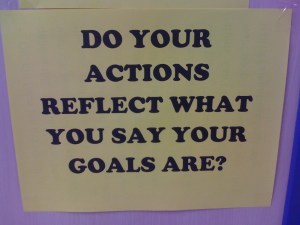
I saw a sign recently at a school that made me stop and think.  So much so that I had to take a picture.

“Do your actions reflect what you say your goals are?”  That’s a great, and very deep question that applies to many areas of our lives.  It also raises so many more questions that I have to ask myself from time to time.  I thought I’d take a minute and share a few with you.

Spiritual: Am I walking daily as Christ calls me to?

Matthew 7:15-20 –  15 “Watch out for false prophets. They come to you in sheep’s clothing, but inwardly they are ferocious wolves. 16By their fruit you will recognize them. Do people pick grapes from thornbushes, or figs from thistles? 17 Likewise, every good tree bears good fruit, but a bad tree bears bad fruit. 18A good tree cannot bear bad fruit, and a bad tree cannot bear good fruit. 19 Every tree that does not bear good fruit is cut down and thrown into the fire. 20 Thus, by their fruit you will recognize them.

This passage always gets me wondering…do people view me as a good tree, or a bad tree?  How does God view my fruit?  After all, he is the chief fruit inspector.  Do my actions always show others I am a Christian?  If a film crew followed me around for a day without me knowing they were watching, would those viewing the tape know I was a Christian from my actions?

Professional: Is my career where I truly want it to be?  If not, what can I do to make my goal a reality?  Am I working toward my dream job/professional goals, or am I endlessly spinning my wheels while claiming that I’m “trying” to reach them? (Thanks Tyler for the heads-up on “trying!”)

Relational: Am I truly doing the things I need to do every day to be a good friend to others?  Am I constantly working to improve my relationship with my wife?  Am I working toward being a better husband? A better friend?  A better co-worker?

Financial:  Am I sticking to my financial plan? Am I managing my money in a way that honors God, provides for my family, and plans for my future?  Am I constantly making frivolous purchases while there are still financial commitments that need to be met?  Am I truly doing all I can to get out of debt and change my family tree?

There are many other topics and questions that I could mention, but I won’t do that here.  I can’t say that I answer all of these questions perfectly all the time, but they are questions that constantly run through my mind to help guide my decisions.  The tricky part isn’t asking the questions, or really answering them.  It’s making adjustments and corrections as needed once the answers have been given.

“Do your actions reflect what you say your goals are?”

What are some of your goals, and how can you change your actions to accomplish them?