
Divorce and Remarriage in the Church

Biblical Divorce: Divorce in Israel – Part 1

As we continue to explore a Biblical view of divorce, we need to begin with a word about the Bible itself. Our Bibles are in reality a library bound in one cover. The Bible is a collection of 66 writings—letters, sermons, history, songs, prayers, complaints, warnings and prophecies—written by over 40 people over a span of 1600 years in three languages on three continents, and has a mysteriously unifying theme that can only be explained by a good God behind its writing. As Paul so wonderfully summarized…

3:16 Every scripture is inspired by God and useful for teaching, for reproof, for correction, and for training in righteousness, 3:17 that the person dedicated to God may be capable and equipped for every good work.

2 Tim 3:16–17, Biblical Studies Press, The NET Bible First Edition; Bible. English. NET Bible.; The NET Bible (Biblical Studies Press, 2005).

Paul further clarifies that these same texts are able to give us “wisdom for salvation through faith in Christ Jesus” (2 Tim 3:15 NET). I hope you realize that Paul is writing the New Testament as he pens this, meaning the texts that Timothy had known “from infancy” refer to the Old Testament.

I am further convinced by James that we serve a God whose Word does not change, and does not contradict itself.

1:16 Do not be led astray, my dear brothers and sisters. 1:17 All generous giving and every perfect gift is from above, coming down from the Father of lights, with whom there is no variation or the slightest hint of change. 1:18 By his sovereign plan he gave us birth through the message of truth, that we would be a kind of firstfruits of all he created. 

Jas 1:16–18, Biblical Studies Press, The NET Bible First Edition; Bible. English. NET Bible.; The NET Bible (Biblical Studies Press, 2005).

Therefore, as we study what the Bible has to say about divorce for the Christian, we need to consider everything the Bible has to say about divorce…yes, even the Old Testament. Over the next few weeks, we’ll discover that those famous sayings by Jesus and Paul about divorce are in fact commentaries on what the Bible had already taught concerning divorce.

The Rights of Women in the Old Testament

What we encounter in looking at the Pentateuch is an overview of the laws of Israel, not a full collection of Israel’s laws. Without wandering off topic, let me simply say there are basic laws any society would need that are not recounted in Scripture. The main purpose of God preserving some laws in Scripture was to highlight the differences between Israel and the rest of the world in faith, ethics, and practice. Dr. David Instone-Brewer, honorary research fellow in Rabbinics and the New Testament at Tyndale House, comments on some of these differences.

“In particular, women have greater rights in the Pentateuch than in the ancient Near East generally…The differences that do exist are in the rights of the wife and the divorcée.”

David Instone-Brewer, Divorce and Remarriage in the Bible: The Social and Literary Context (Grand Rapids, MI; Cambridge, U.K.: William B. Eerdmans Publishing Company, 2002), 21.

There are a number of passages that reference divorce throughout the Old Testament that we will explore in future postings. For today, I want to start with the first of two key texts of the Old Testament that directly addresses divorce.

Exodus 21:9-11

 In Exodus 21, following the giving of the 10 Commandments, we encounter case law for God’s covenant people to learn, and apply to their future situations. One of these case laws involves a young lady sold by her father as a servant to another Israelite. This is where verse 9 picks up.

21:9 If he designated her for his son, then he will deal with her according to the customary rights of daughters. 21:10 If he takes another wife, he must not diminish the first one’s food, her clothing, or her marital rights. 21:11 If he does not provide her with these three things, then she will go out free, without paying money. 

 Biblical Studies Press, The NET Bible First Edition; Bible. English. NET Bible.; The NET Bible (Biblical Studies Press, 2005), Ex 21:9–11.

Notice that even this servant is to be treated like a daughter with full rights. Even though this person is owned, they receive full rights as a citizen of Israel and equal family member when getting married (v. 9). If polygamy is practiced by the Israelite man, then the provision for his first wife (in this case, the former servant of verse 9) must continue to include food, clothing, and her marital rights (v. 10). Notice that these are expected as part of marriage regardless of the practice of polygamy.

These three staples are a requirement of an Israelite marriage. And if any of these three things are missing from the marriage, the woman has the right to go free, without payment. That would indicate she did not have to buy her way out of a marriage, nor buy her freedom. She was absolutely free from her marriage if food, clothing, or marital rights were neglected by the husband. According to Stuart, not providing these three items…

“…was sufficient grounds for the wife to be freed from both her marriage (which had been profaned by the discrimination of her husband) and her service…”

Douglas K. Stuart, Exodus, vol. 2, The New American Commentary (Nashville: Broadman & Holman Publishers, 2006), 483.

A note on “marital rights”

Most translations and commentaries view the third word, ענתה (ʿonathah), as sexual relations of the marriage covenant. In other words, if the husband neglects his sexual duty to his wife, the marriage would have legitimate grounds to end. Conversely, it could end if the woman deprived her husband (consider 1 Corinthians 7:3-4).

There is also the possibility of translating ענתה (ʿonathah) as an oil or salve of some type, indicating the necessity to also provide necessary personal beauty/health products. This would exactly mirror the requirements of the neighboring nations including Babylon (consider Hosea 2:5, which references divorce and which we will consider in its full context in a future post).

I believe the NET Bible translation notes summarize the point of this text, and the translation difficulty well.

“The point is that the woman was to be cared for with all that was required for a woman in that situation.”

Translation note on Exod. 21:10,  Biblical Studies Press, The NET Bible First Edition; Bible. English. NET Bible.; The NET Bible (Biblical Studies Press, 2005).

Summary of Biblical Divorce in Exodus 21

  • There are certain requirements for a marriage to be valid.
  • According to Exodus 21, these requirements are food, clothing, and marital rights.
  • This text deals with the lowest class of citizenry, and is considered the minimum requirements of a marriage in Israel.
  • If these basic needs are not met, the deprived person is free to go.
  • The marriage can end because the one party has not fulfilled the obligations of the marriage.
  • Nothing in this text indicates the marriage must end. Rather, the wronged party has the choice of ending the marriage.

Next time we will look at Deuteronomy 24.
Biblical Divorce Series

  1. God’s Divorce
  2. Biblical Divorce: Divorce in Israel – Part 1
  3. Biblical Divorce: Divorce in Israel – Part 2
  4. Biblical Divorce: Divorce in Israel – Part 3
  5. Biblical Divorce and Jesus – Part 1
  6. Biblical Divorce and Jesus – Part 2
  7. The Apostle Paul and Divorce

The Problem With the Ten Commandments

The Decalogue, otherwise known as the Ten Commandments, have impacted the world in ways that very few things have. They are the basis for many legal systems, they are foundational to our understanding of God, and unfortunately they are the source of much controversy in our day and time. They are a small portion of the sum of God’s Word given to Moses, and yet everyone seems to know (or know about) them. 

And still I think they are greatly misunderstood. The Decalogue is referenced throughout Scripture, and is present in its entirety in both Exodus 20 and Deuteronomy 5. And yet even in these two passages there are differences between the two lists. They are ten “words” to be literal with the Hebrew language, and even what exactly those ten are is debated. Jewish readers will tell you the first command is:

I am the Lord your God, who brought you out of Egypt, out of the land of slavery.

Deuteronomy 5:6 NIV

If one counts this as a command rather than an introduction, then you wind up with 11. Various groups have debated on how to settle that discrepancy, some by uniting 2 & 3 (Dt. 5:8 & 11), while other groups combine 1-3 as one command and divide up the last command into two parts (Dt. 5:21).

In reality, determining the exact grouping is not as important as the text itself. But even the text is problematic when removed from the context of the Torah…after all the Decalogue isn’t independent of the rest of Torah, and really serves as more of a summary, or a statement of understanding before we get into the more technical parts of the law. What kind of killing is defined as murder? That detail is not in the Decalogue. We need the rest of the Torah for that.

Many government buildings have had statues, or monuments removed because the Decalogue was printed upon them. And while I can understand the Christian’s desire to see these monuments remain, I’m also puzzled. If we want God’s Word present at these government buildings, then why not seek to have the Sermon on the Mount put on a monument instead of the Decalogue? Or better yet, why not the Greatest Commands?

When Jesus was asked what the greatest command was he gave two, not one. They are connected and inseparable. I would suggest you cannot fully keep one without the other. Fully loving God requires loving your neighbor, and truly loving your neighbor requires you know and love God. 

I think it’s worth noting that neither of the commandments Jesus gave came from the Decalogue. Rather they come from the Shema (Deut. 6:4-9) as well as the eighteenth verse of the various laws found in Leviticus 19.

“The most important one,” answered Jesus, “is this: ‘Hear, O Israel: The Lord our God, the Lord is one. Love the Lord your God with all your heart and with all your soul and with all your mind and with all your strength.’ The second is this: ‘Love your neighbor as yourself.’ There is no commandment greater than these.” 

Mark 12:28-31 NIV

Jesus said all the laws and prophets hang on these two commands (Mt. 22:40). Even the Decalogue falls short when compared to the Greatest Commands. Love God with all of your everything. Love your neighbor as yourself. “There is no commandment greater than these.” 

The real problem with any commandment from God is that if they simply exist in writing, they are useless. These monuments with the Ten Commandments inscribed have done little to prevent our culture from turning further and further from God.

Perhaps our world would be better served by Jesus’ followers living out the Greatest Commands instead of relying on words carved in stone. 

(Sermon text for 10/6: Deuteronomy 6:4-9; Mark 12:28-31)

5 Reasons Not To Obey God – The Calling of Moses

Last week our focus was on Jacob and the faithfulness God showed by keeping his promises, even while wrestling with Jacob. He also gave Jacob a new name, Israel – one who struggles with God.

This week we will talk about Moses, a complex character just like Jacob. Moses had been hiding out for about 40 years as a shepherd because he had committed murder back in Egypt. Now, at roughly the age of 80, Moses saw a burning bush and God called him to lead the nation of Israel out of slavery (Acts 7:23,30).  There are several points to ponder in this great text, but I want to focus on just one area: Moses didn’t want to do it!

At least 5 times in Exodus 3 & 4 Moses comes up with excuses for why he cannot do the job. “Who am I…what shall I tell them…what if they don’t believe…I have never been eloquent…” And the final excuse makes it abundantly clear what Moses wants:

But Moses said, “Pardon your servant, Lord. Please send someone else.”

Exodus 4:13 NIV

To state that Moses was a reluctant participant in the work of God through the Exodus is an understatement. He did not want to go! The text tells us that Moses made God angry through his excuses and hesitation, but once again notice the faithfulness of God through this statement:

“I will help both of you speak and will teach you what to do.”

Exodus 4:15 NIV

Even though Moses was not the most eager participant, God promised that he will “teach” Moses and Aaron what to do. God wasn’t going to just toss them to the wolves, he would be with them and would teach them.

Life is often difficult. And if we’re honest, God has called the church to do things that most of us don’t want to do. We would prefer being called to sit in the pews instead of obeying the command to make disciples (Mt. 28:19) Most of us can think of a hundred reasons why we aren’t qualified to do what God has called the church to do, but we forget that God is also a teacher at heart. 

There’s an old saying that I love:

God doesn’t call the equipped, he equips the called.

That’s the story of Abraham, Isaac, Jacob, Moses…and it’s our story too. We don’t have to rely on our own abilities if we are obeying the work God has called us to. He will prepare the way, he will take care of all the variables, and he will teach us as we go (Lk. 12:12, Jn. 14:26, 1 Jn. 2:27)

(Sermon text for 10/1 – Exodus 1:8-14; 3:1-15; Mark 12:26-27)

Miriam: Prophet of God?

This week we’ll look at Miriam, who is much more than the sister of Moses. She is a child of God with an important role to play as one of the three deliverers of Israel from Egypt, as well as the namesake of the mother of Jesus! (Our English translations notoriously anglicize names in Scripture. “Mary’s” literal name is “Miriam,” which should draw us to compare the two.)

We first encounter Miriam in Exodus 2 as she looks after the ark in which her baby brother Moses is hidden. When Pharaoh’s daughter discovers Moses, it is Miriam who suggests finding a Hebrew woman (Jochebed, the mother of Moses, Aaron, and Miriam) to nurse the baby. The Exodus narrative shifts to focus on the power of God over Egypt through many signs and wonders, and we once again find Miriam after the crossing of the Red Sea.

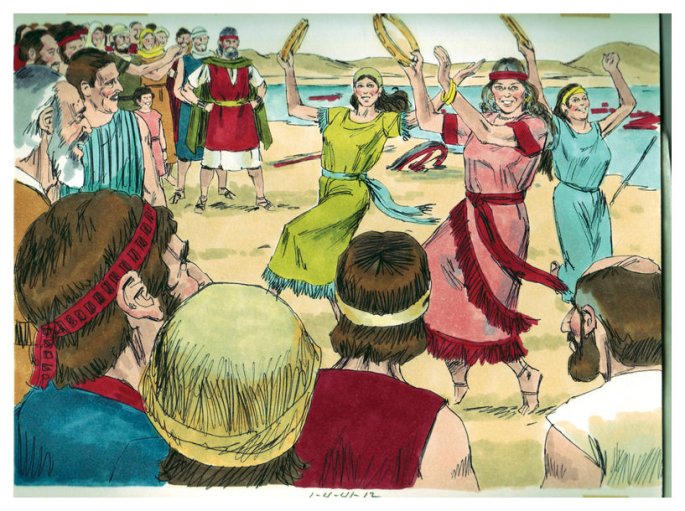
Then Miriam the prophet, Aaron’s sister, took a timbrel in her hand, and all the women followed her, with timbrels and dancing. Miriam sang to them: “Sing to the Lord, for he is highly exalted. Both horse and driver he has hurled into the sea.”

Exodus 15:19–21 NIV

If you are reading, thinking, “I didn’t know women could be prophets,” this is exactly why I’m writing this article. Let’s remove any cultural biases we may have and see Scripture the way the writers (and the Holy Spirit) intended. So Miriam is a prophet! That means she is a spokesperson for God responsible for teaching, preaching, and instructing the people of Israel in the word of God. One of the ways Miriam proclaims the word of God is by leading the women in singing and dancing in praise of God! Scripture also informs us that Miriam was considered a leader of Israel right alongside Moses and Aaron.

“I brought you up out of Egypt and redeemed you from the land of slavery. I sent Moses to lead you, also Aaron and Miriam.”

Micah 6:4 NIV

I feel it important to comment on efforts to dismiss Miriam’s role, or status as a prophet and leader of Israel because she is a female. Yet if we simply let Scripture speak for itself and accept it for what it says, we will have a more accurate view of who God is, and be blessed in doing so. The truth is God uses who he wants, regardless of what we think he should do. He chooses people who bring him glory and accomplish his purposes in this world. God created both male and female in his image (Gen. 1:27) to proclaim his message, and Miriam did just that! She was not perfect, and was punished by God for treating Moses with contempt, but Moses and Aaron pleaded for God to restore her (see Numbers 12). Nevertheless, she is one of many female prophets listed in the pages of Scripture and deserves to be appreciated as such.

Consider the parallels between Miriam in the Hebrew Scriptures and Mary/Miriam in the Gospels. Besides sharing the same name, both protect the savior of Israel in Egypt (Ex. 2:1-10/Mt. 2:13-18), both write and sing songs to tell of God’s salvation (Ex. 15:20-21/Lk. 1:46-56), and their placement is important – Miriam at the beginning of the story of Israel as well as Mary/Miriam at the beginning of the story of the renewed Israel through our savior, Jesus.

Next week we will take a look at another female prophet who is often minimized, contrary to what Scripture tells us about her.