Daily Psalms – Psalm 23

Daily Psalm Reading – Psalm 21-25

Today our meditation is on Psalm 23, perhaps the most famous passage of Scripture, and one that our western experience doesn’t really understand. We don’t live in a shepherding culture, and we certainly don’t live in the landscape of rural Israel. But that’s the context in which this passage speaks most clearly.

We often read this psalm with images of God’s abundant blessings. “I lack nothing” seems to indicate “I have everything I want!” “Green pastures” seems to indicate a feast of epic proportions in belly deep alfalfa hay. But have you ever seen pictures of Israel? Do we really understand what David is writing here?

Keep in mind that Psalms 20-23 are Messianic in nature; they describe the coming (returning) Messiah and how he would live. Did Jesus have all the physical possessions he wanted? Was his a wealthy and luxurious existence? Something seems to be off with our American understanding of this famous psalm.

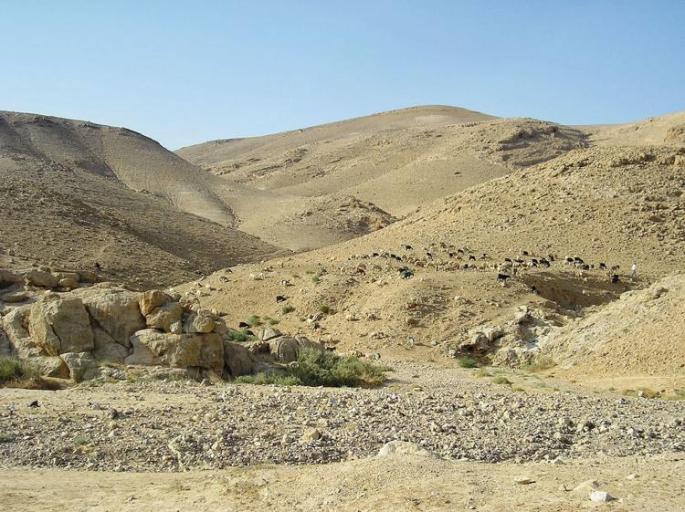
If you look at the picture I have attached to this post, you will see the “green pastures” of Israel. Look closely. Do you see the sheep grazing on the hillside? Can you see the little tufts of green grass on the hillside in the desert? These are the green pastures of David’s world, of Jesus’ world, and of Psalm 23.

In the desert that is very little water and virtually no grass, yet this is where you can raise sheep in Israel. Each night a strong wind from the west blows humid air from the Mediterranean Sea against the hot desert hills and the condensation occurs. Overnight this moisture causes green tufts of grass to sprout that in the morning provide grass for the sheep, but by mid afternoon the sun has scorched everything there. Unless the sheep are in the right place at the right time they will have nothing to eat.

Do you know the most common cause of death in the desert? Drowning. Seriously, I’m not making this up! Though it doesn’t rain in the desert, it pours in the mountains and the mountains cannot absorb the water. These torrential runoffs stream through dry riverbeds (wadi’s) into the desert. Often there is water left over in the bottom of these wadi’s, and that’s the problem. When you attempt to get water out of these wadi’s you leave the rock often get stuck in the miry mud that is left.

People drown like this every year because they see water, their thirst in the desert drives them into these wadi canyons and when 70 feet of floodwater rushes through the canyon at once they cannot get out. Desert people will tell you instead to get your water from springs, also known as “still” or “quiet waters.” In these places there is no danger.

So who knows where the grass will appear in the morning? Who knows the difference between flood waters and quiet waters? The sheep? No, it’s the Shepherd that knows these things. So what does it mean to have Yahweh as your shepherd? And what what might happen if we don’t listen to our Shepherd?

I could write about this psalm all day, but hopefully I’ve provided enough to get you thinking. Here’s a couple of takeaways. First, read this psalm with the cultural and geographical information from above and see what David might be saying. Is he saying we will have everything we want because we follow Yahweh, or is he saying we don’t have to worry because because the Shepherd will always give us just what we need when we need it? The words of Jesus seem to echo here as well!

“Therefore I tell you, do not worry about your life, what you will eat or drink; or about your body or what you will wear. Is not life more than food, and the body more than clothes?…But seek first the kingdom and his righteousness, and all theses things will be given to you as well.”

Matthew 6:25, 33 NIV

Second, if Psalm 23 is Messianic in nature, then read this as if Jesus were speaking. Can you see his story here? And finally, read this in your voice. What does it mean to dwell in the house of Yahweh forever? What does it look like to dwell in his house now?

May Yahweh bless you as you spend time wrestling with his word today. Shalom.

Daily Psalms – Psalm 8

Daily Psalm Reading – Psalms 6-10

Today we will spend some time reflecting on Psalm 8, a psalm of David that is closely tied to the narrative of both Job, and the writer of Hebrews (as well as several other passages in Scripture.)

Psalm 8 is the first psalm of praise in the psalter, and comes at the end of a series of Psalms about suffering (Ps. 3-7) that certainly resonate with Job. Yet just like Job, the Psalter brings us into a time of great praise of Yahweh at the end of the suffering, almost as if the suffering itself has allowed us to see God’s glory and majesty in every aspect of creation, and the result is praise!

I think the key to understanding Psalm 8 is verse 4:

“…what is mankind that you are mindful of them, human beings that you care for them?”

Psalm 8:4 NIV

Again, this verse resonates with Job’s questions as well:

“What is mankind that you make so much of them, that you give them so much attention…”

Job 7:17 NIV

When we consider the vastness of creation, the glory of God proclaimed in the heavens, why in the world would God care so much for us?

Verses 5-8 answer the question posed in verse 4 by returning to the Garden of Eden and the mission we are given to co-rule creation with Yahweh (Gen. 1:26-28). David then lists out all the creatures from the days of creation (Gen. 1). God has subjected creation to us! He created us to co-rule creation with him. What an awesome responsibility!

This is the imagery that the writer of Hebrews draws upon, directly quoting verses 4-6, and then makes the following statements:

“In putting everything under them (mankind), God left nothing that is not subject to them. Yet at present we do not see everything subject to them. But we do see Jesus, who was made lower than the angels for a little while, now crowned with glory and honor because he suffered death…the pioneer of our salvation perfect through what he suffered.”

Hebrews 2:8-9, 10 NIV

Psalm 1 gives us a great picture of who the Messiah should be; one who mediates on God’s scripture day and night. Psalm 2 ends by telling us “Blessed are all who take refuge in him (Messianic King).” Then we see a period of suffering in Psalms 3-7, and Psalm 8 celebrates that humanity has all creation subject to them, and the Hebrew writer points that image to Jesus, the firstfruits of the resurrection. We too will ultimately join with Jesus in our resurrection, but at the moment we are still bound by the constraints of our human bodies, and the effects of sin in our lives.

But for now we do have a job. We have responsibility from Yahweh to co-rule creation under the Lordship of our Messiah Jesus, in order to establish his kingdom “on earth as it is in heaven.” Since everything has already been subjected to Jesus (including you and me), we serve at his pleasure. We follow him and him alone! We carry out his mission on earth.

What an awesome responsibility we have! And the only fitting answer to such an awesome responsibility is praise!

“Yahweh, our Lord, how majestic is your name in all the earth!”

Psalm 8:9

Blessings!

DAILY PSALM READING – PSALMS 6-10

Life Back Then

This was posted by John Mark Hicks this morning on Facebook. I thought it was too good to not share. We get to take a look into the early life of the church!

Letter of Mathetes to Diognetus (probably around 130-150 A.D.)

“Christians are indistinguishable from other people either by nationality, language or customs. They do not inhabit separate cities of their own, or speak a strange dialect, or follow some outlandish way of life….With regard to dress, food and manner of life in general, they follow the customs of whatever city they happen to be living in, whether it is Greek or foreign…And yet there is something extraordinary about their lives. They live in their own countries as though they were only passing through…Any country can be their homeland, but for them their homeland, wherever it may be, is a foreign country….They live in the flesh, but they are not governed by the desires of the flesh. They pass their days upon earth, but they are citizens of heaven. Obedient to the laws, they yet live on a level that transcends the law. Christians love all people….A blessing is their answer to abuse, deference their response to insult.”

1 Peter 2:12, “Conduct yourselves honorably among the nations, so that, though they malign you as evildoers, they may see your honorable deeds and glorify God when he comes to judge.”