
Daily Psalms – Psalm 49

Daily Psalm Reading – Psalm 46-50

Our reading started today with the following proclamation:

God is our refuge and strength,
an ever-present help in trouble.

Psalm 46:1 NIV

The reading for today seems to focus around this theme. It is God who helps us. It is God who provides for us. It is God who reigns. It is God who is worthy of praise. It is God who saves. And Psalm 49 is a clear reminder that we cannot save ourselves.

When we moved here to Snyder several years ago, we got rid of many things we determined we no longer needed. We didn’t have room to move everything out here, so we sold, or gave away a great amount of stuff. Since we have moved here there have been boxes full of things in my storage building that have yet to be opened. It seems I didn’t even need all the things we moved out here!

We’re in a season of purging, asking ourselves if we really need the things we have. Do I really need all the clothes I have, or can I sell/donate most of them and just keep a few outfits for all occasions? Do I really need to pay for a streaming service when I rarely sit to watch TV? Do I really even need a TV? Does our joy and sense of identity really depend on a bunch of stuff sitting in our house, or is it found elsewhere?

I think these are the things the psalmist wants us to reflect upon in Psalm 49. The words are spoken for both rich and poor because both of us face the same reality:

People, despite their wealth, do not endure;
they are like the beasts that perish.
This is the fate of those who trust in themselves,
and of their followers, who approve their sayings.

Psalm 49:12-13 NIV

Now if those last two verses don’t speak to our culture, I don’t know what will. We get so excited and focused on people we don’t even know, wanting to “follow” them on social media. We pay a lot of attention to people, and things that really don’t matter. The end result of this all is death and decay. The question we need to ask ourselves is, “What am I living for?”

Do not be overawed when others grow rich,
when the splendor of their houses increases;
for they will take nothing with them when they die,
their splendor will not descend with them.

Psalm 49:16-17 NIV

As we approach a time of worship tomorrow morning, focus on what really matters. Not on my stuff. Not on my schedule. Not on my wishes and desires. Not on my job.

What really matters is my relationship with the only one who can conquer death.

But God will redeem me from the realm of the dead;
He will surely take me to himself.

Psalm 49:15 NIV

If you can’t truly say verse 15 about your present relationship with God, then that’s where your focus needs to be. Because in the end, nothing else matters.


Priscilla – The Leader?

Luke continues telling the stories of women serving in the Kingdom throughout his second volume, which we call “Acts.” Today we’ll begin with Priscilla. Paul first meets Aquila and Priscilla, fellow tentmakers, in Corinth after they had been ordered to leave Rome by Emperor Claudius (Acts 18:2-3). Later on these two were missionaries traveling with Paul to Syria, staying for a time in Ephesus, and later returning to Rome (Acts 18:18-19, 2 Tim. 4:19, Rom.16:3).

Of all the times that these two co-workers of Paul are mentioned (seven times total), two of these times Aquila is mentioned first: When Paul meets Aquila, and then Priscilla, and when Paul sends greetings to the church in Corinth on their behalf. The other five times this ministry team is mentioned it is the female, Priscilla, who is mentioned first.

What does this tell us about Priscilla? She played a very active role in these events, likely the lead role. When we tell stories we tend to include the key player in the discussion first. We say “Tom Brady and the Patriots,” not “Jarrett Stidham and the Patriots.” Stidham is one of the backup quarterbacks. Does he play a role in the organization? Of course. Is he the key player? Not usually. Luke does this in other places as well. At the beginning of his relationship with Barnabas, Luke refers to the two as “Barnabas and Saul/Paul” (Acts 11-13). But after chapter 13, Paul becomes the main player, except for occasionally like Acts 14:14, and 15:12. When Paul is the main player, he is mentioned first. When Barnabas is the main player, he is mentioned first.

Priscilla is mentioned as the main player five of the seven times she is mentioned with Aquila. This includes the teaching of Apollos (Acts 18:26), the missionary work in Ephesus (Acts 18:19, 2 Tim. 4:19), and on three other occasions. Saying Priscilla helped her husband is inadequate. They are both called co-workers with Paul (Rom. 16:3), and Priscilla is mentioned first 71% of the time.

There are some who teach women are not allowed to minister in this way, yet time and time again Scripture shows them doing so. And they are never rebuked or criticized for doing so! Luke mentions numerous other women prophesying on the day of Pentecost (Acts 1:14-15, 2:1, 4, 17-18), or Mary, who had a sizable church meeting in her home (Acts 12:12), Lydia, who also hosted a church (Acts 16:40), or Philip’s four daughters, who were prophets (Acts 21:8)?

Many have tried to take two verses from Paul’s writings out of context and use them to silence women in the Kingdom. The problem is the rest of Scripture, and even Paul’s own writings and ministry, show them doing the very things they are supposedly not allowed to do. So do we allow tradition to shape our understanding of what women may or may not do in the Kingdom, or will we allow the examples set forth in Scripture to set those guidelines?

Next week we’ll look at Paul’s conclusion to the Romans, and look at a few of the women he mentions there, as well as their roles in the Kingdom.

Daily Psalms – Psalm 45

Daily Psalm Reading – Psalm 41-45

Today’s psalm reading concludes Book 1 of Psalms (Pss. 1-41) and begins Book 2 (Pss. 42-72). This Book begins by reflecting on hope for the future, and a return to the Temple in Zion. There is also a great deal of Messianic hope in these psalms, which is most obvious in Psalm 45.

Psalm 45 was originally a secular psalm written for a royal wedding between the king of Israel and what is almost certainly a foreign wife (v. 10-12). A flat reading of the text can see the secular roots and leave someone to wonder why a psalm praising an earthly king and his wife are included in the psalter. The reason lies in how it was read and interpreted later.

After the fall of the monarchy in Israel, this psalm came to be understood as a foreshadow of they type of ruler the Messiah would be. This can be clearly seen in Scripture because when the Hebrew writer wants to tell his readers about Jesus, he does so by quoting Psalm 45:6-7. So instead of reading this psalm by focusing on its secular roots, let us look at it the way the Jews, and early Christians read it – as a reflection on the Messiah, whom we believe is Jesus.

Anointing (lit. messiah) language is present in several places in the text. This begins with the lips (understood words) that are anointed with grace (v. 2). The anointed one is clothed in splendor and majesty, and is mighty with a sword (see Rev. 19:11-16). The anointed one will seek truth, humility and justice, just like Yahweh wants his people to do. (Mic. 6:8) The nations will be placed below his feet. (Lk. 20:41-44) He is fragrant with myrrh, aloes and cassia. (Jn. 19:39)

We understand the Messianic references, but I want us to see how we, followers of Jesus, are viewed in the psalm. We are the royal bride adorned in gold (v. 9). We are called to forsake any other earthly relationship for our Anointed King (v. 10). Our king finds us beautiful, worthy of gifts and favor (v. 11-12). We are adorned with the finest robes and led joyfully into the King’s presence (v. 13-15).

Did you realize that Jesus views you this way? That you are not some stray dog he had mercy on. You are his chosen bride! (Eph 5:22-33, 2 Cor. 11:2, Rev. 19:6-9) No matter your faults, no matter your failures, seek him because he loves you and has chosen you! Even when you were still a mess, he chose you! (Rom. 5:8)

Today, walk with King Jesus and keep your head held high, because you are his chosen one! Tell your story today because all are invited to the wedding banquet of our King.

I will perpetuate your memory through all generations;
therefore the nations will praise you for ever and ever.

Psalm 45:17 NIV

Daily Psalms – Psalm 38

Daily Psalm Reading – Psalm 36-40

Have you ever felt guilty for being honest with God? Have you ever felt like you are supposed to say nice things and be thankful, but really all you want to do is complain? You’re not alone.

Psalm 38 is designated as a “petition.” Mostly it’s a complaint, but the main petition is found in verses 21 & 22:

LORD, do not forsake me;
do not be far from me, my God.
Come quickly to help me,
my Lord and my Savior.

Psalm 38:21-22 NIV

The psalmist blames Yahweh for the state he is in. “Your arrows have pierced me, and your hand has come down on me.” (v. 2) It’s “your wrath” that has caused my suffering. (v. 3) After many verses of lamenting his lowly state come these words:

LORD, I wait for you;
you will answer, Lord my God.

Psalm 38:15 NIV

We’re dealing with a moody 4 year old daughter at the moment who sometimes decides she doesn’t want to say a prayer. I reminded her tonight that it’s ok if you’re mad, or sad, or unhappy…tell God that in prayer. Yet I find so many adults who don’t believe they can be honest when talking to the Creator of the the universe, as if he didn’t know how you felt already! Why not just be honest with him? It’s what we see the most in this section of the psalms.

But as we move through the psalter you begin to notice that there are more psalms of praise than lament. It’s as if the psalter as a whole is teaching us that even when it’s hard, even when you don’t want to, and even when all you want to do is cast blame, pray anyway! This practice, especially when it’s hard, molds us into the kind of person Yahweh wishes us to be.

Prayer is less about asking for what you want, and more about becoming who God wants.

So, happy or sad, thankful or angry…have you talked to God today?

Daily Psalms – Psalm 34

Today we look at Psalm 34, a psalm of thanksgiving that seeks to teach us to “teach you the fear of Yahweh.” (v. 11)

Psalm 34 is an acrostic, meaning each verse begins with a successive letter of the Hebrew alphabet. From that standpoint this is a highly stylized psalm, but it isn’t just for show…there is a clear intent. The psalmist hopes to instill wise living to “Whoever of you loves life and desires to see many good days.” (v. 12)

Spend any time watching TV or browsing social media and you will find what our culture says is important for loving life and having good days. It’s all about the food you eat, the clothes you wear, the places you go, the famous people you interact with, who you vote for, who you hang out with, the car you drive, the house you live in, the movies you see, the games you play…the list is never ending. Approximately $205 Billion dollars was spent in the United States on advertising in 2017 in hopes that companies could get you to spend your money to buy their stuff. Our culture says it’s all about stuff.

The psalmist has a very different view. It’s not about what you have, it’s about who you trust. It’s about the aim of our heart rather than the bulk of our possessions. Instead of putting our hope and trust in things, we’re called to put our trust in Yahweh alone.

I sought the LORD, and he answered me;
he delivered me from all my fears.
Those who look to him are radiant;
their faces are never covered with shame.
This poor man called, and the LORD heard him;
he saved him out of all his troubles.

Psalm 34:4-6 NIV

Whereas the wealthy are the only ones in our culture who can enjoy “good days”, Yahweh hears the poor and saves them too! This is something that anyone can do, but it is something that must be done. We can’t live our lives the way our society promotes and be righteous before Yahweh.

Yahweh listens to the righteous (v. 15), but his face is against those who do evil (v. 16). He delivers the righteous, he is close to the brokenhearted, he protects them. Notice Yahweh’s focus is on the righteous and those that seek him. It’s not an easy and carefree life, but it is one that is secured by the protection and provision of Yahweh. Evil will be slayed (v. 21), but Yahweh will rescue us.

This seems too good to be true. Can I really live a righteous life and be pleasing to Yahweh? The answer is yes! It takes faith to change your life and step out in trusting Yahweh. But the psalmist assures us that we won’t be disappointed in what we find.

Taste and see that the LORD is good;
blessed is the one who takes refuge in him.

Psalm 34:8 NIV

May you be blessed as you learn to trust Yahweh. Blessings.

Daily Psalms – Psalm 29

Daily Psalm Reading – Psalm 26-30

Today we spend a little time meditating on Psalm 29 which many scholars believe to be the oldest psalm we have. This belief comes from finding very similar songs written to Baal by the Canaanites, and it appears that the Canaanite text has been reclaimed and rightly reappropriated to honor Yahweh.

Baal was known as the god over storms and fertility. If anything grew it was because Baal provided the fertility. If rain came it was because Baal made it so, and his voice was heard in the thunder of the storm. There was a belief amongst the Canaanites that they could manipulate Baal to do what they wanted by worshipping at the right time and in certain ways. They believed they could do certain things to obligate Baal to give them what they asked for. (Sadly some who follow Christ believe this as well.)

Psalm 29, however, takes everything that the Canaanites believed and flips it on its head. It isn’t Baal who does anything! It is Yahweh, and Yahweh alone who controls everything in the universe, and we are reminded of his name 18 times in this psalm alone!

Everything that comes from powerful storms: floods, thunder, tremors, lightning, destruction in nature – all of it subject to Yahweh. Blessings, strength, peace? All from Yahweh! Baal has no place in the discussion because it is Yahweh who does all of these things.

Let’s take a moment and focus on how our world views these things. Where do storms come from? We could look at scientific answers, but the general person on the street would attribute it to “Mother Nature.” How do we get rain? Hope the patterns found in “Mother Nature” will bring it about.

Our society, in large part, has done what the Canaanites did in attributing the power evident in the universe to created things. Humans can control a lot of things (or at least we pretend we can.) We can control our schedules, what crops we grow, where we want to build roads, where we want to travel, etc. We have amazing control over our world, but we cannot control the weather. Truth be told we can’t even accurately predict it most of the time.

Psalm 29 reminds us that we are not in control. No matter how hard we try, to matter what spells or chants we recite, no matter how many prayers we pray; we are not in control. Yahweh alone is in control. The only one who can control the weather is the only one in control of everything else.

And what should the response of creation be?

Ascribe to the Lord, you heavenly beings, 
ascribe to the Lord glory and strength. 
Ascribe to the Lord the glory due his name; 
worship the Lord in the splendor of his holiness. 

Psalm 29:1-2 NIV

May Yahweh give you strength and bless you with peace.

Daily Psalms – Psalm 23

Daily Psalm Reading – Psalm 21-25

Today our meditation is on Psalm 23, perhaps the most famous passage of Scripture, and one that our western experience doesn’t really understand. We don’t live in a shepherding culture, and we certainly don’t live in the landscape of rural Israel. But that’s the context in which this passage speaks most clearly.

We often read this psalm with images of God’s abundant blessings. “I lack nothing” seems to indicate “I have everything I want!” “Green pastures” seems to indicate a feast of epic proportions in belly deep alfalfa hay. But have you ever seen pictures of Israel? Do we really understand what David is writing here?

Keep in mind that Psalms 20-23 are Messianic in nature; they describe the coming (returning) Messiah and how he would live. Did Jesus have all the physical possessions he wanted? Was his a wealthy and luxurious existence? Something seems to be off with our American understanding of this famous psalm.

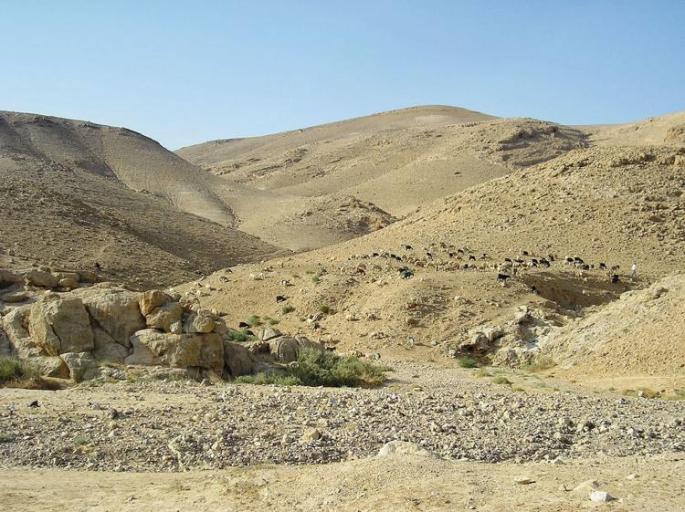
If you look at the picture I have attached to this post, you will see the “green pastures” of Israel. Look closely. Do you see the sheep grazing on the hillside? Can you see the little tufts of green grass on the hillside in the desert? These are the green pastures of David’s world, of Jesus’ world, and of Psalm 23.

In the desert that is very little water and virtually no grass, yet this is where you can raise sheep in Israel. Each night a strong wind from the west blows humid air from the Mediterranean Sea against the hot desert hills and the condensation occurs. Overnight this moisture causes green tufts of grass to sprout that in the morning provide grass for the sheep, but by mid afternoon the sun has scorched everything there. Unless the sheep are in the right place at the right time they will have nothing to eat.

Do you know the most common cause of death in the desert? Drowning. Seriously, I’m not making this up! Though it doesn’t rain in the desert, it pours in the mountains and the mountains cannot absorb the water. These torrential runoffs stream through dry riverbeds (wadi’s) into the desert. Often there is water left over in the bottom of these wadi’s, and that’s the problem. When you attempt to get water out of these wadi’s you leave the rock often get stuck in the miry mud that is left.

People drown like this every year because they see water, their thirst in the desert drives them into these wadi canyons and when 70 feet of floodwater rushes through the canyon at once they cannot get out. Desert people will tell you instead to get your water from springs, also known as “still” or “quiet waters.” In these places there is no danger.

So who knows where the grass will appear in the morning? Who knows the difference between flood waters and quiet waters? The sheep? No, it’s the Shepherd that knows these things. So what does it mean to have Yahweh as your shepherd? And what what might happen if we don’t listen to our Shepherd?

I could write about this psalm all day, but hopefully I’ve provided enough to get you thinking. Here’s a couple of takeaways. First, read this psalm with the cultural and geographical information from above and see what David might be saying. Is he saying we will have everything we want because we follow Yahweh, or is he saying we don’t have to worry because because the Shepherd will always give us just what we need when we need it? The words of Jesus seem to echo here as well!

“Therefore I tell you, do not worry about your life, what you will eat or drink; or about your body or what you will wear. Is not life more than food, and the body more than clothes?…But seek first the kingdom and his righteousness, and all theses things will be given to you as well.”

Matthew 6:25, 33 NIV

Second, if Psalm 23 is Messianic in nature, then read this as if Jesus were speaking. Can you see his story here? And finally, read this in your voice. What does it mean to dwell in the house of Yahweh forever? What does it look like to dwell in his house now?

May Yahweh bless you as you spend time wrestling with his word today. Shalom.

Daily Psalms – Psalm 20

Daily Psalm Reading – Psalm 16-20

(Sunday’s are hard. It’s very tiring on those of us who preach regularly. Saturday nights offer little sleep as God shapes our sermons in our heads. We awake early Sunday and arrive early to pray and seek the voice and wisdom of God. We pour ourselves out and then come home and crash, only to do it all over again. All this to say the tank is pretty empty on Sundays, so don’t expect this to be an overly deep, or lengthy reflection today.)

Today we meditate on Psalm 20 and the promised Messiah. Psalm 20 – 23 focus on David’s seed (the Messiah, Jesus) and his deliverance and rule over the nations. Here we encounter psalms of prophecy that tell us about Jesus.

Verse 6 states: “Now this I know: The LORD gives victory to his anointed.” The Hebrew word for anointed is “messiah.” No matter how upside down this world seems, no matter how chaotic and out of control, victory will be given to our Messiah Jesus!

After the first 5 verses of prayer and blessing over the coming (returning) Messiah, verses 6-9 point us to what the Messiah will do and where we should put our trust. The admonition to not trust in earthly power, but in the name of Yahweh our God is one we need to hear today. In a time where most pray “Our god which art in Washington…” we need to remember our help comes from Yahweh!

I’ll confess it is a struggle not to trust in our own strength. As the psalmist says we want to “trust in chariots and…horses.” The idea of picking ourselves up by our bootstraps isn’t a Biblical one. Rather we are encouraged time and time again to rely on our God, not our own abilities. Trusting in anything other than our God results in failure (v.8).

Today I pray we all learn to trust our God, to believe that our Messiah has been given victory over evil, and will return soon to eliminate it completely. Come Lord Jesus!

To echo the final words of the psalm, “Yahweh, give victory to King Jesus! Answer our prayers!” Shalom.

CLICK HERE TO READ TODAY’s DAILY PSALM READING – PSALM 16-20

Daily Psalms – Psalm 13

Our Psalm reading today is Psalm 11-15.

I was planning on focusing on a different Psalm today, but in light of the tragedy unfolding, I will save that for another time. Today we just need to lament and pray.

Why is there such evil in the world? Why does it seem like wickedness rules? At the time of this writing NBC confirms at least 19 people have been murdered in a mass shooting today in El Paso, TX. Though I seek for answers I know the cause: The sinful nature of humans.

Psalms 11-14 are a series of laments. They ask questions of why evil exists, why wicked people inflict pain upon the innocent, and pleads to Yahweh for salvation. And then Psalm 15 gives us a glimpse of the coming (returning) Messiah Jesus. The reading seems to say “weeping may stay for the night, but rejoicing comes in the morning.”

Yahweh calls us to love him above all else, and love our neighbor as ourselves. Jesus called these the Greatest Commands. And yet our culture says that God is not real, and promotes a culture of violence in television, movies, and video games that glorifies shooting whomever you don’t agree with. Our entertainment is death and destruction, and we wonder why these things happen.

We are not alone in our laments when evil seems to rule. Psalm 13, a psalm of David begs these same questions. “Has Yahweh forgotten us? How long will evil rule?”

Today we mourn great loss. Today we lament great tragedy. We beg Yahweh to move so nothing like this ever has to happen again. But David reminds us that Yahweh has not forgotten us, that he will not forget us, and that salvation is coming.

But I trust in your unfailing love;
    my heart rejoices in your salvation.
 I will sing the Lord’s praise,
    for he has been good to me.

Psalm 13:5-6 NIV

May the God of all comfort heal our broken land. Shalom.

Click here for today’s PSALM READING

Daily Psalms – Psalm 8

Daily Psalm Reading – Psalms 6-10

Today we will spend some time reflecting on Psalm 8, a psalm of David that is closely tied to the narrative of both Job, and the writer of Hebrews (as well as several other passages in Scripture.)

Psalm 8 is the first psalm of praise in the psalter, and comes at the end of a series of Psalms about suffering (Ps. 3-7) that certainly resonate with Job. Yet just like Job, the Psalter brings us into a time of great praise of Yahweh at the end of the suffering, almost as if the suffering itself has allowed us to see God’s glory and majesty in every aspect of creation, and the result is praise!

I think the key to understanding Psalm 8 is verse 4:

“…what is mankind that you are mindful of them, human beings that you care for them?”

Psalm 8:4 NIV

Again, this verse resonates with Job’s questions as well:

“What is mankind that you make so much of them, that you give them so much attention…”

Job 7:17 NIV

When we consider the vastness of creation, the glory of God proclaimed in the heavens, why in the world would God care so much for us?

Verses 5-8 answer the question posed in verse 4 by returning to the Garden of Eden and the mission we are given to co-rule creation with Yahweh (Gen. 1:26-28). David then lists out all the creatures from the days of creation (Gen. 1). God has subjected creation to us! He created us to co-rule creation with him. What an awesome responsibility!

This is the imagery that the writer of Hebrews draws upon, directly quoting verses 4-6, and then makes the following statements:

“In putting everything under them (mankind), God left nothing that is not subject to them. Yet at present we do not see everything subject to them. But we do see Jesus, who was made lower than the angels for a little while, now crowned with glory and honor because he suffered death…the pioneer of our salvation perfect through what he suffered.”

Hebrews 2:8-9, 10 NIV

Psalm 1 gives us a great picture of who the Messiah should be; one who mediates on God’s scripture day and night. Psalm 2 ends by telling us “Blessed are all who take refuge in him (Messianic King).” Then we see a period of suffering in Psalms 3-7, and Psalm 8 celebrates that humanity has all creation subject to them, and the Hebrew writer points that image to Jesus, the firstfruits of the resurrection. We too will ultimately join with Jesus in our resurrection, but at the moment we are still bound by the constraints of our human bodies, and the effects of sin in our lives.

But for now we do have a job. We have responsibility from Yahweh to co-rule creation under the Lordship of our Messiah Jesus, in order to establish his kingdom “on earth as it is in heaven.” Since everything has already been subjected to Jesus (including you and me), we serve at his pleasure. We follow him and him alone! We carry out his mission on earth.

What an awesome responsibility we have! And the only fitting answer to such an awesome responsibility is praise!

“Yahweh, our Lord, how majestic is your name in all the earth!”

Psalm 8:9

Blessings!

DAILY PSALM READING – PSALMS 6-10