

Ruth: A Story of Hesed

The story of Ruth, although only four chapters long in your Bible, is far to massive of a story to hope to distill in one article. There are too many intertwining themes to be able to simply state “this is what the story means, and this is what you should get out of it.” I am going to focus on one aspect only in this article, and have explored other themes in sermons and Bible classes (I hope to have those linked here soon.) The story of Ruth teaches us, through several character interactions, about the hesed of God. What is hesed? 

It’s a difficult Hebrew word to translate, is most often translated as “love,” but almost as often translated as “loyalty, joint obligation, mercy, faithfulness, goodness, graciousness, kindness, favor, etc..” Hesed is one of the most fundamental characteristics of Yahweh, so much in fact that I’ve often heard hesed described by the fruits of the Spirit. Hesed is a “love, joy, peace, patience, kindness, goodness, faithfulness, gentleness, self-control” kind of love. That’s hesed.

Within the story of Ruth, we find hesed at play in a number of places. Ruth’s refusal to leave Naomi? Hesed. Ruth’s willingness to glean for food? Hesed. Boaz going above and beyond to let Ruth harvest with his workers instead of gleaning, and sending her away at the end of the day with months worth of grain instead of what she picked up that day? Hesed. Naomi devising a plan for Ruth to marry Boaz? Hesed. 

But I think the most brave, selfless, and daring act of hesed comes when Ruth goes to Boaz at night with a marriage proposal. Chapter 3 is clear that Naomi wants to get Ruth a husband so she can go on with her life. Ruth takes Naomi’s plan, however, and changes it completely!

Without getting too technical, Ruth invokes two cultural laws here: the levirate and kinsman-redeemer laws. The levirate law saw to it that if a woman’s husband died leaving her childless, the dead husband’s brother must marry the woman and give her a child (Deut. 25:5-10). The kinsman-redeemer law dealt with the responsibility of redeeming land, so it didn’t leave, or at least returned to the possession of the original family to whom it was given (Lev. 25:23-28). Neither of these rules apply to Ruth. Boaz was a relative to Elimelek, Naomi’s husband. Levirate law would fall to a brother of Elimelek, for Naomi, not Ruth, and Boaz was not a brother. Kinsman-redeemer law dealt with Boaz buying back land for Naomi, not Ruth, and Boaz was not the closest relative.

What does all this mean? Naomi wanted to take care of Ruth by finding her a good man to marry. Naomi was only concerned with Ruth. This is Hesed. Ruth’s only concern was Naomi in getting Elimelek’s land back, and this point is vitally important, invoking levirate law using herself as the surrogate for bearing Naomi a child (see Ruth 4:13-17). This is why Boaz says her “kindness” (hesed) is greater than she showed earlier in gleaning for Naomi. Ruth shows hesed toward Naomi, and does not look out for herself. And then Boaz, not bound by either of these laws, decides to carry out Ruth’s plan and as a result, Obed, the grandfather of King David, is born to Ruth, and becomes Naomi’s son! (Ruth 4:16-17)

Hesed is shown most clearly in Ruth giving of herself, and her son, to Naomi.

Hesed floods this story. A hesed so great to self sacrifice for the sake of others. That’s Ruth. That’s also God. No wonder Ruth appears in Jesus’ genealogy! (Mt. 1:5).
The Song of Deborah

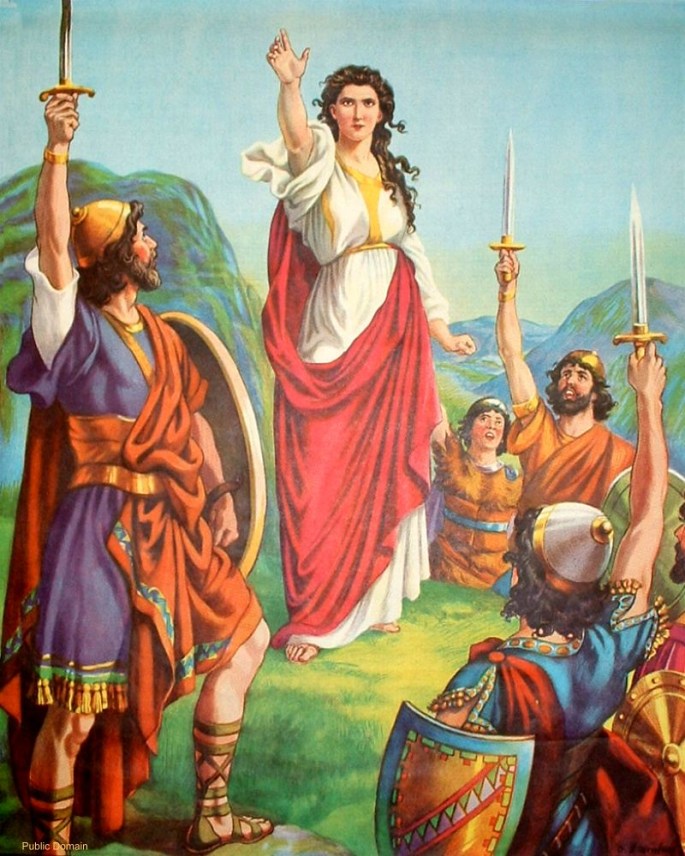
Last week we looked at Deborah: judge of Israel, prophet, wife,  and as we’ll discover today she was also a worship leader. Due to the Lord’s work through the leadership of Deborah, and the bravery of Jael, Israel enjoyed peace for forty years. Today we will look at Deborah’s celebratory song in Judges 5, and what it tells us about God and his people.

The beginning of verse 2 is problematic for translators, literally beginning with “In the breaking forth of the breakers in Israel.” NIV translates this as “When the princes in Israel take the lead.” I believe the ESV’s rendering to be clearer:

“That the leaders took the lead in Israel, that the people offered themselves willingly, bless the Lord!”

Judges 5:2 ESV

This is the story of Deborah! When the leader God had ordained, regardless of gender, took the lead and offered herself willingly, it brings praise to the Lord. All people should offer themselves willingly and lead in the mission of God as their divinely given gifts allow (1 Cor. 12:7).

The song is clear that it is God’s power that won the victory for the nation (v.4-5, 31) but the song clearly exalts the acts of Deborah in motivating and leading the people (v.7-9) and Jael for defeating Sisera (v. 24-27). And once again, we have a clear statement that this is not a story of renegade women usurping authority because of weak males in the kingdom. That belief is making assertions that the text does not. In fact, it states quite the opposite: God is behind this. God chose the leaders of Israel (2:16, 5:8) to accomplish his will and bring the people back into line with God’s covenant.

7 Villagers in Israel would not fight; they held back until I, Deborah, arose, until I arose, a mother in Israel.
8 God chose new leaders when war came to the city gates, but not a shield or spear was seen among forty thousand in Israel.
9 My heart is with Israel’s princes, with the willing volunteers among the people. Praise the Lord!

Judges 5:7-9 NIV

The further you go into Judges, the further Israel drifts from the knowledge of God. Eventually, even the Judges know so little about God that they do detestable things thinking it pleases God. Most of the judges failed to follow God, and by the end of the book the people no longer knew God. Judges sadly ends by saying this:

In those days Israel had no king; everyone did as they saw fit.

Judges 21:25 NIV

Deborah’s story at the beginning of the book shows us what good Godly leadership should do: bring people back into line with God’s will. God raised up Deborah and she followed God. She didn’t issue excuses as to why her situation wasn’t ideal. She simply offered herself and her God given abilities willingly. Our world is in desperate need of more women and men like Deborah!

Deborah: Prophet & Leader

Last week we looked at Miriam: leader of Israel (Mic. 6:4), a worship leader (Ex. 15:21), and a prophet of God (Ex. 15:20).  She was also the namesake of the mother of Jesus, Mary (Miriam in Greek). Today we look at the story of Deborah as told in the book of Judges. We will take this week, and next to look at Deborah.

Deborah lived somewhere between 1200-1100BC. Just as Moses and Joshua had done before hand, God appointed people (judges) over the people to help rule the nation and settle disputes. Don’t think courtroom judge. Think about judges like a governor, or tribal military leader. Judges 2 makes this process pretty clear.

18 Whenever the Lord raised up a judge for them, he was with the judge and saved them out of the hands of their enemies as long as the judge lived; for the Lord relented because of their groaning under those who oppressed and afflicted them. 19 But when the judge died, the people returned to ways even more corrupt than those of their ancestors, following other gods and serving and worshiping them. They refused to give up their evil practices and stubborn ways.

Jdg 2:18–19 NIV

During this time Israel struggles to maintain its identity as God’s people. In many ways they became just like the Canaanites they were to drive out, but God would raise up leaders to bring them back in line with who they were supposed to be. It is the Lord who appoints judges, not the people. And when the judges passed away, the Israelites rebelled against God. It is in this context that we are told about Deborah. Ehud, the previous judge, died and Israel returned to doing evil again. As punishment, God allowed Israel to be ruled by the Canaanite king Jaban, and his army commander Sisera. For twenty years the Israelites were mistreated by the Cannanites, and then Deborah is chosen as judge of Israel to correct, instruct them as prophet, and rescue them from the Canaanites.

The very first statement about Deorah tells us that she is a prophet and a wife (Jdg. 4:4), as well as a mother (Jdg. 5:7).  Deborah was so well respected that the people, including Barak the military commander, didn’t want to go into battle unless Deborah was with them, a role that is usually reserved for a king! (Jdg. 4:8).

Usually at this point someone chimes in claiming that Deborah had to do these things because there was a lack of men to lead. That is an assertion that Scripture doesn’t support. Nothing in this story indicates Deborah should not be doing any of these things because she is a woman. Remember, the Lord appoints judges. In fact, the story elevates women greatly! Sisera is eventually killed by a woman, Jael, who drives a tent peg through his head into the ground. The name Sisera means snake, and Jael means Yahweh is God. Through two women, Deborah and Jael, the head of the serpent is crushed by God! (Gen. 3:15).

Due to the Lord’s work through the leadership of Deborah, and the bravery of Jael, Israel enjoyed peace for forty years. Next week we will look at Deborah’s celebratory song (Judges 5), and what it tells us about God and his people.

Miriam: Prophet of God?

This week we’ll look at Miriam, who is much more than the sister of Moses. She is a child of God with an important role to play as one of the three deliverers of Israel from Egypt, as well as the namesake of the mother of Jesus! (Our English translations notoriously anglicize names in Scripture. “Mary’s” literal name is “Miriam,” which should draw us to compare the two.)

We first encounter Miriam in Exodus 2 as she looks after the ark in which her baby brother Moses is hidden. When Pharaoh’s daughter discovers Moses, it is Miriam who suggests finding a Hebrew woman (Jochebed, the mother of Moses, Aaron, and Miriam) to nurse the baby. The Exodus narrative shifts to focus on the power of God over Egypt through many signs and wonders, and we once again find Miriam after the crossing of the Red Sea.

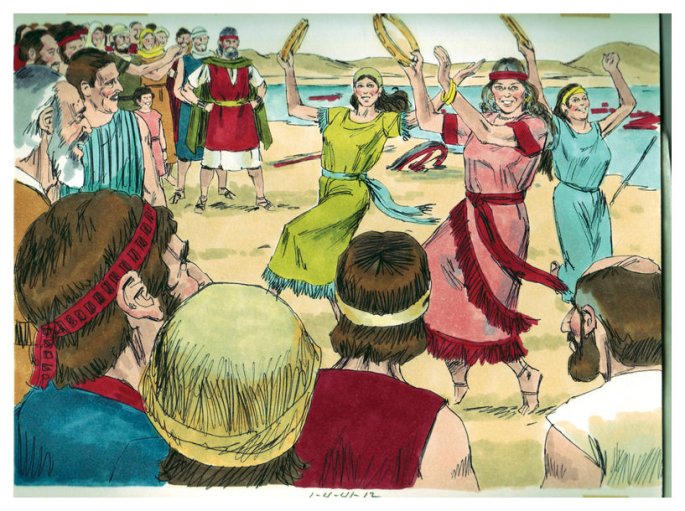
Then Miriam the prophet, Aaron’s sister, took a timbrel in her hand, and all the women followed her, with timbrels and dancing. Miriam sang to them: “Sing to the Lord, for he is highly exalted. Both horse and driver he has hurled into the sea.”

Exodus 15:19–21 NIV

If you are reading, thinking, “I didn’t know women could be prophets,” this is exactly why I’m writing this article. Let’s remove any cultural biases we may have and see Scripture the way the writers (and the Holy Spirit) intended. So Miriam is a prophet! That means she is a spokesperson for God responsible for teaching, preaching, and instructing the people of Israel in the word of God. One of the ways Miriam proclaims the word of God is by leading the women in singing and dancing in praise of God! Scripture also informs us that Miriam was considered a leader of Israel right alongside Moses and Aaron.

“I brought you up out of Egypt and redeemed you from the land of slavery. I sent Moses to lead you, also Aaron and Miriam.”

Micah 6:4 NIV

I feel it important to comment on efforts to dismiss Miriam’s role, or status as a prophet and leader of Israel because she is a female. Yet if we simply let Scripture speak for itself and accept it for what it says, we will have a more accurate view of who God is, and be blessed in doing so. The truth is God uses who he wants, regardless of what we think he should do. He chooses people who bring him glory and accomplish his purposes in this world. God created both male and female in his image (Gen. 1:27) to proclaim his message, and Miriam did just that! She was not perfect, and was punished by God for treating Moses with contempt, but Moses and Aaron pleaded for God to restore her (see Numbers 12). Nevertheless, she is one of many female prophets listed in the pages of Scripture and deserves to be appreciated as such.

Consider the parallels between Miriam in the Hebrew Scriptures and Mary/Miriam in the Gospels. Besides sharing the same name, both protect the savior of Israel in Egypt (Ex. 2:1-10/Mt. 2:13-18), both write and sing songs to tell of God’s salvation (Ex. 15:20-21/Lk. 1:46-56), and their placement is important – Miriam at the beginning of the story of Israel as well as Mary/Miriam at the beginning of the story of the renewed Israel through our savior, Jesus.

Next week we will take a look at another female prophet who is often minimized, contrary to what Scripture tells us about her.

He will rule over you: Prescription or Description?

I realize that this is a series on the women of the Bible and their stories, and last week I spent the entire article talking about the first sin, but it’s important to our understanding of the stories of women in the Bible. So much of what we believe about Genesis 1-3 influences the way we read the rest of Scripture. A bit more heavy lifting this week, and then on to other stories next week.

Last week we discussed how Genesis 3 is not an elevation of man over woman. It shows us that sin is a problem that impacts all creation – humans, animals, and even the garden which is now devoid of its human caretakers. The point we are to take away is that sin affects everything. That is consistent with the consequences of the sin that God enumerates in the last half of chapter 3. I find it fascinating that the word “cursed” is applied to the serpent, and to the ground because of Adam’s failure, but not to Eve.

The real reason we are looking at this passage again is our understanding of verse 16, specifically the last half of the verse:

“Your desire will be for your husband, and he will rule over you.”

Genesis 3:16b NIV

Many have interpreted this verse as a sexual desire on the part of the woman, and God now wants man to be in charge. Let’s take a look at this verse within the immediate context of Genesis 3, and the larger context of Genesis and the whole of Scripture.  Genesis 4:7 is a parallel verse to Genesis 3:16 using the same Hebrew words:

“…[sin] desires to have you, but you must rule over it.”

Genesis 4:7 NIV

With regards to Cain we understand from the same Hebrew language that sin wants to possess Cain, but Cain’s response should be to rule over sin. We get that. Yet the same language when used with the consequences of sin in the Garden gets interpreted differently because we think God wants men to rule over women. This is not how God established relationships in the Garden. He did not create Eve as subservient to Adam (as we looked at for the last two weeks.) Remember, the Garden was God’s ideal environment for humans, but now as a result of sin there will be broken relationships between humans and God, and between men and women, each seeking to dominate the other. I really appreciated Derek Kinder’s statement about this phrase in his commentary on Genesis.

“‘To love and to cherish’ becomes ‘To desire and to dominate’. While even pagan marriage can rise far above this, the pull of sin is always towards it.”  

Derek Kinder, Genesis: an introduction and commentary

So are we to take Genesis 3:16b as God describing the effects of sin, or are we to take the statement as a prescription/authority for man to rule over women going forward? We will answer that question through the rest of this series. From here we will continue to look at how God’s Word describes the relationship between men and women throughout the story of the Bible. We’ll look at how each story portrays this relationship and how those stories should influence our churches today.

Next week we’ll look at Miriam, who is much more than the sister of Moses. She is a child of God with an important role to play.

Question: What was Miriam’s role in God’s rescue of Israel?

Eve: Equality with Adam – Part 2

We continue our look at the women of the Bible by looking again at Eve’s story. Last week we noted that nothing in Genesis 1 or 2 indicates that Eve is somehow inferior to Adam. In fact, it proves quite the opposite. Both Adam and Eve are fully created in the image of God. We ended with a question last week: Who sinned first? Adam or Eve? Let’s look at a few verses to find the answer.

And Adam was not the one deceived; it was the woman who was deceived and became a sinner.

1 Timothy 2:14 NIV

Therefore, just as sin entered the world through one man, and death through sin, and in this way death came to all people, because all sinned…

Romans 5:12 NIV

For since death came through a man, the resurrection of the dead comes also through a man. For as in Adam all die, so in Christ all will be made alive.

1 Corinthians 15:21-22 NIV

Confused yet? Upon first glance it would appear Paul is too, but not quite. Let’s look at one more verse.

The Lord God took the man and put him in the Garden of Eden to work it and take care of it.

Genesis 2:15 NIV

The word for “take care of it” would be the Hebrew word shamar which means “to keep, guard, keep watch and ward, protect, save life.” Adam was charged as the keeper and protector of the Garden. Yet in Genesis chapter 3 as he is with Eve (3:6), he fails to do this. (by the way, all of the serpent’s statements are made using the plural “you,” not singular).

Eve was the first to be deceived (per Paul), but Adam failed to shamar his wife and the Garden from the deception of the serpent. Notice also that both the humans and the serpent are punished; first the serpent, then Eve, then Adam. All three sinned.

So who sinned first? Could it have been Adam for not kicking the serpent out of the Garden? Perhaps. The serpent for deceiving Eve (3:14)? It would seem likely this was the first, although the serpent isn’t human (that’s a theological discussion for another time). Was it Eve who ate the fruit?

I think the way the story is told is intentional to show how intertwined we humans are. Adam was supposed to obey God through his shamar of the Garden and Eve. He failed at this at the same time Eve failed at obeying God’s command through the deception of the serpent. Genesis 3 is not an elevation of man over woman. It shows us that sin is a problem that affects all creation – humans, animals, and even the garden which is now devoid of its human caretakers. Sin affects everything. This is not a problem that we can blame on Eve or Adam. I think Paul understood this as well.

There is no difference…for all have sinned and fall short of the glory of God, and all are justified freely by his grace through the redemption that came by Christ Jesus.

Romans 3:22-24 NIV

Question: So does God want Adam to now rule over Eve because they have sinned?

Eve: Equality with Adam

Today we will begin a series of articles that will focus on the women of the Bible. I must confess that for many years I read the Bible without noticing many of these names and their significance to God’s story, but they are significant to God’s story! Knowing the stories of these women is vitally important to understanding the nature of God. Based on a show-of-hands poll at a recent Bible conference I attended, many (including some in ministry) don’t know these stories even though the Spirit placed them in the pages of the Bible. I hope in some small way these articles will begin to change that. The first woman we will look at is not a stranger to most. In fact she’s the first woman of all: Eve.

Eve has received a lot of blame, scorn, and shame throughout the centuries even though she did what you and I do virtually every day – Eve disobeyed God. For some reason scholars and believers have tried to make Eve somehow fundamentally less than Adam, though that was certainly not how God viewed things. Eve was created equal to Adam. She is just as important to God’s story as he. Consider the following verses:

So God created mankind in his own image, in the image of God he created them; male and female he created them.

Genesis 1:27 NIV

Notice that both Adam and Eve are created fully in the image of God. Notice also that they are one: mankind. Nowhere in the story is it even hinted that Eve is somehow less than Adam. Our roles of gender inequality have been heavily influenced by Plato and Aristotle who believed that women were sub-human, less human than men (see Politics 1.1260a). For years we’ve read this worldview onto the story of Eve, as well as other women in Scripture.

The Lord God said, “It is not good for the man to be alone. I will make a helper suitable for him.”

Genesis 2:18 NIV

Time for a Hebrew lesson. The Hebrew phrase translated here as “helper suitable” and in other translations “help meet” is ezer kenegdo. Many look at this phrase from an English standpoint and say this means Eve was less than Adam because she was his helper. The problem with that is that God himself is referred to as our ezer (helper) in a number of places in Scripture (see Ps. 33:20 for example). Does that mean that God is somehow less than us because he helps us? Quite the contrary! He is more powerful than us which means he can help us! God himself is the only other ezer in all of Scripture: God & Eve! The word kenegdo regulates ezer by indicating that this is a helper in likeness, someone who is like the other that can help. According to Dr. Kindy DeLong, without kenegdo a Hebrew reader would have to assume that Eve was more powerful than Adam, but kenegdo shows equality.

Nothing in Genesis 1 or 2 indicates that Eve is somehow inferior to Adam. In fact, it proves quite the opposite. Both Adam and Eve are fully created in the image of God. Eve is a “helper” (ezer) for Adam just as God is a “helper” (ezer) for the psalmist. Instead of God being superior to the psalmist, Eve here is portrayed as equal (kenegdo) to Adam. Next week we’ll look at Genesis 3, and how the New Testament uses that story.

Question to consider: Who sinned first? Adam or Eve? (hint: re-read Gen. 1-3)

Much of the content of this article was inspired by a lecture i attended given by Dr. Kindy DeLong during Harbor 2019 at Pepperdine University. You can listen to the lecture by clicking here.

We Must Take This More Seriously!

I just sat on my couch in Snyder, TX, USA and watched a live (and powerful) sermon streamed over YouTube from Australia. I got to watch and hear the same message preached that my brothers and sisters in Christ are hearing on the other side of the world at the same time they were hearing it. What a time we live in that the Word of God can be transmitted in such a way.

And yet it worries me that we don’t take the Word of God as seriously as we should. We have more opportunity to interact with the Word than any other time in human history. Our access to Scripture is unprecedented, the resources we have to study Scripture and access to quality teaching us seemingly unending. And I think therein lies the problem.

Can you imagine living in a world where every sermon you ever heard was in a language you didn’t understand? And there was no copy of the Bible in your own language? I’m reading a biography on William Tyndale and it’s reminding me of the immense blessing God has given us through having the Bible in our own native language. Tyndale died because he dared to translate the Bible into English, and yet we often find it a bother to carry a Bible around. It’s “inconvenient.”

Can you imagine for the first time in your life hearing these words in your own language for the first time:

“For God so loved the world that he hath given his only son that none that believe in him should perish, but should have everlasting life.” (Tyndale New Testament)

Friends, don’t ever let interacting with the Word of God become routine. Don’t ever let it become so “common” that we don’t take it seriously. About 10 hours from now I’ll gather with brothers and sisters and we’ll open God’s Word once again. I pray you do the same, wherever you are, whatever is going on in your life. I pray you stop and open God’s Word again with the same excitement and passion as if you were hearing it for the very first time. Because for some of you reading this, the Word just might come alive as though it were the very first time.

May God bless you as you gather with the saints and as you dwell in His Word.

Will We Learn From Our Past?

Paul’s admonition to Timothy is to correctly handle the Scriptures. Does any true follower of Christ seek to do otherwise? I’m sure we can find spurious people that misuse Scripture for ulterior motives. Yet Paul needs to caution Timothy about handling the Word. Surely this caution would extend to us, and we have more need of concern.  Timothy saw Paul’s ministry firsthand, and thoroughly understood the culture in which the New Testament was written, and Paul still feels the need to caution him in the correct handling of God’s Word. What are we to do when it comes to the handling of Scripture? This is where a basic understanding of church history comes into play.

The community of believers in Christ has always worked together to study and interpret the Scriptures, and this community approach is still needed today. From the time of Paul we see the Bereans working together to compare the truth of Scripture with Paul’s message (Acts 17:11), or the need in Philippi for the members to be of the same mind (Phil. 4:1-3). We also see the leaders of the church come together in community to discuss how to apply Scripture to these new Gentile converts (Acts 15). There are many other examples of the church coming together in community to interpret the Scriptures in the pages of the New Testament alone, but what about after the first century? Should Christians continue to read and understand Scripture in community? Absolutely! And many of the beliefs you hold today are a direct result of this process.

Most Christians understand that our New Testament was written in the first century AD. What we often forget is that the New Testament didn’t exist in a leather bound, easy to carry book for all believers to read. Many Christians went their entire lives never having the opportunity to read the New Testament. How could they ever live the Christian life without a personal copy of the Scriptures? Community! Believers came together and summarized the teachings of the apostles in the second century with the Old Roman Creed, which eventually became known as The Apostles Creed. While it is not a complete retelling of the New Testament, it does summarize many of the facts of Bible in a format that believers could memorize and discuss.

These discussions eventually raised some questions concerning the deity of Jesus. What did it mean to be “the Son of God,” or the “Word,” or “one with the Father?” Has Jesus existed for all eternity like the Father, or was he created first before all things? In 325 AD, over two hundred Church leaders gathered in the town of Nicaea to sort these matters out. Like the Bereans two centuries before, they searched the Scriptures in community to give language to the deity of Christ. The core Christian belief today that Jesus was “fully God and fully man,” or as The Nicene Creed states “true God from true God…became human,” came out of this meeting.  With Christians coming together in community to interpret the Scriptures, major questions were answered, heresies were silenced, and Scripture was upheld.

We’ll continue to look at other examples from Church History next week, but today I want to leave you with a question: What’s the best way to study Scripture in community today?

Faith, Hope, & Love: Being the Church

This week at East Side we looked at being a Faith, Hope, & Love kind of Church. These three are so intertwined in Scripture, and are key elements of being a Jesus follower. Below is a link to the text of the sermon, and a link to the audio recording. I pray it’s a blessing to you.

https://sermons.faithlife.com/embed/sermons/348579